Why a Sanxingdui Bronze Head Replica Has Wide Eyes
Why Do Sanxingdui Bronze Head Replicas Have Wide Eyes?
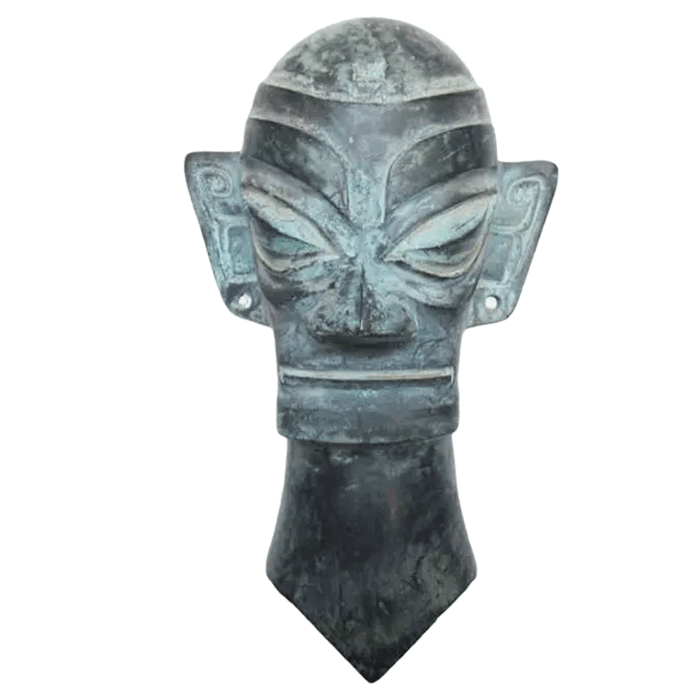
The wide eyes seen on a Sanxingdui Bronze Head Replica are not simply a decorative feature. They are among the most recognizable visual elements of the Sanxingdui bronze tradition and are closely connected to the spiritual, ceremonial, and artistic language of the ancient culture that flourished in present-day Sichuan. For resellers, museum-gift buyers, cultural retailers, and project purchasers, understanding this feature helps distinguish a thoughtful reproduction from a generic ancient-style bronze ornament.
Sanxingdui bronze heads are known for their enlarged, sharply outlined eyes, high nose bridges, broad faces, and stylized ears. Some related bronze masks have especially dramatic tubular or projecting eyes. These designs differ greatly from the more restrained facial modeling found in many bronze works from the Central Plains. Their unusual appearance has led to many interpretations, but the original meaning cannot be confirmed with complete certainty because the ancient Sanxingdui culture did not leave written explanations of its religious imagery.
For buyers researching Sanxingdui-inspired artworks, the most useful approach is to view the wide-eye design as a deliberate symbolic and ceremonial choice rather than as a naturalistic portrait. A well-made reproduction should preserve this visual logic through proportion, facial structure, surface treatment, and a patina that supports the artifact-inspired character of the piece.
The Wide Eyes Are a Deliberate Symbolic Design
The eyes on Sanxingdui bronzes attract immediate attention because they are enlarged far beyond ordinary human proportions. In many examples, the eyes appear as large almond-shaped forms defined by strong rims. In certain masks, the eyes project outward in a highly theatrical manner. This treatment suggests that the object was designed to communicate something beyond an individual person’s physical appearance.
Archaeologists and historians have proposed several possible interpretations. The broadest interpretation is that the prominent eyes may relate to vision, spiritual awareness, ritual observation, or communication with unseen forces. Sanxingdui artifacts were excavated in contexts that indicate ceremonial use, including ritual pits containing bronze objects, jade, ivory, gold, and other valuable materials. Within such a setting, an exaggerated gaze may have helped express the authority or supernatural role of a deity, ancestor figure, ritual participant, or symbolic guardian.
It is important not to present one interpretation as proven fact. Statements such as “the wide eyes definitely represent a particular god” go beyond the available evidence. A responsible product description should instead explain that the eye design is widely understood as part of Sanxingdui’s distinctive ritual and symbolic visual language. This wording is accurate, informative, and suitable for cultural-gift or educational retail environments.
The wide-eyed appearance also makes these artworks memorable from a distance. Ancient ritual objects were often intended to create impact in ceremonial spaces. Enlarged facial features, strong contours, and controlled symmetry can make a bronze face appear powerful under changing light. Today, those same qualities give a replica strong display value in museum shops, cultural venues, hotel interiors, collector displays, and curated home décor collections.
Sanxingdui Heads and Masks Should Not Be Treated as Identical
When sourcing Sanxingdui-inspired products, buyers should distinguish between bronze heads and bronze masks. Both categories may share wide-eye styling, but they are not automatically the same object type. A bronze head is typically modeled as a three-dimensional head, while a mask is generally designed around a frontal facial surface. Certain masks are especially known for dramatic projecting eyes, whereas bronze heads may show large but less protruding eyes.
This distinction matters for design accuracy. A supplier should not place the most exaggerated mask features onto every head-shaped sculpture without considering the source form. For example, a product based on a bronze head may need a more balanced facial profile, visible ears, a proportional forehead, and a carefully shaped crown or headdress. A mask-inspired piece may instead prioritize frontal symmetry, eye projection, and a more graphic silhouette.
For a broader introduction to the distinctive objects associated with this archaeological tradition, buyers can review Sanxingdui bronze ware history. Context is valuable when building an educational product range, preparing sales descriptions, or selecting pieces for a themed cultural display.
A clear catalog description can prevent confusion. Rather than labeling every product as an “ancient bronze face,” it is better to identify whether it is a head-inspired sculpture, a mask-inspired wall piece, a decorative interpretation, or a custom adaptation. Clear product naming supports buyer confidence and helps resellers present the item with appropriate cultural context.
Why the Facial Proportions Look Unusual to Modern Viewers
Modern viewers are accustomed to portrait sculpture that aims to reproduce ordinary anatomy. Sanxingdui bronzes follow a different visual system. The face is often organized through bold geometric relationships rather than soft naturalistic modeling. Eyes, brows, nose, ears, and mouth are treated as important symbolic forms, each contributing to the overall ritual expression.
The large eyes work with other facial features. A high, straight nose bridge can intensify the vertical structure of the face. Strong ears can widen the silhouette. A small mouth can make the eyes seem even more dominant. The result is an expression that may appear solemn, watchful, distant, or otherworldly. This is precisely why the wide-eye motif has become a key reference point for Sanxingdui-inspired design.
For a replica, proportional relationships matter more than adding random decorative texture. If the eyes are too small, the sculpture can lose its cultural identity. If they are oversized without an appropriate nose, brow line, and facial width, the result can look cartoonish rather than artifact-inspired. Skilled modeling considers the face as a complete composition.
Buyers should also understand that “wide eyes” does not mean every reproduction needs the same dimensions. Sanxingdui-related objects vary in their surviving form, scale, and level of stylization. A supplier can develop different sizes and display formats while maintaining the recognizable visual language of the original tradition. Small desk ornaments, medium display heads, wall plaques, and larger entrance sculptures may all require different structural solutions.
How Design Accuracy Is Evaluated in a Sanxingdui Bronze Head Replica
A quality Sanxingdui Bronze Head Replica should be evaluated through more than its eye size. Cultural-gift buyers and resellers can use several practical criteria when comparing supplier samples or reviewing product images.
1. Eye Shape and Placement
The eyes should look intentionally designed, not merely enlarged. Their angle, rim thickness, depth, and distance from the nose should create a controlled expression. For a head-based design, the eyes should remain integrated with the three-dimensional face rather than appearing pasted onto the surface.
2. Facial Symmetry and Structure
Many ritual bronzes rely on a strong sense of order. A replica should retain balanced left and right facial features unless the reference object itself has asymmetry caused by age, damage, or original construction. The brow line, nose bridge, cheeks, and ears should support the overall visual balance.
3. Surface Texture and Casting Detail
Ancient-inspired does not mean rough or poorly finished. Fine transitions around the eyelids, nostrils, ears, and facial planes are important. Lost-wax casting is well suited to capturing this type of sculptural detail. After casting, hand chasing can refine seams and restore crisp edges that may be softened during production.
4. Patina Character
Green, dark brown, black-brown, and antique mixed patinas are often selected for archaeological-inspired bronze décor. However, a patina should not hide weak sculptural work. The best surface finishes emphasize raised edges, recesses, and facial depth. For commercial collections, consistent color matching is also important when multiple pieces are displayed together.
5. Display Base and Product Purpose
A replica intended as a shelf gift may need a stable base and compact proportions. A larger lobby sculpture may require internal support planning, installation considerations, and protective shipping arrangements. The design should match the intended market application, whether it is a museum-style gift, collector piece, interior accent, or custom cultural artwork.
For buyers comparing material options, the article on bronze and brass differences can help clarify why alloy selection affects appearance, durability, and finishing results. Authentic bronze-style projects benefit from a material and patina approach that supports the visual weight of the design.
How Traditional Bronze Craft Supports Artifact-Inspired Reproductions
Luoyang Yichuan Bronze Craft Co., Ltd. produces bronze artworks in Yichuan County, Luoyang, Henan Province, an area connected with China’s long bronze heritage. The company uses premium Cu-Sn bronze alloy and traditional lost-wax casting for bronze sculptures, vessels, mirrors, incense burners, Buddhist statues, and custom bronze artworks.
Lost-wax casting is especially appropriate for a wide-eyed bronze head because the process can reproduce complex contours and controlled facial relief. A model is prepared, a mold is formed, molten bronze is cast, and the finished work is refined through hand chasing, polishing, and patina treatment. The process supports both small cultural-gift items and larger sculptural projects when the design requires strong surface detail.
The company operates a 3,000-square-meter production area and has more than 30 skilled craftsmen, including bronze-casting masters and finishing artisans. With annual output exceeding 50,000 bronze art pieces, the production team can support custom prototypes as well as bulk production runs. Custom sculpture orders can begin from one piece, while bulk order arrangements can be discussed according to size and design complexity.
For buyers seeking a custom interpretation, it is helpful to provide reference images, target dimensions, desired finish, base requirements, intended quantity, and destination market. The team can then assess modeling, casting, finishing, and packaging requirements. Buyers planning their own original concept can explore how to customize a bronze sculpture for a clearer view of the custom-order process.
What Resellers Should Say About the Wide-Eye Motif
Concise, accurate messaging is especially important at the awareness and product-research stage. Resellers do not need to overstate archaeological certainty in order to make the product interesting. A clear explanation can focus on visible design facts and responsible cultural context.
- The enlarged eyes are a defining feature of Sanxingdui-inspired bronze imagery.
- The design is commonly associated with ritual, symbolic, and spiritual expression.
- The unusual facial proportions are intentional and differ from naturalistic portrait sculpture.
- Wide-eye forms should be paired with correct brow, nose, ear, and face proportions for a convincing result.
- Bronze alloy, hand finishing, and patina selection influence the final artifact-inspired appearance.
A suitable short product description may state: “Inspired by the striking bronze imagery of Sanxingdui, this sculpture features the culture’s recognizable enlarged-eye motif, bold facial structure, and an antique-style bronze finish.” This type of language avoids unsupported claims while giving customers a meaningful reason to appreciate the design.
For collections that combine historical motifs with other decorative sculpture categories, buyers may also consider Chinese bronze sculpture options that complement an artifact-inspired display. Coordinated collections can include figures, animals, vessels, and decorative bronzes while maintaining a consistent material and finish direction.
Questions to Ask Before Ordering
Before placing an order for a Sanxingdui Bronze Head Replica, B2B buyers should confirm the level of historical reference, the intended sales channel, and the finish expectations. This helps avoid a mismatch between a museum-style item, a modern decorative sculpture, and a highly stylized gift product.
- Is the design based on a bronze head, a mask, or a contemporary Sanxingdui-inspired concept?
- What dimensions and weight range are suitable for the intended retail or display environment?
- Should the surface use antique green patina, dark brown patina, black-brown patina, or a modern polished bronze finish?
- Is a custom logo, engraved plaque, gift box, or presentation base required?
- What protective packaging is needed for export shipment and fragile facial details?
- Does the order require a single prototype, a sample approval stage, or a bulk production schedule?
Luoyang Yichuan Bronze Craft Co., Ltd. is ISO 9001 quality management system certified, and its products comply with export quality inspection standards for art crafts. Each shipment receives quality inspection before dispatch. The company also provides free replacement for casting defects and offers after-sales support for patina touch-ups and restoration guidance.
Wide Eyes Create Recognition, Not Just Decoration
The lasting appeal of the Sanxingdui wide-eye motif comes from its ability to communicate mystery, ceremony, and artistic individuality in a single glance. The eyes make the bronze head immediately recognizable, but their importance goes deeper than visual novelty. They are part of a complete ancient design language in which scale, symmetry, facial structure, material, and ritual character work together.
For cultural-gift buyers and resellers, the best approach is to select reproductions that respect these relationships. Accurate eye proportions, careful hand finishing, suitable bronze patina, and clear product descriptions can turn an unusual ancient motif into a credible and engaging contemporary product. When designed thoughtfully, a Sanxingdui-inspired bronze head can serve as both a decorative artwork and a conversation piece connected to China’s diverse bronze heritage.