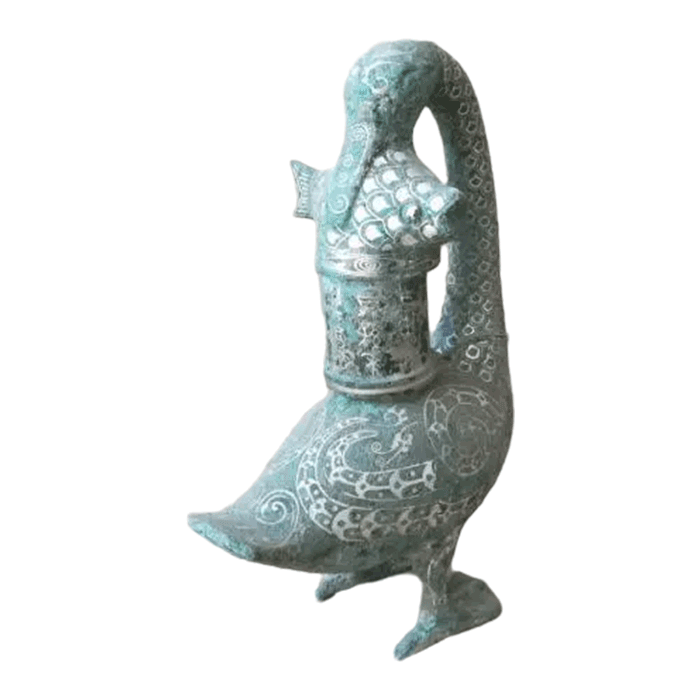
Western Han Goose-Fish Bronze Lamp Smoke Venting
The Western Han Goose-Fish Bronze Lamp used an internal water chamber to manage smoke
For museum buyers, replica retailers, and cultural-artware researchers, Han-dynasty lighting objects are valuable not only for their decorative forms but also for the practical thinking embodied in their construction. The goose-and-fish lamp is one of the most recognizable examples. Its sculptural appearance presents a goose holding a fish in its beak, while its hollow interior creates a route intended to draw lamp smoke away from the immediate indoor environment.
The design is often described as an early smoke-control solution. Rather than allowing soot and fumes from burning oil to rise directly into a room, the lamp was made with connected hollow sections. Smoke could enter the body of the lamp, travel through the goose’s neck, and reach a water-containing chamber in the goose body. There, particulate matter and some smoke-related residues could be retained by the water before the remaining air moved onward.
This mechanism makes the object especially relevant to institutions studying ancient Chinese technology. It also creates an important standard for suppliers making educational display replicas: the exterior form, internal cavity layout, component fit, and surface finish should be evaluated together. A visually convincing reproduction that ignores the internal engineering may not communicate the lamp’s historical significance effectively.
How smoke moved through the lamp structure
The lamp generally consists of several coordinated parts: a lamp tray for oil and wick, a cover or shade arrangement, a fish-shaped connector, a long goose neck, and a hollow goose body. The precise construction may vary among surviving examples and modern interpretive replicas, but the operating principle remains clear. The lamp was designed as a connected system rather than as a solid decorative statue with a burner placed on top.
When the wick burned, heat encouraged smoke and hot air to rise. The lamp’s upper structure directed this smoke toward the hollow passage associated with the fish and goose neck. The goose’s neck functioned as a concealed flue. It visually reads as part of an animal sculpture, yet it also provides an interior channel between the lamp head and the body cavity.
Once smoke entered the body, it encountered water placed inside the hollow chamber. Water could capture a portion of soot and ash particles, reducing the amount released directly into the surrounding space. It is more accurate to describe this as smoke management rather than complete elimination of emissions. Ancient oil lamps still produced combustion by-products, and the effectiveness of the system would have depended on fuel quality, wick condition, water level, airflow, and how well the sections were fitted together.
The arrangement demonstrates an intelligent combination of artistic symbolism and functional design. The goose was not selected only for visual appeal. Its long neck offered a natural sculptural form for concealing a smoke passage, while its body provided enough volume for a water chamber. The fish held in the beak formed a transitional visual element between the lamp tray and the bird figure.
The role of the water chamber
The water chamber is central to understanding the lamp. In a working interpretation, water is introduced into the goose body through an opening or removable component. Smoke entering the body passes into the chamber, where suspended soot can contact water or settle as the smoke cools. This type of design reflects awareness that indoor lamp smoke could be unpleasant and could soil furnishings, walls, and textiles.
For research and retail display, it is useful to distinguish between a historically inspired water chamber and a fully functional demonstration device. A replica intended for exhibition may reproduce the visible assembly and communicate the internal route through drawings, cutaway models, or interpretive labels. A unit intended for controlled technical demonstration requires closer attention to joint tolerances, access for cleaning, safe fuel use, and museum operating procedures.
Researchers comparing this object with other historical lighting forms may also benefit from studying the Changxin Palace lantern, another well-known Han design associated with an internal smoke-guiding concept. Together, such objects show that practical concerns could be integrated into sophisticated bronze artistry.
Why the goose-and-fish form was effective engineering
The lamp’s engineering is notable because it uses the anatomy of an animal figure to organize separate functional zones. The upper area holds the flame. The elongated neck provides a route for hot smoke. The lower body creates space for water and collected residue. Each feature is visually unified, so the user sees a bronze bird rather than an exposed pipe-and-reservoir system.
This integration matters when assessing a reproduction. The profile of the neck must be proportionate enough to suggest a continuous hidden route. The body should have an appropriate hollow volume if an interpretive internal chamber is required. The junction between the fish, neck, tray, and shade should look intentional rather than assembled from unrelated decorative parts.
Traditional bronze casting also supports forms that combine curved surfaces, hollow sections, fine animal details, and separate fitted elements. The lost-wax method is particularly suited to expressive sculptural work because it can preserve textured feathers, fish scales, facial modeling, and hand-finished transitions. For an overview of the broader material context, buyers can consult bronze and brass differences when specifying alloy expectations for reproduction projects.
However, appearance alone should not be treated as evidence of historical accuracy. Ancient objects may show workshop-specific details, corrosion changes, restoration interventions, or missing components. A supplier should work from the buyer’s approved drawings, reference images, dimensions, and curatorial notes rather than claiming that every version represents one definitive original.
What museum and replica buyers should evaluate
A buyer at the early research stage should begin with the intended use of the piece. A gallery display reproduction, a museum-shop product, a study model, and a functional educational demonstration each require different specifications. Clear requirements reduce later disagreement about internal construction, patina, assembly, and packaging.
| Evaluation area | Questions for buyers | Why it matters |
|---|---|---|
| Reference basis | Which museum image, drawing, or approved source defines the form? | Prevents mixing details from different artifacts. |
| Scale | Is the piece full scale, reduced scale, or enlarged for display? | Scale affects wall thickness, weight, and component fit. |
| Internal structure | Should the smoke passage and water chamber be represented? | Determines whether the object is decorative or interpretive. |
| Surface finish | Is an archaeological green patina, dark antique tone, or modern bronze finish required? | Color consistency is important across collections and retail batches. |
| Safety | Will the lamp ever be lit, or is it display-only? | Defines required warnings and demonstration controls. |
| Packaging | Are detachable elements packed separately and protected? | Reduces risk to delicate necks, trays, and handles in export transit. |
For museum buyers, documentation is often as important as the casting itself. It may be useful to request dimensional drawings, photographs before shipment, weight information, material descriptions, and installation guidance. For retailers, repeatability across a product range is equally important. Buyers may need agreed finishes, logo-free surfaces, barcode-ready packaging, or separate instructions for customers.
Luoyang Yichuan Bronze Craft Co., Ltd. produces bronze art pieces using premium Cu-Sn bronze alloy and traditional lost-wax casting. The company supports custom work from a single prototype to larger production runs, with custom sculpture orders available from one piece. Its production team includes bronze-casting masters and finishing artisans, allowing hand chasing, polishing, and antique or modern patina finishing according to the approved project brief.
For a broader view of suitable styles and display categories, buyers can review Chinese bronze sculpture options. Projects involving animals, historical figures, vessels, Buddhist images, and decorative objects can be developed as separate commissions or as coordinated cultural-artware collections.
Production considerations for faithful bronze reproductions
A well-planned reproduction project starts with a reference package. This may include front, side, rear, and top views; overall height and width; close-up images of ornamental details; desired patina samples; and notes on whether the object needs removable parts. If the historical smoke-management route is to be shown, the buyer should identify whether the interior is nonfunctional, partially open for education, or constructed as a sealed interpretive cavity.
Lost-wax casting allows a maker to translate a sculpted wax model into bronze with detailed relief and organic contours. After casting, artisans can remove gates, chase seams, refine surface transitions, polish selected areas, and apply patina. On a goose-and-fish lamp reproduction, these finishing stages are important for feather texture, fish scales, beak edges, lamp-tray contours, and the visual continuity of joints.
Patina should be specified carefully. A green archaeological appearance may be desirable for museum-inspired retail, but it should not be presented as naturally excavated corrosion. A controlled hand-applied patina can instead provide an antique visual character while remaining appropriate for a newly made object. Buyers who need consistent batch color should approve a sample standard before bulk production.
Before shipment, quality inspection should address dimensions, assembly, visible casting condition, finish consistency, and protective packing. Luoyang Yichuan Bronze Craft Co., Ltd. performs inspection before shipment and provides free replacement for casting defects. The company also offers after-sales support for patina touch-ups and restoration guidance, which can be useful when a display object experiences handling marks or long-term surface changes.
Interpreting Han lamp technology responsibly
The Western Han Goose-Fish Bronze Lamp should be understood as both a work of art and a technical artifact. Its form communicates animal imagery, ritual taste, and high-level bronze craftsmanship, while its inner route addresses the everyday issue of lamp smoke. That combination makes it especially useful for exhibitions and educational collections focused on ancient design intelligence.
Responsible interpretation avoids overstating what the object could accomplish. The water chamber could reduce soot and smoke released into an interior, but it would not make an oil flame emission-free. Similarly, a modern replica can explain the engineering principle without being represented as an excavated artifact or an exact substitute for a specific museum-held original.
For buyers planning a custom project, the best approach is to define the historical reference, level of functional interpretation, display environment, and finish standard before production begins. Through this process, a bronze reproduction can preserve the visual elegance of Han design while giving visitors and customers a clearer understanding of how ancient craftsmen used hidden structure to solve a practical problem.
Luoyang’s long bronze heritage provides a meaningful context for such work. With a 3,000-square-meter production area and more than 30 skilled craftsmen, Luoyang Yichuan Bronze Craft Co., Ltd. combines traditional bronze techniques with modern project coordination for museum, retail, and custom-art buyers. For organizations developing a tailored artifact reproduction, the company can customize bronze sculptures based on approved technical and visual requirements.