Western Han Goose-Fish Bronze Lamp: Museum Size and Date
Western Han Goose-Fish Bronze Lamp: Museum Size and Date Explained for Collectors
Few pieces of Han dynasty metalwork capture the imagination quite like the goose-and-fish lamp, a functional lighting fixture that doubled as an environmental engineering achievement more than two thousand years ago. For collectors, museum curators, and buyers commissioning reproductions, understanding the original artifact's documented size, excavation date, and construction is the necessary first step before evaluating any replica offered by a modern foundry. This article walks through what is verifiably known about the piece, then explains what to look for when sourcing a faithful reproduction for display or export.
Origins and Excavation Date of the Goose-Fish Design
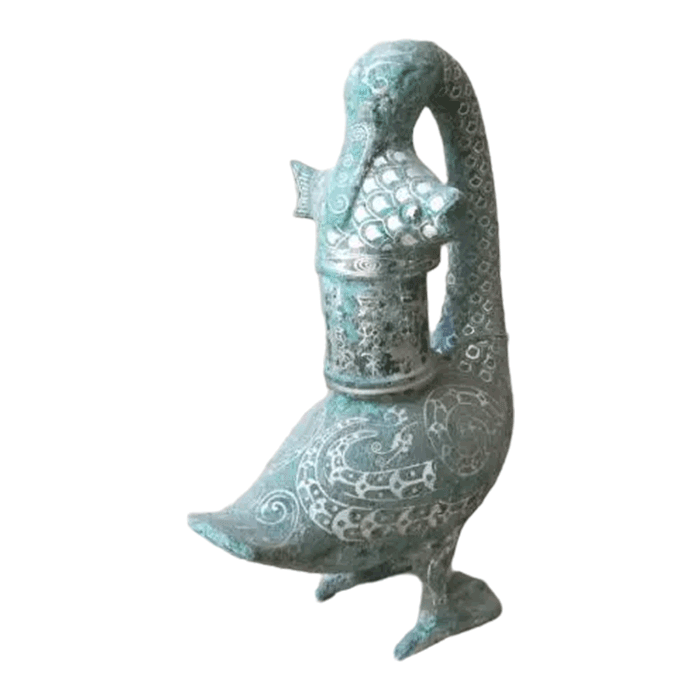
The bronze lamp shaped as a goose holding a fish in its beak — often referred to in museum records simply as the "goose-fish lamp" — belongs to the Western Han Dynasty (206 BCE–9 CE). According to excavation records published by regional museums in Shanxi Province, an example of this lamp type was unearthed from a Han-period tomb in the 1980s and has since become one of the representative bronze lighting fixtures of the period on public display. Museum labeling typically dates the piece to the early-to-mid Western Han era, consistent with the broader flourishing of bronze lamp design during that dynasty.
Bronze lamps of this style were not isolated inventions. They belong to a family of Han-era "environmentally conscious" lamps that also includes the well-known Changxin Palace lantern, which shares the same core innovation: a hollow body designed to trap soot before it could pollute the air of an enclosed room. Readers interested in how these two designs compare in engineering and artistic intent may find it useful to review the Changxin Palace lantern and bronze galloping horse for additional historical context.
Museum Size and Structural Proportions
Reported Height and Scale
Publicly displayed examples of the Western Han Goose-Fish Bronze Lamp are generally recorded at a height of roughly 50 centimeters, standing on a base that supports the goose's webbed feet. The bird's neck curves upward and back in an S-shape to hold the fish-shaped lampshade near head height, a proportion that keeps the piece visually balanced despite its narrow footprint. Because museum catalog entries can vary slightly depending on the specific excavated example and institution, buyers referencing exact centimeter figures should always confirm against the specific museum's published catalog rather than assume a single universal measurement applies to every surviving piece.
Functional Scale Versus Display Scale
The original size was functional, not purely decorative — the goose's body needed enough internal volume to hold water for soot filtration, and the fish-shaped shade needed to rotate to direct or block light without extinguishing the flame. This is an important detail for anyone commissioning a reproduction, since a purely cosmetic scale-down can lose the proportional logic that made the original design work as an actual lamp.
Design Mechanics: How the Smoke-Filtering System Worked
The goose-fish lamp's defining feature is its smoke-management system. Smoke produced by the burning oil or fat rose through the fish-shaped shade, which was connected to the hollow neck of the goose. The neck channeled the smoke downward into the goose's body, where a small reservoir of water absorbed soot particles before they could escape into the room. This design reflects a level of practical engineering knowledge that is often underappreciated when the piece is viewed purely as decorative sculpture. It sits within a broader tradition of Han bronze innovation documented in surveys such as the evolution of bronze culture over 2000 years, which traces how utilitarian needs shaped bronze casting techniques across successive dynasties.
The fish-shaped shade itself could rotate, allowing the user to adjust the direction and intensity of the light while also controlling airflow. This dual-shade mechanism — light control and smoke control combined in one moving part — is one of the reasons the Western Han Goose-Fish Bronze Lamp is frequently cited in museum lighting-history exhibits as an example of ancient functional design rather than purely ceremonial bronze work.
From Excavated Artifact to Commissioned Reproduction
Museums rarely allow direct casting from an original excavated bronze, so faithful reproductions rely on careful study of published dimensions, photographs, and structural drawings rather than a mold taken from the artifact itself. This is where foundry experience becomes critical. At Luoyang Yichuan Bronze Craft Co., Ltd., reproduction pieces such as goose-fish lamps and other Han-style lighting fixtures are produced using the traditional lost-wax casting method with a premium copper-tin bronze alloy, the same general family of alloy used in genuine antique bronzes. This allows the finished surface to accept patina treatments — antique verdigris tones or a more restrained modern finish — that closely resemble the weathering seen on excavated originals.
Because the facility operates under an ISO 9001 quality management system and follows export inspection standards for art crafts, buyers commissioning a museum-scale reproduction can request documentation confirming the alloy composition and casting method before shipment. Production capacity — over 50,000 bronze art pieces annually across a 3,000 square meter workshop staffed by more than 30 skilled craftsmen, including dedicated casting masters and finishing artisans — means both single commemorative pieces and larger institutional orders can be accommodated without switching suppliers between prototype and bulk stages.
For collectors exploring how other Han and Warring States bronze forms are typically reproduced at scale, the overview at chinese bronze sculpture covers casting approaches used across vessels, mirrors, and sculptural lamps alike.
Choosing a Reliable Foundry for a Museum-Grade Replica
Matching Patina and Proportion
The two most common sourcing failures with reproduction Han lamps are inconsistent patina color between batches and proportions that drift from the historical record once a piece is scaled up or down for a client's display space. A foundry that keeps reference photography and measurement notes for each commissioned design — rather than eyeballing proportions from a single reference photo — is far more likely to deliver a shade rotation mechanism and neck curvature that match the historical original.
Packaging and Export Compliance
Bronze lamps with thin necks and cantilevered fish shades are structurally vulnerable during freight. Export-compliant protective packaging designed specifically for fragile cast bronze sculptures — rather than generic crating — reduces the risk of shipping damage to the narrowest points of the design, such as the goose's neck and the shade's pivot point.
Quality Assurance Before Shipment
A pre-shipment inspection process that checks for casting defects, and a stated policy of free replacement when such defects are found, gives buyers confidence that the piece leaving the workshop matches the agreed specification. After-sales support for patina touch-ups is also relevant for institutional buyers who may need to refresh a display piece's finish years after installation, without needing to start a restoration project from scratch.
Practical Considerations Before Placing an Order
| Consideration | Why It Matters |
|---|---|
| Minimum order quantity | Custom sculptures can start from a single piece, making it feasible to commission one accurate reproduction rather than a full batch |
| Alloy composition | Copper-tin bronze alloy affects both casting quality and the way patina develops over time |
| Casting method | Lost-wax casting preserves fine surface detail such as feather texture on the goose and scale texture on the fish shade |
| Finish option | Antique patina or a cleaner modern polish can be selected depending on whether the piece is for a heritage-style interior or a contemporary space |
| Packaging | Fragile, narrow-necked forms require export-grade protective crating to prevent transit damage |
Buyers planning a full room or gallery display sometimes pair a goose-fish lamp reproduction with related Han-period bronze forms, such as vessels or mirrors, to build a coherent thematic collection. Those exploring additional pieces from the same design lineage can review options through customize a bronze sculpture to discuss scale, finish, and lead time for a specific project before committing to a production run.
Conclusion
The documented history of the goose-fish lamp — its Western Han dating, its roughly 50-centimeter museum scale, and its clever smoke-filtering mechanism — gives buyers a solid factual baseline before evaluating any modern reproduction. Whether the goal is a single accurate replica for a private collection or a small production run for a themed exhibition, working with a foundry that combines traditional lost-wax casting, verifiable quality certification, and flexible order sizes helps ensure the final piece honors the proportions and mechanics of the original Western Han Goose-Fish Bronze Lamp rather than merely approximating its silhouette.