Western Han Goose-Fish Bronze Lamp: A Museum Guide
Answering Key Questions About the Ingenious Western Han Goose-Fish Bronze Lamp
Among the vast treasures of ancient Chinese metallurgy, few objects so perfectly capture the union of artistic elegance and scientific innovation as the bronze lamps of the Han Dynasty. These artifacts were not merely sources of light; they were symbols of status, marvels of engineering, and expressions of a sophisticated worldview. The Goose-Fish Lamp, in particular, stands as a testament to the advanced craftsmanship of the era, a piece so remarkable that its design principles continue to inspire awe and study more than two millennia later. For collectors, museum curators, and designers seeking to procure historically accurate replicas, understanding the nuances of this masterpiece is the first step toward appreciating its value. This guide addresses the most frequently asked questions about this iconic example of chinese bronze sculpture, providing the foundational knowledge needed for informed acquisition.
What is the Origin and Discovery Story of the Goose-Fish Lamp?
The celebrated Goose-Fish Lamp was unearthed in 1985 from a Western Han Dynasty (206 BCE – 9 CE) tomb in Shuocheng District, Pingshuo, Shanxi Province, China. This region was a significant northern territory during the Han period, and the tomb's contents reflect the wealth and technological sophistication of the local aristocracy. The lamp was one of two identical pieces discovered, suggesting they were used as a pair to illuminate a prominent chamber.
Now housed in the prestigious National Museum of China in Beijing, the lamp is considered a national treasure and a prime example of the "Han Green" bronze tradition, characterized by the rich, verdigris patina that develops over centuries. Its discovery was significant for several reasons. Firstly, it provided a tangible example of the luxurious lifestyles of the Han elite. Secondly, and more importantly, its complex and functional design offered profound insights into the scientific understanding and environmental consciousness of the time. The lamp's construction reveals a sophisticated grasp of physics and a desire to create a healthier, smoke-free indoor environment—a concept many might assume is a modern preoccupation. The Han Dynasty was a golden age for China, marked by stability, expansion, and extraordinary progress in arts, culture, and technology. The creation of such an intricate object underscores the period's high level of metallurgical skill and the patronage that fueled such artistic and technical endeavors.
How Does the Lamp's Ingenious Design Function?
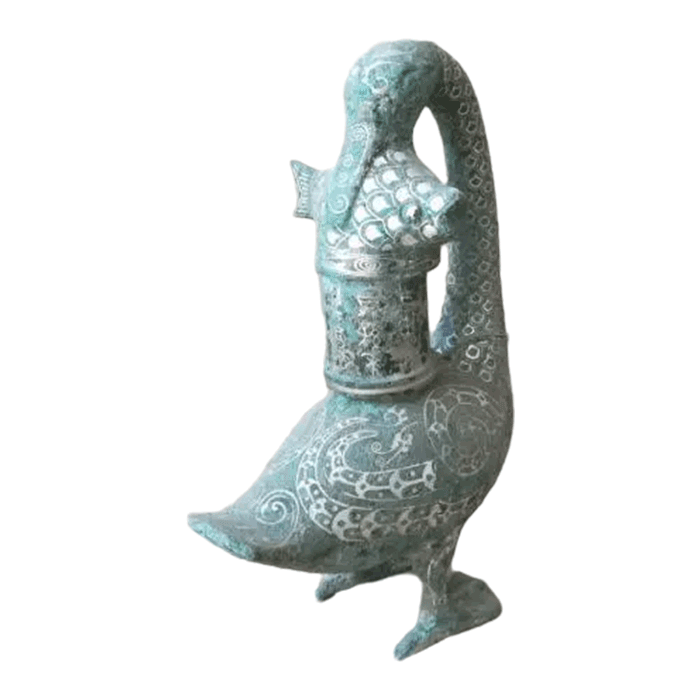
The true genius of the Goose-Fish Lamp lies in its smokeless design, an elegant solution to the problem of indoor air pollution from oil-burning lamps. The artifact is not a single, solid piece but an assembly of precisely fitted components, each playing a crucial role in its function. The design can be deconstructed into four main parts: the goose's body, the goose's neck and head, the circular lamp plate, and a pair of sliding lampshade panels.
The process is as follows:
- Water Reservoir: The hollow body of the goose is designed to be filled with a small amount of water. This serves as the core of the filtration system.
- Smoke Conduction: The lamp plate, where the wick and oil would be placed, sits atop the goose's back. When lit, the smoke and soot generated by the flame rise towards the lampshade.
- Ingenious Flue System: The goose's neck and head form a cleverly designed flue. The neck is a hollow tube that connects directly to an opening above the lamp plate, which is covered by the fish held in the goose's beak. The smoke is drawn up into the goose's neck.
- Soot Filtration: The smoke travels down the hollow neck and is released into the water-filled body of the goose. The soot particles, being heavier than air, are trapped in the water, effectively scrubbing the smoke clean. The result is a brightly lit room without the accompanying haze and odor of a typical oil lamp.
- Adjustable Lighting: The two semi-circular lampshade panels are fitted into grooves on the lamp plate. These panels can be rotated independently to control the direction and intensity of the light, shielding the eyes from direct glare or focusing the illumination on a specific area.
This remarkable integration of form and function highlights the Han artisans' deep understanding of fluid dynamics. The ability to cast hollow, interlocking parts with such precision was a pinnacle of the lost-wax casting technique, allowing for both aesthetic beauty and advanced mechanical utility.
What Artistic and Symbolic Meanings Are Embedded in the Lamp?
Beyond its functional brilliance, the Goose-Fish Lamp is rich with cultural symbolism, reflecting the beliefs and aesthetic values of the Han Dynasty. The choice of a wild goose and a fish was not arbitrary; both creatures held significant meaning in ancient Chinese culture.
The Symbolism of the Goose
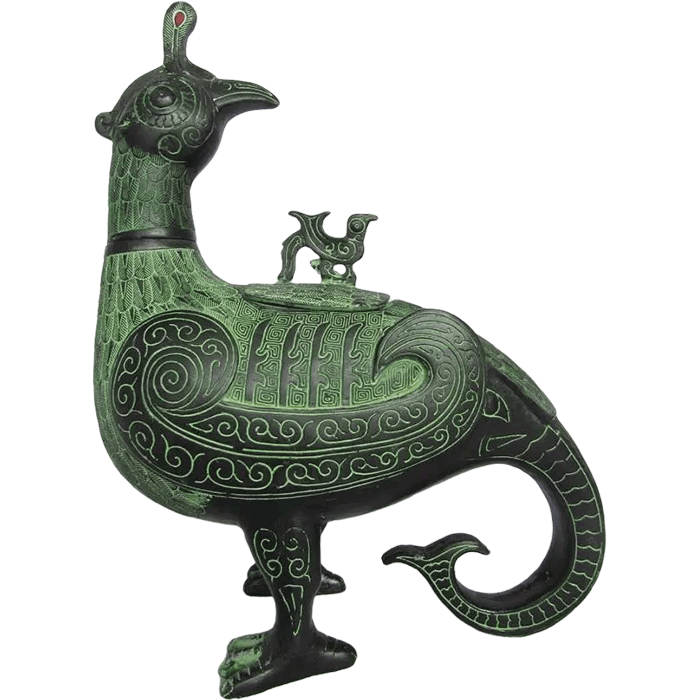
The wild goose (yàn, 雁) was a powerful symbol in Han-era China. Geese are known for their migratory patterns, flying in V-formations over long distances. This made them symbols of communication, messengers carrying news between distant places. They are also famously monogamous, and as such, they came to represent marital fidelity, loyalty, and enduring relationships. The lamp's elegant, serene posture—with its head turned back as if in a moment of quiet contemplation—imbues the object with a sense of grace and tranquility. The naturalistic rendering of the feathers and the creature's anatomy demonstrates the artists' keen observational skills.
The Symbolism of the Fish
The fish (yú, 鱼) is a homophone for the word for abundance or surplus (yú, 余). Consequently, it has been a pervasive symbol of wealth, prosperity, and good fortune throughout Chinese history. The depiction of the goose capturing a fish can be interpreted as a powerful wish for a bountiful harvest and accumulating wealth. This theme of prosperity made the lamp an especially appropriate object for the tomb of a high-ranking individual, intended to ensure their good fortune in the afterlife.
The seamless combination of these two potent symbols within a utilitarian object elevates it from a simple lamp to a piece of functional art charged with auspicious meaning. It reflects a worldview where art, nature, and daily life were deeply intertwined, a core principle in understanding the evolution of bronze culture over 2000 years.
What Bronze Casting Techniques Were Used to Create This Masterpiece?
The creation of the Goose-Fish Lamp required a mastery of bronze-working techniques that were perfected over centuries. The primary method used for such a complex, hollow form was almost certainly a variation of the lost-wax casting (cire-perdue) process. This sophisticated technique allows for intricate details and complex, undercut shapes that are impossible to achieve with simpler piece-mold casting.
The process would have involved these key stages:
- Model Creation: An exact model of each component (goose body, neck, etc.) was sculpted from beeswax.
- Mold Formation: The wax model was encased in a thick layer of fine clay, leaving channels for pouring bronze and allowing air to escape. Once dried, the clay mold was fired.
- Wax Removal: During firing, the beeswax model melted and drained out ("lost wax"), leaving a perfect, hollow cavity in the shape of the original sculpture inside the hardened clay mold.
- Bronze Pouring: Molten bronze alloy, primarily a mixture of copper and tin (Cu-Sn), was poured into the hollow mold.
- Finishing: After the bronze cooled and solidified, the clay mold was broken away to reveal the raw casting. The different cast sections were then meticulously fitted together. Artisans would then engage in extensive hand-finishing work, including chasing (using tools to refine surface details), filing, and polishing the surface to a smooth finish. Finally, a patina would have been applied or allowed to develop naturally to achieve the desired aesthetic.
The lamp's construction showcases the Han artisans’ expertise in sectional casting. The precise fit between the goose's neck, body, and the lamp plate demonstrates an advanced understanding of engineering tolerances. This modular design not only enabled the lamp’s complex function but also made it easier to clean and maintain.
Replicating Historical Accuracy: Sourcing a High-Fidelity Bronze Replica
For institutions and collectors aiming to acquire a replica of the Western Han Goose-Fish Bronze Lamp, the challenge lies in finding a partner capable of honoring the original's technical and artistic integrity. A successful replication is not merely about achieving a visual likeness; it is about respecting the material, the process, and the spirit of the original artifact. Sourcing such a piece requires a supplier with a deep understanding of historical bronze casting and meticulous quality control.
Key challenges that a qualified bronze craft supplier must overcome include:
- Form and Proportional Accuracy: Capturing the subtle, elegant curves of the goose's neck and the lifelike details of its form requires masters with decades of experience. The replica must be dimensionally precise to ensure all interlocking parts function as intended.
- Casting Complexity: Faithfully recreating the hollow structures and ensuring a seamless fit between components demands expertise in the traditional lost-wax method. Modern shortcuts can compromise the replica's structural integrity and authenticity.
- Patina Consistency: Achieving a convincing antique patina is an art form in itself. It involves chemical treatments and hand-finishing techniques to simulate centuries of aging. A specialist supplier can ensure color matching and consistency, whether for a single prototype or a bulk production run.
- Export-Compliant Durability: Antique bronzes are fragile. A high-quality replica must be robust, and for international clients, it must be packaged securely to withstand shipping while complying with all export quality inspection standards for art crafts.
At Luoyang Yichuan Bronze Craft Co., Ltd., we specialize in addressing these exact challenges. Our 3,000-square-meter facility is home to over 30 skilled craftsmen, including bronze-casting masters who have inherited the traditions of the Central Plains region. We utilize the same lost-wax casting method with a premium bronze alloy (Cu-Sn) to ensure historical fidelity. Our ISO 9001 certified quality management system guarantees that every piece, from a single custom order (MOQ from 1 piece) to large-scale productions, meets the highest standards. We offer comprehensive after-sales support, including guidance on patina touch-ups, to ensure the long-term beauty of your investment. If you wish to customize a bronze sculpture from sculpmart.com, our team is equipped to translate historical reverence into tangible, museum-quality art.