Understanding Chinese Bronze Wine Vessel Features
Exploring the Distinctive Features of a Chinese Bronze Wine Vessel
The art of bronze casting in China boasts a heritage spanning over 3,000 years, with Luoyang, Henan Province, standing as a pivotal center for this ancient craft. Among the most iconic artifacts from this rich history are the various forms of bronze vessels, particularly those designed for wine. These pieces are not merely functional containers; they are profound expressions of cultural significance, artistic mastery, and engineering ingenuity. For collectors, institutions, and cultural art buyers, understanding the specific features of these vessels—such as their legs, lids, and spouts—is crucial for appreciating their historical context and the unparalleled craftsmanship involved in their creation.
At Luoyang Yichuan Bronze Craft Co., Ltd., we are dedicated to preserving and perpetuating this legacy. With a production area of 3,000 square meters and a team of over 30 skilled craftsmen, including revered bronze-casting masters and finishing artisans, we specialize in producing high-quality bronze art pieces. Our commitment to excellence is underscored by our ISO 9001 quality management system certification, ensuring that every product complies with stringent export quality inspection standards for art crafts. From a single custom prototype to bulk production runs annually exceeding 50,000 pieces, our expertise encompasses the precise replication of ancient designs and the creation of custom bronze artworks that blend traditional methods with modern aesthetic sensibilities.
The historical significance of the Chinese Bronze Wine Vessel extends beyond its utility. These vessels were central to rituals, feasts, and ceremonial offerings, reflecting the social hierarchy, beliefs, and artistic trends of their respective dynasties. Each design element, from the robust legs that elevate the vessel to the intricate lids that seal its contents and the gracefully sculpted spouts for pouring, tells a story of an era. Our focus at Luoyang Yichuan Bronze Craft Co., Ltd. is not only on crafting these magnificent objects but also on ensuring their authenticity in form and spirit. We employ the traditional lost-wax method, utilizing premium bronze alloy (Cu-Sn), followed by meticulous hand chasing, polishing, and patina finishing, available in both antique and modern looks. This dedication ensures that the profound historical and artistic value of each piece is faithfully recreated and preserved.
The Foundation: Legs and Bases of the Chinese Bronze Wine Vessel
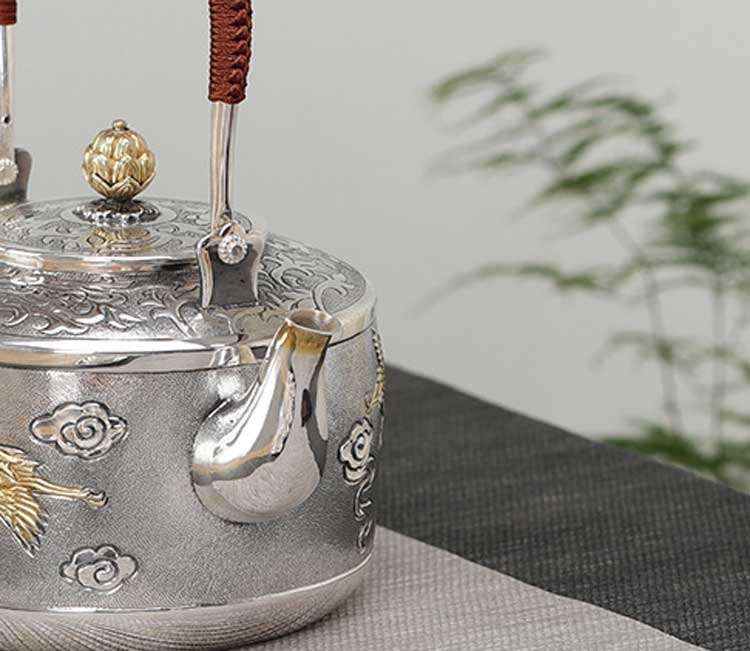
The legs and bases of a bronze wine vessel are fundamental to its stability, aesthetic balance, and ceremonial presence. They elevate the vessel, sometimes literally, to a position of reverence, keeping its contents away from the ground and signifying its importance. The evolution of these foundational elements reflects shifts in design philosophy, metallurgical techniques, and cultural practices across different historical periods. Understanding these variations provides critical insights into the function and symbolism of each piece.
Tripodal and Quadripodal Designs: Jue, Ding, and Gui
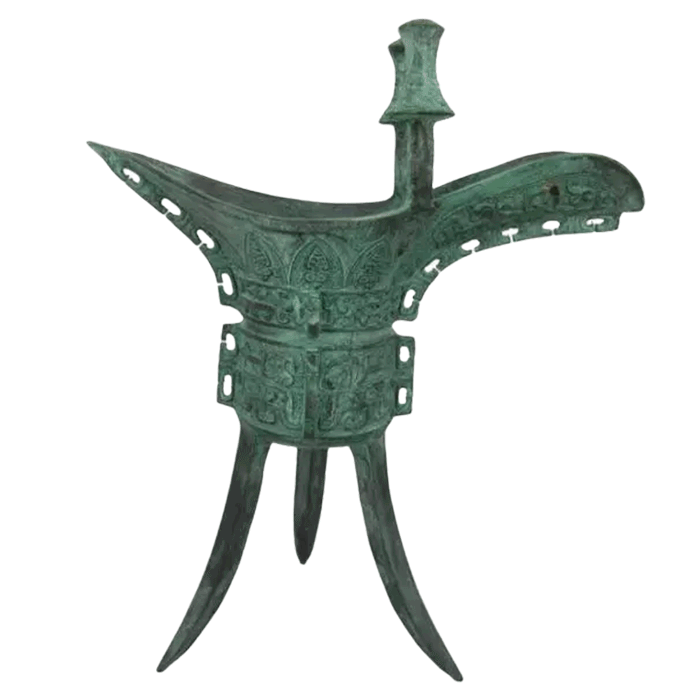
Many early Chinese bronze wine vessels, particularly those from the Shang and Zhou dynasties, feature legs as a prominent design element. The tripodal (three-legged) and quadripodal (four-legged) structures are among the most iconic. For instance, the Jue, a common wine cup, typically rests on three slender, splayed legs, often pointed or blade-like, giving it both stability and an elegant, upward thrust. These legs not only supported the vessel but also facilitated heating its contents directly over a flame, a common practice during ancient rituals and banquets.
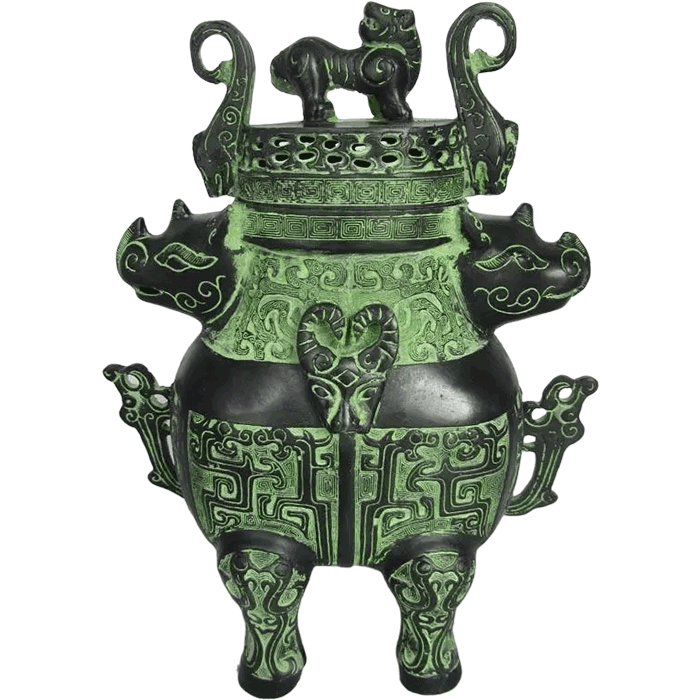
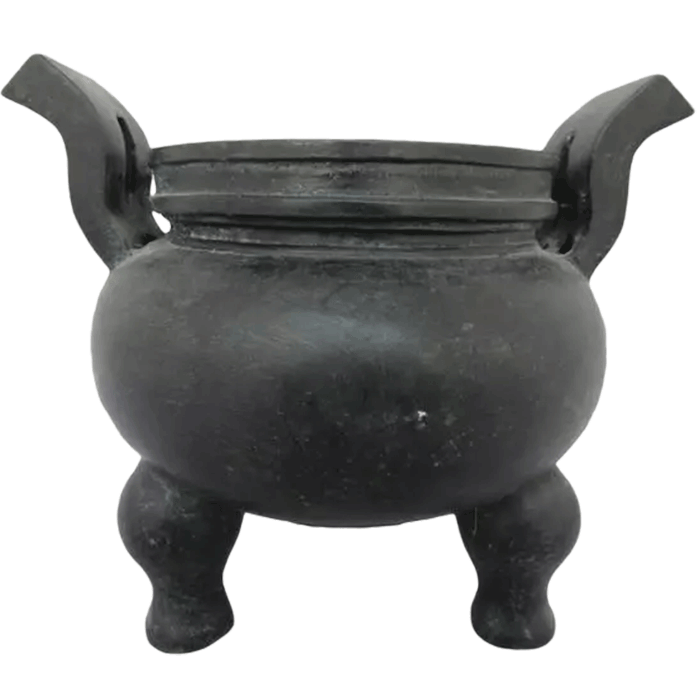
Similarly, the Ding, while primarily a cooking vessel, often served for sacrificial offerings and sometimes held wine. Its robust, typically three or four legs, whether columnar, conical, or hoof-shaped, provided a sturdy base. The Gui, a food container, also sometimes adopted a tripodal form, though it more frequently featured a ring foot. The choice between three or four legs often depended on the specific vessel type, its intended use, and the prevailing aesthetic trends of the period. Our artisans at Luoyang Yichuan Bronze Craft Co., Ltd. specialize in replicating the precise details of every ancient Chinese bronze wine vessel, ensuring that these foundational elements are historically accurate and structurally sound. We meticulously re-create the subtle curves, angles, and decorative patterns that define these leg styles, maintaining the integrity of the original designs.
Ring Feet and Pedestals: Zun and Hu
As bronze casting techniques advanced, and as cultural practices evolved, many vessels transitioned from individual legs to integrated ring feet or elaborate pedestals. This design choice often conveyed a sense of monumentality and stability without the distinct separation of individual legs. The Zun, a tall, often ornate wine vessel, typically features a wide, flaring base that acts as a pedestal, elevating the main body of the vessel. This type of base provides exceptional stability and often serves as a canvas for intricate decorative motifs, such as taotie masks or animal patterns, mirroring the ornamentation on the vessel's body.
The Hu, a pear-shaped or cylindrical wine pot, also frequently rests on a sturdy ring foot, which might be plain or adorned with subtle patterns. These integrated bases allowed for a different aesthetic, often emphasizing the vessel's overall silhouette and the continuous flow of its decorative schemes. The shift towards ring feet and pedestals also reflects a mastery of casting large, complex forms, where the base becomes an integral part of the vessel's structural and artistic whole. Our capabilities extend to producing a wide range of bronze vessels, including Zun and Hu, ensuring consistent patina color matching and export-compliant protective packaging for even the most fragile sculptures, reflecting our commitment to quality from inception to delivery.
Form and Function: Lids and Covers
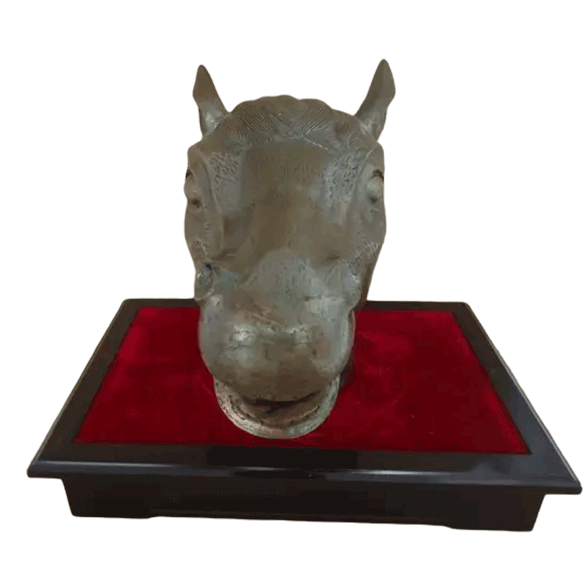
Lids and covers on Chinese bronze wine vessels are far more than simple closures; they are integral components that contribute significantly to the vessel's aesthetic appeal, symbolic meaning, and functional integrity. Their design often mirrors or complements the ornamentation of the vessel's body, creating a cohesive and harmonious artistic statement. From simple caps to elaborate sculptural elements, lids offer another layer of insight into the period's artistic conventions and material culture.
Ceremonial Importance of Lids
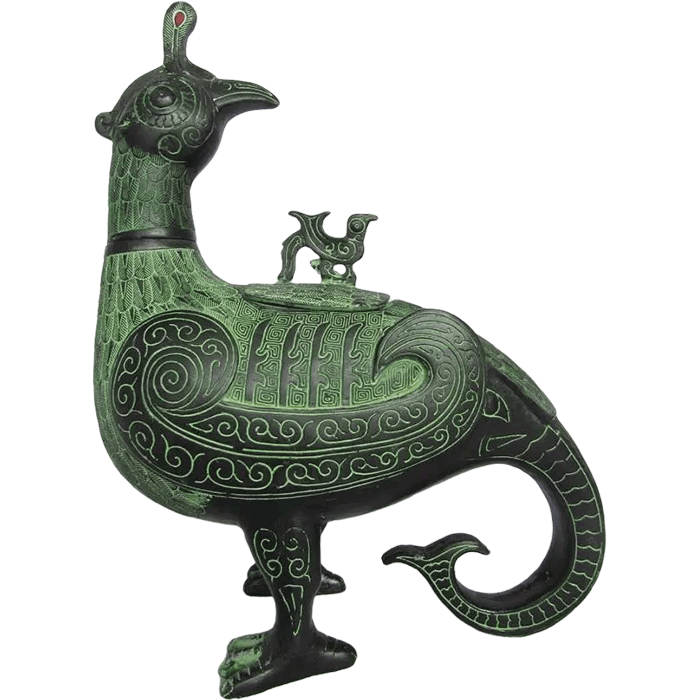
In ancient China, the act of covering a vessel, especially one containing precious wine for rituals or banquets, held symbolic weight. Lids protected the contents from impurities, both physical and spiritual, and served to contain the essence of the wine until the appropriate moment of offering or consumption. Many lids were designed to fit snugly, sometimes even with locking mechanisms, signifying the value of what was held within. The elaborate nature of many bronze vessel lids suggests their importance in elevating the overall grandeur of the ceremony. For instance, some lids might feature a central knob or finial that itself is a miniature sculpture, such as a bird or an animal, adding to the vessel's narrative and visual impact.
The ceremonial significance of these lids is also evident in their frequent pairing with specific vessel types. A lid might complete the form of a vessel, transforming it from an open container into a sealed, self-contained entity, ready for presentation. Luoyang Yichuan Bronze Craft Co., Ltd. excels in the precise replication of such intricate features, ensuring that the lids fit perfectly and the decorative elements are rendered with historical accuracy. Our process, from mold making to final patina, ensures that the spirit and detail of these ancient artifacts are meticulously preserved.
Decorative Motifs and Handles
The surface of a bronze lid often serves as an additional canvas for the rich iconography characteristic of Chinese bronzes. Common decorative motifs include geometric patterns, mythical creatures like dragons and phoenixes, and scenes depicting daily life or historical events. These motifs were not merely ornamental; they often carried profound symbolic meanings, conveying blessings, protection, or status. The ability to precisely cast and hand-chase these intricate designs onto a curved or domed surface is a testament to the skill of ancient and modern bronze craftsmen alike.
Furthermore, many lids are equipped with handles or knobs, which can range from simple rings to elaborate animal effigies. These handles made it easier to lift and replace the lid, but they also added another dimension to the vessel's aesthetic. A lid handle might be sculpted in the form of a coiled serpent, a crouching tiger, or a stylized bird, each adding to the vessel's narrative richness and artistic complexity. Our artisans, leveraging the heritage of Luoyang's 3,000-year bronze culture, blend traditional craftsmanship with modern design sensibilities to accurately reproduce these features. We are dedicated to keeping the art of Chinese bronze alive, reflected in every beautifully finished lid and handle.
Pouring Perfection: Spouts and Handles
The spouts and handles of Chinese bronze wine vessels are designed not only for functionality—to facilitate pouring and handling—but also as key artistic elements that define the vessel's character and elegance. Their forms can vary wildly, reflecting different periods, regional styles, and specific ritualistic requirements. The interplay between the spout and handle often dictates the ergonomic balance and visual flow of the entire piece.
Elegant Spout Designs: Jue and He
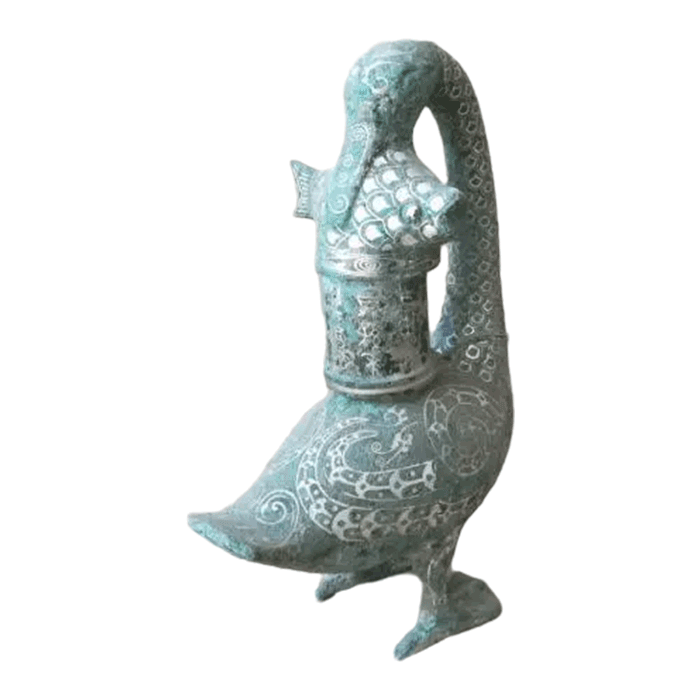
Spout designs are particularly prominent on vessels like the Jue and the He. The Jue, a pouring cup, is distinguished by its characteristic long, trough-like spout, often referred to as a "beak" or "channel." This spout, sometimes paired with a corresponding "tail" on the opposite side, allowed for precise pouring, making it ideal for ceremonial libations. The shape and angle of the Jue's spout are carefully crafted to ensure a smooth, controlled flow of wine, preventing spills during important rituals. The elegant curve of the spout, often adorned with subtle patterns, contributes significantly to the Jue's iconic profile.
The He, another type of wine server, features a more enclosed, often tubular spout that emerges from the body of the vessel. These spouts could be straight or gracefully curved, sometimes terminating in an animal head, adding a zoomorphic detail to the pouring mechanism. The design of the He's spout often allowed for a more controlled and perhaps more formal pouring action, suitable for specific ceremonial contexts. Replicating these distinct spout types requires not only artistic sensitivity but also a deep understanding of ancient fluid dynamics, ensuring both historical accuracy and practical functionality. Luoyang Yichuan Bronze Craft Co., Ltd. ensures that every custom bronze artwork, including those with delicate spouts, is crafted to perfection, reflecting our commitment to solving custom bronze art sourcing pain points through meticulous attention to detail.
Ergonomic and Symbolic Handles
Handles on bronze wine vessels serve the practical purpose of allowing the vessel to be lifted, carried, and poured with ease. However, they are also rich in symbolic and decorative value. Handles can take many forms: simple loops, intricately braided straps, or robust animalistic designs. Many handles are cast in the shape of fantastic creatures, such as dragons, tigers, or mythical beasts, often gripping the rim or body of the vessel. These animal motifs frequently symbolize power, protection, or good fortune, imbuing the vessel with additional layers of meaning.
The placement and attachment of handles are also critical. They are typically positioned to provide optimal balance for pouring, especially when the vessel is full. The connection points between the handle and the vessel's body are often reinforced and decorated, demonstrating the smith's mastery of both structural integrity and artistic embellishment. Whether for a large Hu or a smaller Jue, the handle is designed to be both sturdy and aesthetically pleasing. Our skilled craftsmen apply traditional hand chasing and polishing techniques to every handle, ensuring a smooth, tactile finish that honors the original artisan's intent. We offer after-sales support for patina touch-ups and restoration guidance, guaranteeing the longevity and beauty of these timeless pieces.
Craftsmanship and Legacy: Beyond the Features of Your Chinese Bronze Wine Vessel
While the distinct features of legs, lids, and spouts offer a fascinating lens through which to appreciate Chinese bronze wine vessels, the true essence of these artifacts lies in the unparalleled craftsmanship that brings them to life. At Luoyang Yichuan Bronze Craft Co., Ltd., we uphold this tradition, combining ancient lost-wax casting methods with rigorous quality control to produce bronze art pieces that resonate with historical authenticity and artistic excellence. Our commitment extends beyond mere production; it encompasses a dedication to the cultural legacy of Chinese bronze art.
Our workshop, situated in Yichuan County, Luoyang, the heart of China's bronze heritage, is a testament to this devotion. Here, bronze-casting masters, some with decades of experience, meticulously oversee every stage of production. From the initial design and mold creation, ensuring exact replication of antique bronzes, to the pouring of premium Cu-Sn bronze alloy, and the subsequent stages of hand chasing, polishing, and patina application, every step is executed with precision and reverence for the craft. The ability to achieve consistent patina color matching across multiple pieces, and to offer custom patinas in both antique and modern finishes, is a hallmark of our expertise. When considering a Chinese Bronze Wine Vessel for your collection or project, understanding the intricate process behind its creation illuminates its deeper value.
We understand the unique challenges faced by B2B clients and collectors, such as the need for custom prototypes, large-scale production, and reliable export solutions. Our MOQ starts from 1 piece for custom sculptures, with bulk orders negotiable based on size and design complexity, demonstrating our flexibility and client-centric approach. Each piece undergoes thorough quality inspection before every shipment, and we offer free replacement for casting defects, providing peace of mind to our discerning clients worldwide. Our comprehensive service ensures that from initial consultation to final delivery, your experience is seamless and satisfactory.
The legacy of Chinese bronze art is a continuous narrative, and Luoyang Yichuan Bronze Craft Co., Ltd. is proud to be a part of its ongoing story. By blending traditional craftsmanship with modern design and production capabilities, we ensure that these magnificent vessels, with their distinctive legs, lids, and spouts, continue to inspire awe and appreciation. Whether you are looking to acquire a historically accurate replica, commission a custom design, or simply deepen your understanding of these ancient treasures, we invite you to explore the world of Chinese bronze art through our unparalleled offerings. For more details on the breadth of our work, explore our Chinese bronze sculpture collections or learn about about Sculpmart and our history.