The Purpose of Posts on an Ancient Chinese Ritual Wine Vessel Jue
The Enigmatic Posts of the Ancient Chinese Ritual Wine Vessel Jue Explained
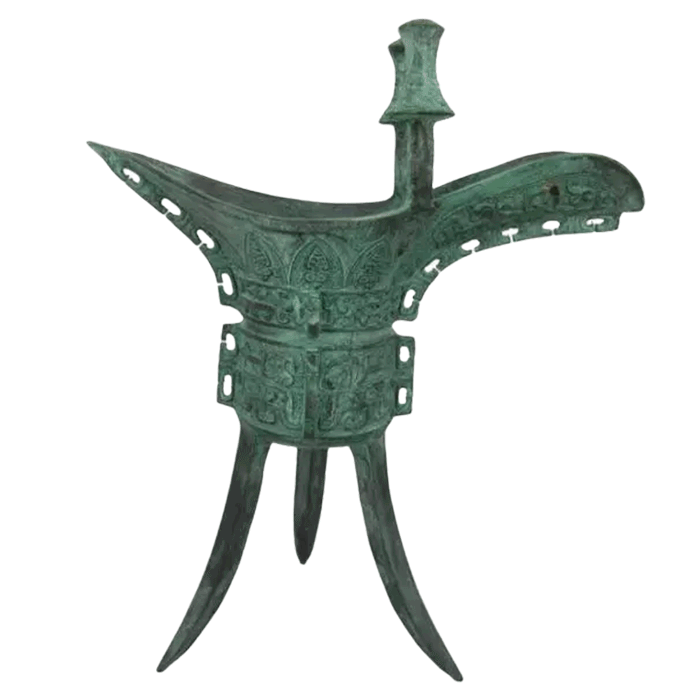
Among the vast and intricate world of Chinese bronzes, few shapes are as instantly recognizable and uniquely perplexing as the Jue. With its elegant tripod legs, a long, trough-like spout balanced by a pointed tail, and a single side handle, its form is a masterclass in ancient metallurgy and design. Yet, it is the two pillar-like posts, rising vertically from the rim near the spout, that capture the imagination and pose a question that has intrigued historians and art lovers for centuries: what was their purpose?
These posts, often capped with whorl or mushroom-shaped finials, are not merely decorative flourishes. In the highly ritualized societies of the Shang (c. 1600–1046 BCE) and Zhou (c. 1046–256 BCE) dynasties, every element of a ritual object held meaning and function. The Jue was central to ancestral worship ceremonies, used for warming and pouring offerings of millet wine. Understanding the role of its posts offers a deeper insight into the customs, beliefs, and practical considerations of Bronze Age China. This article delves into the leading theories surrounding the function of these mysterious posts, connecting the legacy of this remarkable vessel to the meticulous craftsmanship required to replicate it today.
The Jue Vessel: A Cornerstone of Bronze Age Rituals
Before examining the specific function of the posts, it is essential to understand the vessel they belong to. The Jue was not an ordinary drinking cup; it was a sacred instrument of communication with the spirit world. Its primary role was in ceremonies dedicated to honoring ancestors, where warmed wine was poured as a libation to nourish the spirits and seek their favor. The very act of creating and possessing such objects was a demonstration of power and status, as the control of copper and tin resources and the mastery of bronze casting technology were hallmarks of the ruling elite.
The form of the bronze Jue evolved from earlier, simpler pottery prototypes dating back to the Neolithic period. However, it was during the Shang dynasty that it reached its zenith of artistic and technological sophistication. Each part of the vessel was carefully considered:
- The Tripod Legs (Zu): The three legs provided stability, allowing the vessel to stand securely on uneven ground or, more importantly, to be placed directly over a heat source to warm the wine within.
- The Spout (Liu): The long, channeled spout was designed for a controlled, elegant pour during libation rituals.
- The Tail (Wei): The pointed tail acted as a counterweight to the long spout, ensuring the vessel remained balanced in the hand.
- The Handle (Pan): A single D-shaped handle allowed the officiant to hold and pour from the vessel, especially when it was hot.
- The Posts (Zhu): The two pillars rising from the rim, the subject of our inquiry, complete this iconic silhouette.
These vessels were often decorated with intricate patterns, most famously the Taotie mask—a stylized, symmetrical design of a mythical creature, believed to serve a protective or apotropaic function. The creation of these items was a significant undertaking, representing the pinnacle of ancient artistry. The legacy of these forms and techniques continues to inspire the creation of modern chinese bronze handicrafts, which seek to capture the spirit and precision of the originals.
Exploring the Prevailing Theories on the Function of the Jue Posts
The exact purpose of the Jue's posts was never recorded in ancient texts, leaving modern scholars to deduce their function based on the vessel's design, context, and later cultural interpretations. Several compelling theories have emerged over time, each offering a different perspective on their practical or symbolic role.
Theory 1: The "Drinking Moderation" Posts
Perhaps the most widely cited theory is that the posts served to enforce ritual propriety by moderating consumption. According to this hypothesis, when one would drink directly from the Jue, the posts would press against the nose or obstruct the view, forcing the drinker to tilt their head back significantly. This posture prevents one from gulping the wine quickly, encouraging slow, deliberate sips. This act of controlled consumption was seen as a mark of a refined and disciplined individual, befitting the solemnity of an ancestral rite. The name often given to the posts in Chinese, Yin Zhu (飲柱), can be translated as "drinking pillars," lending credence to this interpretation. While the philosophical emphasis on moderation is more strongly associated with the later Confucian era, the principles of ritual decorum were already deeply embedded in Zhou dynasty society.
Theory 2: The Lifting Aid Hypothesis
A highly practical theory suggests the posts were functional aids for handling a hot vessel. The wine inside the Jue was often heated before being offered. The vessel's bronze body would become extremely hot, and the single handle might not have been sufficient or safe for lifting it from a stove or fire. The posts could have been used with a tool, such as tongs, or with cords looped around them to lift the Jue vertically without spilling its contents. The symmetrical placement and sturdy construction of the posts make this a plausible explanation. Some posts on excavated Jue vessels show wear marks that could potentially support this theory, suggesting repeated contact with another object.
Theory 3: The Filter or Herb Holder
Another functional theory posits that the posts were used to support a strainer or a small bundle of aromatic herbs. Ancient millet wine was likely unfiltered and contained dregs and impurities. A piece of fine cloth or a mesh screen could have been stretched between the posts to filter the wine as it was poured. Alternatively, fragrant herbs like cassia or ginger could have been suspended from the posts, infusing the wine with aroma as it was warmed and poured. This would have added another sensory dimension to the ritual, making the offering more pleasing to the spirits. However, direct archaeological evidence for this, such as remnants of filters or herbs, is scarce, making this theory more speculative.
Theory 4: Symbolic or Stylistic Function
It is also possible that the posts served a purely symbolic or vestigial purpose. Their original function may have been lost over time, but the form was retained due to its traditional significance. Symbolically, they could have represented any number of things—horns of a sacrificial animal, markers of spiritual authority, or even an abstract cosmological concept. In some early Jue forms, the posts are minimal, while in later, more elaborate versions, they become highly ornate. This evolution suggests that, whatever their original purpose, they also became an important aesthetic element for artisans to showcase their skill. They may have simply been a defining feature of the Jue's form that was preserved and embellished for tradition's sake.
The Craftsmanship Behind Recreating an Authentic Jue Vessel
The elegant and complex structure of the Jue makes it a testament to the skill of ancient bronze casters. Recreating this vessel with historical fidelity requires not only artistic talent but also a deep understanding of traditional metallurgical techniques. At Luoyang Yichuan Bronze Craft Co., Ltd., we honor this legacy by employing the same time-honored lost-wax casting method used to create the masterpieces of the Shang and Zhou dynasties.
This meticulous process begins with a precisely sculpted model of the Jue, often made from wax or a modern equivalent. This model is then encased in a heat-resistant clay or ceramic shell, which becomes the mold. Once the shell hardens, it is heated, causing the wax to melt and drain out—hence the term "lost-wax." This leaves a perfect, hollow cavity in the shape of the original model. Molten bronze, formulated from a premium copper-tin alloy (Cu-Sn) for strength and authentic appearance, is then poured into the mold. After the metal cools and solidifies, the mold is carefully broken away to reveal the raw bronze casting.
The work, however, is far from over. The raw casting requires extensive hand-finishing by our team of over 30 skilled craftsmen. Artisans meticulously chase the decorative details, smooth the surfaces, and polish the vessel to perfection. The final and most critical step is the application of the patina. Whether a client requires the mottled green and blue hues of a centuries-old excavated antique or a sleek, modern bronze finish, our masters apply chemical treatments with heat and precision to achieve the desired effect. This ability to achieve consistent patina color matching across large orders is one of the key challenges we solve for our clients. It is this dedication to process that allows us to customize a bronze sculpture from sculpmart.com with unparalleled accuracy.
Sourcing High-Fidelity Bronze Replicas for Collections and Education
For museum curators, educators, and importers of fine decor, sourcing high-quality replicas of historical artifacts like the Jue presents a unique set of challenges. Authenticity in form, material, and finish is paramount. Consistency across multiple pieces is crucial for large-scale exhibits or product lines. And ensuring that fragile, intricate pieces survive international shipping requires expert packaging.
Luoyang Yichuan Bronze Craft Co., Ltd. is structured to meet these specific B2B needs. Our 3,000-square-meter production facility, certified under the ISO 9001 quality management system, is capable of an annual output of over 50,000 bronze art pieces. This allows us to support everything from a single, custom-made prototype for a museum exhibit to large production runs for commercial importers. We offer a low MOQ of just one piece for custom sculptures, providing flexibility for projects of any scale.
We solve the most common sourcing pain points by combining traditional craftsmanship with modern quality control. Our expertise in the lost-wax method allows for the exact replication of complex antique forms. Our skilled artisans ensure that patina colors are consistent and historically accurate. Before any product leaves our facility, it undergoes a rigorous quality inspection to ensure it complies with export standards for art crafts. We also specialize in developing export-compliant protective packaging to safeguard even the most fragile sculptures during transit. In the rare event of a casting defect, we offer a free replacement, and our after-sales support includes guidance on patina touch-ups and restoration.
While the definitive purpose of the Jue's posts may remain a subject of scholarly debate, the vessel itself stands as an enduring symbol of a sophisticated ancient culture. By offering meticulously crafted replicas, we provide a tangible connection to this rich history, enabling institutions and individuals worldwide to study and appreciate the profound artistry of the ancient chinese bronze wine vessel.