The Chinese Jue Vessel: Were Its Posts Used for Warming Wine?
Decoding the Jue: Were the Posts on this Ancient Chinese Ritual Wine Vessel Jue for Warming Wine?
Among the vast and intricate world of Chinese bronzes, few vessels are as iconic or as enigmatic as the Jue. With its distinctive tripod legs, elegant long spout, and a pair of mysterious posts rising from its rim, the Jue is a hallmark of the Shang and Zhou dynasties. For centuries, its unique form has captivated historians, archaeologists, and art collectors alike. The most enduring question, however, revolves around its two pillar-like posts (zhu 柱): what was their purpose? A popular and long-standing theory suggests they were used to lift the vessel after warming wine over a fire. But as we delve deeper into the vessel's construction, historical context, and practical use, this common explanation begins to reveal significant flaws.
This article explores the debate surrounding the function of the Jue's posts, examining the evidence for and against the wine-warming theory and presenting alternative hypotheses. Understanding these details is not merely an academic exercise; it offers profound insight into the ritual practices, technological capabilities, and aesthetic values of ancient China—knowledge that is essential for anyone seeking to commission or collect authentic reproductions of these magnificent artifacts.
The Form and Function of the Jue Vessel
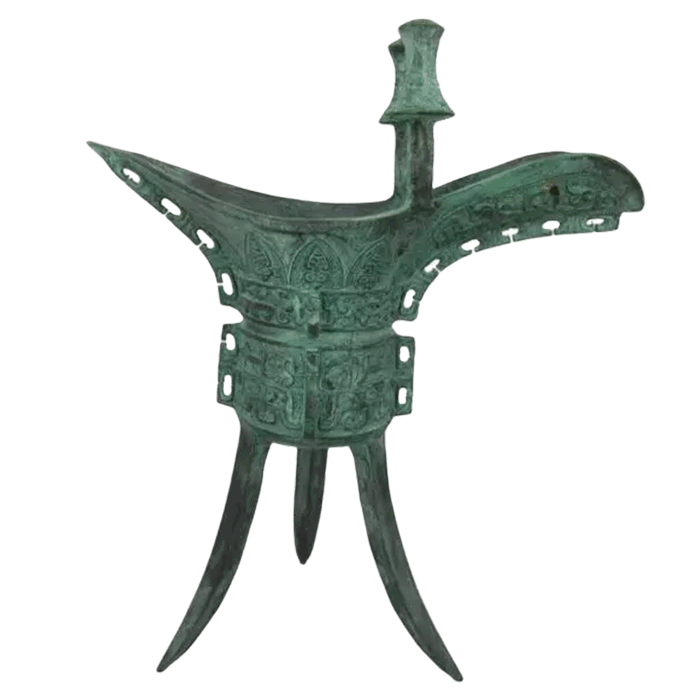
The Jue first appeared during the late Neolithic period with the Erlitou culture and became one of the most prominent ritual bronze vessels during the Shang (c. 1600–1046 BCE) and Western Zhou (c. 1046–771 BCE) dynasties. Its fundamental design is remarkably consistent: a deep, cup-like body for holding liquid, supported by three blade-like or conical legs (zu 足). A long, trough-shaped spout (liu 流) on one side facilitated controlled pouring during libation ceremonies, while a pointed flange or tail (wei 尾) on the opposite side provided a counterbalance. A handle (pan 鋬) was typically situated on the side, allowing the user to hold it securely.
The most debated features, of course, are the two posts that stand upright on the rim, positioned at the base of the spout. These posts vary significantly in design, from simple, functional-looking columns to elaborate mushroom-shaped caps, sometimes inlaid with precious materials like turquoise. The Jue was primarily used for ceremonial offerings of wine, likely a fermented beverage made from millet or rice. In rituals dedicated to ancestors and deities, the wine would be gently heated and then poured onto the ground as a libation, or consumed by the participants. The presence of the chinese bronze sculpture in ancestral temples underscores its central role in the spiritual life of the elite.
The Wine-Warming Theory: A Plausible but Flawed Explanation
The most widely circulated theory about the Jue's posts is that they served as handles for lifting the vessel when it was hot. The argument is straightforward: ancient ritual texts mention the practice of warming wine (wen jiu 温酒) as a sign of respect for the ancestors. The Jue's three-legged structure is inherently stable, making it suitable for placing over a small fire or a bed of hot embers. After the wine reached the desired temperature, the vessel itself would be too hot to touch. The posts, being further from the main body and heat source, would theoretically remain cooler, allowing a person to lift the Jue using two fingers or a simple tool.
Arguments Supporting the Theory:
- Textual Evidence: References in classical texts to warming wine for ceremonies provide a strong contextual basis for this function.
- Structural Stability: The tripod design is one of the most stable configurations for an object, perfectly suited for heating over an uneven surface like charcoal.
- Soot on Artifacts: Some excavated Jue vessels exhibit traces of soot on their legs and underside, which has been interpreted as direct physical evidence of their use over a fire.
- Apparent Practicality: At first glance, the posts appear to be a clever, integrated solution to the problem of handling a hot container.
This explanation has been popular for its simplicity and apparent logic. However, a closer examination by bronze specialists, metallurgists, and artisans reveals numerous practical and material contradictions that cast serious doubt on this hypothesis.
Debunking the Myth: Why the Posts Were Likely Not for Heating
While the wine-warming theory is appealing, it fails to stand up to rigorous scrutiny. The arguments against it are rooted in the physical properties of bronze, the vessel's intricate design, and more efficient alternative methods available at the time.
1. Material and Structural Integrity
Ancient bronze is an alloy, primarily of copper and tin. While durable, it is susceptible to damage from direct, concentrated heat. Placing a thinly cast, ornate vessel like a Jue directly over a fire would create thermal stress. The slender legs, often the most delicate part of the structure, would heat unevenly and could easily warp, crack, or even melt, especially at the joints where they connect to the body. Such a valuable ritual object would unlikely be subjected to such a high-risk procedure. At Luoyang Yichuan Bronze Craft, our team of over 30 skilled craftsmen uses the traditional lost-wax method to create our replicas. This hands-on process provides a deep understanding of the structural limits of bronze; the elegant, blade-like legs of many Jue were clearly designed for aesthetic grace and stability, not for enduring the thermal shock of an open flame.
2. Damage to Decorative Elements
Many Jue, particularly those from the height of the Shang dynasty, feature posts that are highly decorative. They are often topped with complex, sculptural caps or, more importantly, inlaid with turquoise. Turquoise is a fragile stone that would crack, discolor, or fall out entirely when exposed to the heat required to warm wine. It is inconceivable that artisans would incorporate such delicate, heat-sensitive materials into a part of the vessel that was intended to be used for lifting it off a fire. The very existence of these ornate posts serves as strong evidence against the heating theory.
3. The Existence of a Perfectly Good Handle
Perhaps the most compelling argument against the posts-as-handles theory is the presence of the pan—the actual handle. This D-shaped loop is almost always present on the side of the Jue, providing a secure and ergonomic grip. It is far safer and more logical to lift the vessel by this purpose-built handle than to attempt a precarious pinch-grip on two small, often smooth and rounded, posts. Why would a design incorporate a redundant, less-safe lifting mechanism when a superior one already exists? The handle is robust and positioned to balance the vessel perfectly for both holding and pouring.
4. Inefficient Heating Method
From a practical standpoint, heating wine in individual serving cups is highly inefficient. Rituals often involved numerous participants. It would have been far more logical and efficient to warm a larger batch of wine in a sturdier, more appropriate heating vessel—such as a He (a pitcher with legs) or a Li (a tripod cauldron)—and then decant it into the individual Jue for the ceremony. This division of labor among different vessel types is a common feature of Chinese ritual bronze sets, where each piece had a specialized function.
Alternative Theories on the Function of the Jue Posts
If the posts were not for lifting a hot vessel, what was their purpose? Scholars have proposed several alternative theories, which fall into two main categories: practical (non-heating) and symbolic.
Practical Functions
- Straining Device: Ancient wine was likely unfiltered and contained sediment from the grain. One theory suggests that a small cloth or mesh bag could be draped over the posts to strain the wine as it was poured into the vessel. This would provide a purer liquid for the offering or for drinking.
- Etiquette and Moderation: A fascinating hypothesis proposes that the posts served as a device to enforce proper drinking etiquette. When drinking from the long spout, the drinker must tilt their head back significantly. The posts would touch the face or nose, preventing them from gulping the wine too quickly and encouraging a more deliberate, respectful pace of consumption suitable for a solemn ceremony. *Counterbalance: The posts, located near the heavy spout, may have functioned partly as a counterbalance to the tail, ensuring the vessel remained stable and did not tip forward when full.
Symbolic and Ritualistic Functions
- Cosmological Significance: The two posts could represent fundamental dualities in Chinese philosophy, such as Yin and Yang, or Heaven and Earth. Their vertical orientation could symbolize a connection between the earthly realm of the ritual and the celestial realm of the ancestors.
- Aesthetic Evolution: The posts may have originated from a simple, functional feature on earlier pottery prototypes and evolved over time into a purely aesthetic or status-defining element. In the competitive world of elite bronze casting, elaborate and distinctive posts could have been a way to showcase a patron's wealth and the artisan's skill.
The true purpose may have been a combination of these ideas, or it may have changed over the centuries. What is clear is that the simple explanation of them being handles for a hot pot is almost certainly incorrect. The mystery is part of what makes the ancient Chinese ritual wine vessel Jue such a compelling object of study.
Crafting History: The Art of Replicating the Jue Today
While the exact function of the Jue's posts remains a captivating historical debate, the vessel's artistic and cultural importance is undisputed. Today, creating a faithful replica of a Jue requires more than just technical skill; it demands a deep appreciation for the original's form, material, and spirit. For museums, collectors, and designers of bronze home decor arts, authenticity is paramount.
At Luoyang Yichuan Bronze Craft Co., Ltd., our production process is rooted in the same traditions that produced the original masterpieces. We use a premium bronze alloy (Cu-Sn) and the time-honored lost-wax casting technique, which allows for the incredible detail seen in the intricate taotie masks and geometric patterns that adorn these vessels. Our ISO 9001 certified quality management system ensures every piece, from a single custom prototype to a large production run, meets exacting standards.
We solve the key challenges in sourcing high-quality bronze reproductions. Our artisans specialize in hand-chasing to sharpen details post-casting and applying complex patinas that authentically replicate the beautiful green and blue corrosion of excavated artifacts. We excel at consistent patina color matching, a crucial detail for creating cohesive collections or museum displays. For anyone looking to customize a bronze sculpture from sculpmart.com, whether it's an exact replica of a specific Jue or a new design inspired by ancient forms, our expertise ensures a result that is both beautiful and historically resonant.
In conclusion, the popular notion that the posts on a Jue were used for lifting the hot vessel is a persistent myth that overlooks critical evidence. The structural risks, damage to decorations, and existence of a proper handle all point toward a different, more nuanced purpose—be it practical, symbolic, or purely aesthetic. The ongoing debate only adds to the allure of this extraordinary artifact. The Jue remains a testament to the sophisticated metallurgy and profound ritual culture of ancient China, a legacy we are proud to honor and preserve through our craft.