The Art of Casting a Chinese Bronze Sculpture Explained
The Enduring Artistry of Chinese Bronze Sculpture Casting
The legacy of Chinese bronze sculpture is a testament to millennia of artistic innovation and metallurgical mastery. From the intricate ritual vessels of the Shang and Zhou dynasties to the powerful statues of later eras, these artifacts represent a pinnacle of cultural achievement. For collectors, historians, and art aficionados, a common question arises: how were these complex and enduring masterpieces actually made? The primary technique, refined over centuries and still revered today, is the lost-wax casting method—an intricate process that transforms a simple idea into a timeless work of art.
This method, known as cire perdue, is a multi-stage journey demanding precision, patience, and profound artistic skill. It is a tradition we proudly continue at Luoyang Yichuan Bronze Craft Co., Ltd., blending ancient techniques with modern quality control to produce bronze artworks that honor their historical lineage. Understanding this process illuminates not only the value of an individual piece but also the incredible human effort embedded within its metallic sheen. Exploring the evolution of bronze culture over 2000 years reveals a consistent thread of dedication to this demanding craft.
The Foundation: Material Selection and Model Creation
Every great bronze work begins long before any metal is melted. The initial stages of design and model-making are foundational, as they dictate the form, detail, and ultimate success of the finished piece. This phase is a blend of artistic vision and technical preparation.
Choosing the Right Alloy
The term "bronze" itself refers to a family of copper alloys, typically with tin as the main additive. The specific ratio of copper to tin (Cu-Sn) dramatically affects the metal's properties, including its pouring temperature, color, hardness, and resistance to corrosion. Historically, Chinese artisans perfected their alloys to suit the intended purpose of the object, whether it was a resonant bell or a durable weapon. For modern high-fidelity reproductions and new creations, we utilize a premium bronze alloy that ensures excellent flow into detailed molds and provides a superior surface for finishing and patination. This commitment to material quality is the first step in creating a lasting piece of art.
From Concept to Physical Form: The Master Model
The creation of a Chinese bronze sculpture begins with a master model, or pattern. This is the original, positive form of the sculpture, meticulously crafted by an artist. Traditionally, this model would be sculpted from a pliable material like clay, which allows for intricate detail and fluid shapes. The artist must consider not only the aesthetics but also the practicalities of the casting process, ensuring the design can be successfully molded and cast.
In contemporary production, while clay remains a primary medium for its expressive potential, other materials like wax, wood, plaster, or even 3D-printed resins can be used to create the master model. Regardless of the material, this initial sculpture is a unique work of art in itself. Every texture, every subtle contour, and every sharp line carved into this model will be faithfully transferred through the subsequent stages to the final bronze object.

The Lost-Wax Method: A Step-by-Step Breakdown
The lost-wax process is both an art and a science. It is a method of investment casting—one of the oldest known metal-forming techniques. Its enduring appeal lies in its ability to capture extraordinarily fine details, allowing for the creation of complex, one-of-a-kind sculptures that would be impossible to produce through other means. At our 3,000-square-meter facility, our team of over 30 skilled craftsmen, including bronze-casting masters, follows this time-honored procedure with rigorous attention to detail.
Step 1: The Negative Mold
Once the master model is complete, a negative mold is made from it. Modern foundries typically use a flexible silicone rubber for this purpose. The liquid silicone is applied over the entire surface of the master model, capturing every minute detail. It is often applied in layers and reinforced with a rigid outer shell, or mother mold, made of plaster or fiberglass. This two-part mold ensures the delicate silicone holds its shape while remaining flexible enough to be removed without damaging the master model or the mold itself.
Step 2: The Wax Positive
With the negative mold prepared, molten wax is poured into it. For hollow sculptures, the wax is swirled around inside the mold to create an even coating on the interior surface, typically a few millimeters thick. The excess wax is poured out. Once cooled and hardened, the flexible silicone mold is carefully peeled away, revealing a perfect, hollow wax replica of the original master model. This wax positive is an ephemeral but critical component of the process.
Step 3: Chasing the Wax and Gating
The wax replica is rarely perfect at this stage. There may be a seam line where the mold pieces met or tiny air bubbles on the surface. Skilled artisans "chase" the wax, using heated metal tools and small knives to smooth imperfections, re-sculpt fine details, and ensure the replica is a flawless representation of the original. This is also the stage where the gating system is added. This consists of a network of wax rods (sprues, gates, and vents) attached to the wax model. These will later form the channels through which molten bronze flows into the mold cavity and gases escape, ensuring a complete and solid casting.
Step 4: The Ceramic Shell (Investment)
The gated wax model is then dipped into a tank of fine ceramic slurry. This liquid, a type of refractory cement, coats the wax inside and out. After the first coat, the wet slurry is dusted with a very fine refractory sand. This process is repeated multiple times—sometimes a dozen or more—with progressively coarser grades of sand. Each layer must be allowed to dry completely before the next is applied. This meticulous layering builds a strong, seamless, and highly heat-resistant ceramic shell around the wax model. This shell becomes the final mold for the bronze.
Step 5: The Burnout (De-waxing)
The ceramic shell is placed in a kiln or furnace and heated to a high temperature. Two crucial things happen during this stage. First, the wax inside the shell melts and drains out through the channels created by the gating system—this is the "lost wax" that gives the process its name. Second, the high heat fires the ceramic, vitrifying it into a hard, durable mold capable of withstanding the extreme temperature of molten bronze. What remains is a hollow, perfect negative impression of the sculpture inside the ceramic shell.
Step 6: The Bronze Pour
This is the dramatic climax of the casting process. Ingots of the premium bronze alloy are melted in a crucible at temperatures exceeding 1,100°C (2,000°F). While the ceramic shell is still hot from the burnout, the molten bronze is carefully and steadily poured into it. Pouring into a hot shell helps the metal flow more smoothly into every crevice and prevents it from cooling too quickly, which could result in an incomplete casting. Precision and safety are paramount at this stage.
From Raw Casting to Finished Masterpiece: The Art of Finishing
Once the bronze has cooled and solidified—a process that can take hours or even days for a large sculpture—the ceramic shell is carefully broken and chipped away. This "divesting" process reveals the raw bronze casting, a metallic twin of the original wax model, complete with the gating system still attached. The journey, however, is far from over. The final stages of finishing are what transform this raw metal into a polished work of art.
Chasing, Polishing, and Assembly
The bronze rods of the gating system are cut off, and the marks they leave are ground down and meticulously blended into the sculpture's surface. This is known as metal chasing. Artisans use a variety of tools, including grinders, welders, and hand files, to remove any remaining imperfections and to re-create textures and details that may have been softened during casting. The surface is then polished to the desired level of smoothness. For large sculptures cast in multiple pieces, this is the stage where the sections are expertly welded together and the seams are chased until they become invisible. The result is a seamless, unified final Chinese bronze sculpture.
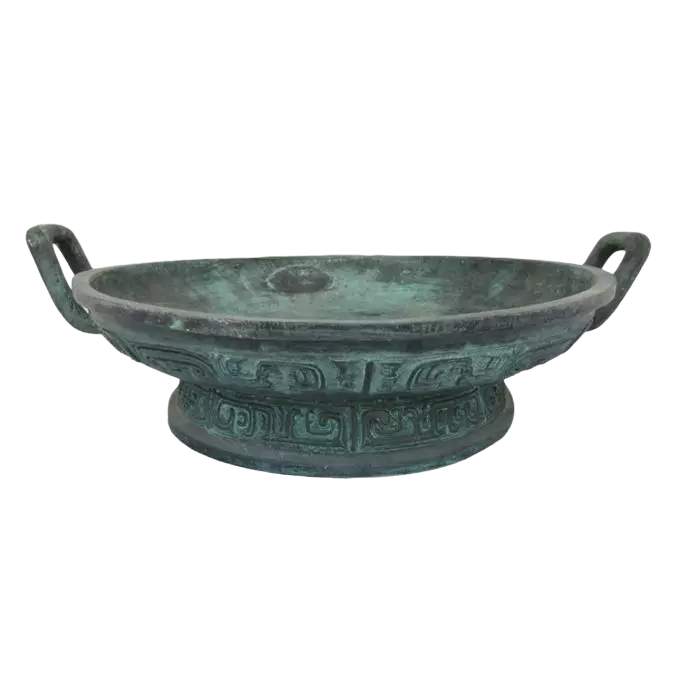
Patination: Applying the Final Color
A freshly cast bronze has a shiny, golden color similar to a new penny. The rich greens, deep browns, blacks, and reds we associate with bronze are the result of a patina. A patina is a thin chemical layer on the surface of the metal, formed either naturally over centuries of exposure to the elements or applied deliberately by an artist. Patination is a highly skilled art form. Artisans use a combination of chemicals and heat, applied with brushes, sprays, and sponges, to achieve specific colors and effects. The bronze is heated with a torch, and the chemicals are applied, reacting with the hot metal to create a permanent, beautiful finish. This process can be repeated in layers to create complex, multi-toned patinas that give a sculpture its character, depth, and final aesthetic, whether antique or modern. Achieving consistent patina color matching across multiple pieces is one of the most significant challenges in bronze production, and a hallmark of a master foundry.
Quality Assurance and Sourcing for Modern Needs
In both ancient and modern times, the creation of bronze art has been a symbol of quality and permanence. For businesses, collectors, and institutions looking to source high-quality Chinese bronze sculpture, partnering with a manufacturer that combines traditional craft with modern standards is essential. Our production is guided by an ISO 9001 certified quality management system, ensuring that every piece meets rigorous standards from material selection to final inspection.
We understand the pain points of international sourcing. That's why we offer everything from a single custom prototype—with a minimum order quantity (MOQ) of just one piece—to bulk production runs capable of an annual output of over 50,000 pieces. Whether you need an exact replication of an antique bronze or wish to customize a bronze sculpture from a new design, the process allows for unparalleled fidelity. Every piece undergoes a final quality inspection before shipment, and we provide export-compliant protective packaging to ensure even the most fragile sculptures arrive safely. This commitment to quality is backed by after-sales support, including a free replacement policy for casting defects, ensuring confidence and peace of mind for our B2B clients. From an introduction to several bronze wares to the most complex custom projects, the principles of quality and artistry remain the same.