The Ancient Chinese Ritual Wine Vessel Jue in Ancestor Rites
Understanding the Ancient Chinese Ritual Wine Vessel Jue in Ancestral Rites
Among the vast and intricate array of Chinese bronzes, few objects are as instantly recognizable and culturally significant as the Jue. With its distinctive tripod legs, elegant spout, and enigmatic posts, this vessel is more than just an archaic wine cup; it is a profound artifact that offers a direct window into the spiritual beliefs, social structures, and ritual practices of ancient China, particularly during the Shang (c. 1600–1046 BCE) and Zhou (c. 1046–256 BCE) dynasties. For collectors, museums, and cultural institutions, understanding the Jue's role in ancestor rites is essential to appreciating its full historical and artistic value. It was not merely an object of utility but a sacred instrument designed to bridge the gap between the mortal world and the realm of the spirits.
The Distinctive Form and Function of the Jue
The unique and seemingly complex design of the Jue is a masterclass in functional ritual art, where every curve and component served a specific purpose within the ceremony. Unlike a simple drinking cup, its form was meticulously engineered for the solemn act of presenting heated wine to ancestral spirits.
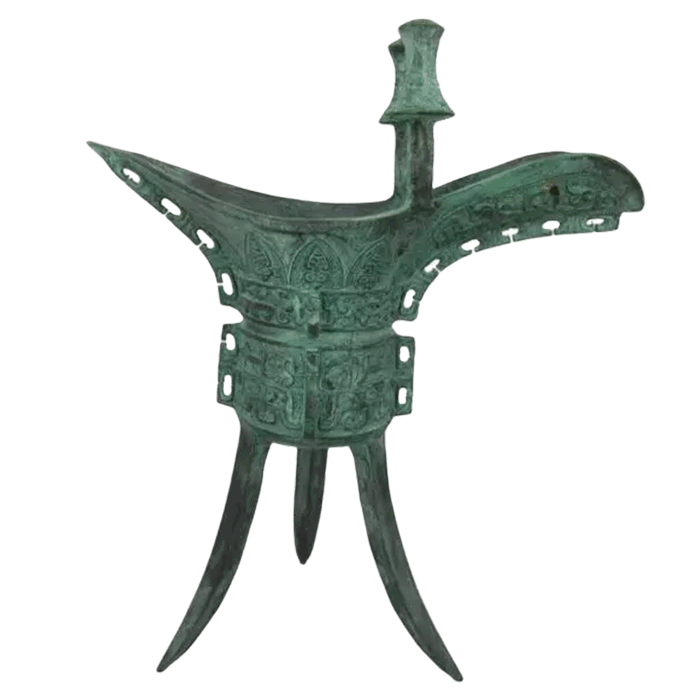
The core components of a Jue include:
- Tripod Legs (Zú): The three splayed, often blade-like legs provided exceptional stability, a crucial feature for a vessel placed on uneven earthen floors of ancestral temples. More importantly, they elevated the body of the vessel, allowing it to be placed directly over a small charcoal fire or embers to gently warm the wine within. The aroma of heated millet wine was believed to be more enticing to the spirits.
- Deep Body (Fù): The vessel's cup-like body was designed to hold a specific measure of wine, often corresponding to the rank of the individual performing the ritual.
- Long Spout (Liú): A prominent, trough-shaped spout extended from one side of the rim. This was not for drinking but for pouring. Its length and shape allowed for a controlled, graceful, and steady stream of wine to be poured as a libation onto the ground or a ceremonial altar, minimizing spills and maintaining the solemnity of the act.
- Pointed Tail (Wěi): Opposite the spout, a pointed tail or flare acted as a counterweight, ensuring the vessel remained balanced in the hand while pouring. Its sharp form also contributed to the vessel's dynamic and zoomorphic appearance.
- Handle (Pàn): A C-shaped handle was typically placed on the side, often decorated with an animal head, allowing the officiant to hold the vessel securely, especially when it was hot.
- Upright Posts (Zhù): Perhaps the most debated feature, two posts, often capped with mushroom- or cone-shaped tops, rise from the rim near the base of the spout. Scholars have proposed various functions: they may have been used for lifting the hot vessel with tongs, for hanging sachets of herbs to infuse the wine, or simply as a visual aid to help the user pour a measured amount without tilting the vessel too far.
Creating such a complex, multi-part form required immense skill. At Luoyang Yichuan Bronze Craft Co., Ltd., we honor this legacy by employing the traditional lost-wax method of casting, a technique that allows for the incredible detail and hollow forms seen in original artifacts. Using a premium bronze alloy of copper and tin (Cu-Sn), our artisans can faithfully recreate the precise balance and intricate details that made the Jue both a functional tool and a masterpiece of ancient metallurgy.
The Jue's Central Role in Ancestral Veneration
To understand the Jue, one must first understand the central role of ancestor worship in early Chinese society. The Shang and Zhou people believed that the spirits of their ancestors were not gone but resided in a parallel world from which they could influence the fortunes of their living descendants. These spirits held the power to grant bountiful harvests, victory in battle, and good health, or to inflict famine, defeat, and disease. Appeasing and honoring these spirits was therefore not just a matter of respect but of survival and prosperity.
The primary method of honoring ancestors was through elaborate ritual ceremonies, and the most important of these involved sacrificial offerings of food and wine. The Jue was the principal vessel used in the wine portion of this rite, known as libation. The ceremony would typically unfold in a sequence of solemn actions:
- Preparation: Millet wine, a staple alcoholic beverage, was poured into the Jue.
- Heating: The Jue was placed over a heat source. The rising steam and aroma were considered the spiritual essence of the wine, which would ascend to the heavens to nourish the spirits.
- The Libation: The officiant, often the king or the head of a noble clan, would lift the Jue and pour the heated wine onto a bundle of fragrant herbs on the ground or a dedicated altar. This act of pouring was the physical transfer of the offering from the human world to the spirit world. The long spout of the Jue ensured this was a deliberate and reverent gesture, not a hasty splash.
- Communication: This ritual was a form of sacred communication. Through the offering, the living demonstrated their filial piety and reverence, and in return, they would ask for blessings, guidance, or protection. The Jue, therefore, acted as a conduit—a physical instrument for a spiritual transaction.
The presence of Jue vessels in tombs underscores their importance. They were buried with the elite to ensure they could continue to perform these vital rituals and maintain their connection with their ancestors in the afterlife. The Jue was not just for a single ceremony but was an essential piece of equipment for fulfilling one's eternal spiritual duties. For those looking to learn more about the broader category of vessels used in these ceremonies, exploring the history of the ancient Chinese bronze wine vessel provides greater context.
Symbolism and Status: Reading the Jue's Decorations
Beyond its functional shape, the Jue was a canvas for the symbolic language of the Bronze Age. The surfaces were rarely plain, instead covered in intricate, stylized decorations that reinforced the vessel's ritual power and the owner's social standing. The most dominant motif found on Shang and early Zhou bronzes, including the Jue, is the *taotie*.
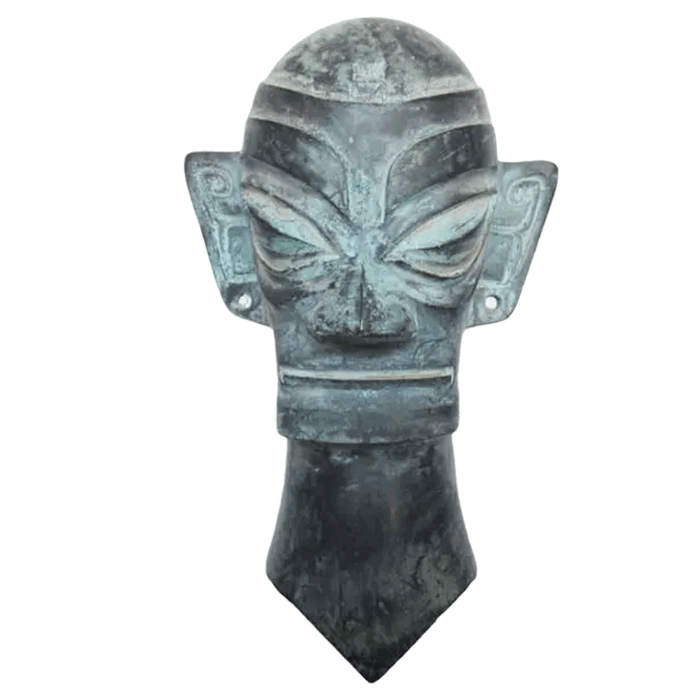
The *taotie* is a stylized, symmetrical mask of a mythical creature, characterized by prominent, bulging eyes, a nose or crest, horns, and a jaw, but often lacking a lower jaw. Its exact meaning is lost to time, but several theories exist. Some scholars believe it represents a fearsome guardian protecting against evil spirits. Others suggest it is a representation of a gluttonous beast, serving as a warning against overindulgence. A more compelling interpretation connects it to shamanism, suggesting the *taotie* is a composite creature that could traverse different realms, acting as an intermediary between the human and spirit worlds—a fitting symbol for a ritual vessel.
Other common motifs include:
- Kui Dragons: Stylized, one-legged dragons shown in profile, often arranged in bands around the vessel.
- Leiwen (Thunder Pattern): Fine, squared spiral patterns that often serve as a background filler, symbolizing the life-giving energy of thunder and rain.
- Cicadas: Symbols of rebirth and immortality, as the cicada emerges from the ground after a long dormancy.
The quality of the casting and the complexity of these decorations were direct indicators of status. A finely cast Jue with sharp, intricate patterns was a symbol of immense wealth and power. In tombs, the number and types of bronze vessels found were strictly prescribed by ritual law, corresponding to one's rank in the nobility. A king might be buried with a full orchestra of bronze bells and dozens of ritual vessels, whereas a lesser noble would have a smaller, prescribed set. The Jue was a fundamental part of these sets, signifying one's right to perform ancestral rites. Reproducing these historically significant patterns requires exceptional expertise. Our team of over 30 skilled craftsmen, including bronze-casting masters and finishing artisans, specializes in the exact replication of antique bronzes, ensuring that every decorative detail, from the powerful stare of the *taotie* to the delicate lines of the *leiwen*, is rendered with historical accuracy.
Sourcing Authentic Jue Replicas for Modern Collections
For museums, educational programs, and private collectors, acquiring a high-quality replica of an chinese bronze sculpture like the Jue is crucial for study and display. However, sourcing pieces that are both historically accurate and well-crafted can be challenging. Many reproductions suffer from a lack of detail, inaccurate proportions, or artificial-looking patinas that fail to capture the gravitas of the original artifacts.
A faithful reproduction must honor the materials, techniques, and artistic spirit of the Bronze Age. This requires a deep understanding of ancient metallurgy and casting processes. At Luoyang Yichuan Bronze Craft Co., Ltd., we address these sourcing pain points directly. Our entire production process is governed by an ISO 9001 certified quality management system, ensuring that every piece, from a single custom prototype to a bulk production run, complies with rigorous export quality standards for art crafts.
We solve key challenges for our B2B clients:
- Authentic Craftsmanship: We use the lost-wax casting method, the same core technique that allowed ancient artisans to create these complex forms. This is followed by meticulous hand-chasing and polishing to sharpen details.
- Consistent Patina Matching: Our artisans are skilled in creating a range of patinas, from the blue-green verdigris of archaeological finds to a more subtle, antique bronze finish, ensuring consistency across a collection or production run.
- Customization and Flexibility: We understand that every project is unique. Whether you need an exact replica of a specific museum piece or a custom-designed artwork inspired by ancient forms, we can deliver. Our MOQ starts from just one piece for custom sculptures, making us an ideal partner for specialized projects. We invite you to customize a bronze sculpture from sculpmart.com to meet your specific needs.
The ancient Chinese ritual wine vessel Jue is far more than an object of aesthetic beauty. It is a vessel of communication, a symbol of status, and a key to unlocking the spiritual world of one of history's most fascinating civilizations. By understanding its ritual context, we can appreciate it not just for what it is, but for the profound cultural role it played.