Simuwu Ding Replica: Weight, Walls & Casting Design Guide
A Simuwu Ding Replica Must Balance Historical Weight, Wall Thickness, and Casting Precision to Satisfy Museum-Grade Buyers
The original Houmuwu (formerly transliterated Simuwu) square cauldron is the largest bronze vessel excavated from the Shang Dynasty, weighing over 800 kilograms and standing nearly 1.3 meters tall. For technical buyers evaluating a Simuwu Ding replica for exhibition, corporate lobbies, or cultural heritage projects, the engineering questions are rarely about aesthetics alone. They concern casting tolerances, structural weight distribution, wall thickness consistency, and how a foundry translates archaeological data into a reproducible bronze alloy piece. This article walks through the technical decisions that separate a decorative approximation from a dimensionally faithful reproduction.
Why Weight and Proportion Matter in a Simuwu Ding Replica
Weight is not a cosmetic detail in bronze vessel reproduction — it directly affects how a piece is transported, mounted, and insured. The original vessel's mass comes from thick cast walls, four hollow legs, and a rectangular basin designed to hold sacrificial offerings. When a foundry scales a Simuwu Ding replica down to 60%, 40%, or tabletop size, the relationship between surface area and wall thickness does not scale linearly. A naive uniform shrink can produce a piece that looks correct but feels hollow and lightweight, undermining the perceived authenticity that architects and collectors expect.
Reputable workshops calculate an adjusted alloy density and wall profile for each scale so that the finished piece retains a proportional heft relative to the original bronze artifact. This is one of the reasons buyers researching Houmuwu square cauldron reproductions should request a weight specification sheet before committing to a production run, rather than relying on visual renderings alone.
Typical Scale-to-Weight Reference
| Scale (relative to original) | Approximate Height | Typical Cast Weight |
|---|---|---|
| 1:1 (museum reproduction) | ~133 cm | 750–830 kg |
| 60% | ~80 cm | 180–220 kg |
| 40% | ~53 cm | 60–90 kg |
| 20% (tabletop display) | ~26 cm | 8–14 kg |
These figures vary depending on alloy composition and whether the interior is fully solid, partially cored, or hollow-cast with internal ribbing for structural support.
Wall Thickness Control in Lost-Wax Casting
Wall thickness is arguably the single most technical variable in reproducing a large bronze vessel. Too thin, and the casting risks porosity, warping, or cracking during cooling; too thick, and the piece becomes unnecessarily heavy and expensive without improving visual fidelity. The traditional lost-wax method allows a skilled bronze-casting master to build a wax model with graduated wall thickness — thicker at load-bearing legs and corners, thinner across flat panel surfaces — closely mirroring how Shang Dynasty foundries distributed metal for structural stability.
For a Simuwu Ding replica intended for outdoor or high-traffic indoor display, wall thickness typically ranges from 6mm to 12mm depending on scale, with reinforced sections at the leg-to-body joints where stress concentrates. Foundries producing export-grade pieces should be able to provide:
- A wax model inspection stage before pouring, allowing clients or their agents to verify thickness at multiple cross-sections.
- Post-cast ultrasonic or visual thickness verification on critical structural points.
- Documentation of the copper-tin (Cu-Sn) ratio used, since alloy composition affects both casting flow and finished wall integrity.
Buyers unfamiliar with alloy terminology may also want to review the difference between bronze and brass before finalizing specifications, since the two metals behave differently under casting stress and patina treatment.
Casting Design Decisions: Solid, Hollow, or Segmented
Solid Casting
Solid casting is generally reserved for smaller-scale reproductions where weight is not a logistical concern. It offers maximum structural durability but is impractical for large-scale vessels due to excessive material cost and shipping weight.
Hollow-Core Casting
Most mid-to-large Simuwu Ding replica projects use hollow-core casting with internal bracing. This mirrors the original construction method, where the ancient artisans used clay-core mold sections to control both weight and metal flow. Hollow casting also reduces the risk of shrinkage cracks that occur when large solid masses of bronze cool unevenly.
Segmented Assembly
For very large or 1:1 scale reproductions, some foundries cast the vessel in sections — legs, body panels, and handles separately — then join them using traditional brazing or modern structural pinning, followed by hand chasing to conceal seams. This approach is common when a client requires a piece too large for a single mold pour, and it allows for easier transport disassembly and reassembly on-site.
Surface Detail: Taotie Motifs and Patina Matching
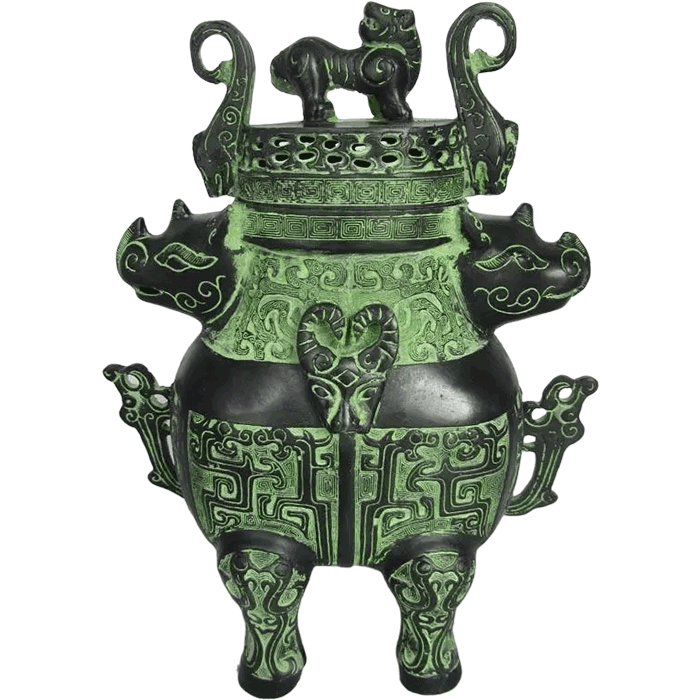
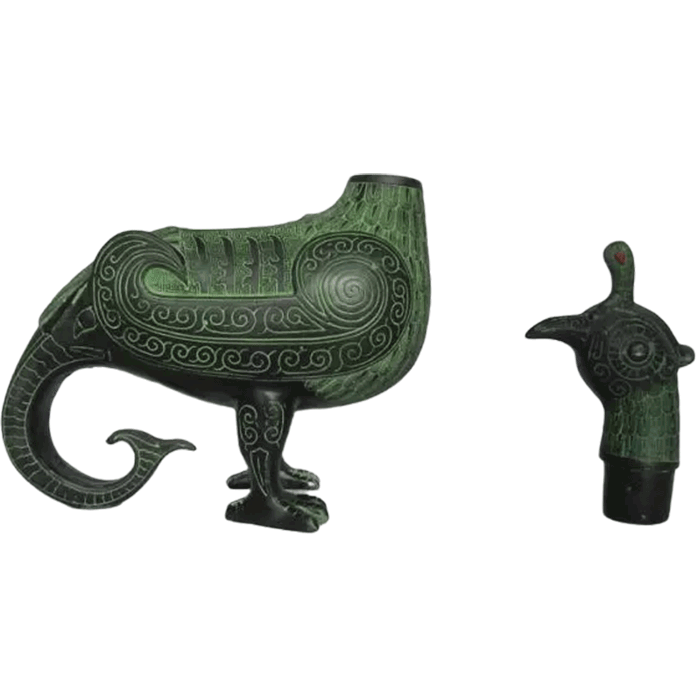
Beyond structural engineering, the visual authenticity of a Simuwu Ding replica depends on how accurately the taotie animal-mask motifs, cloud-and-thunder background patterns, and inscription characters are reproduced on the vessel's exterior. This requires hand chasing after the initial cast, since even precise molds lose some sharpness in fine relief lines during the pour. Skilled finishing artisans re-cut and refine these details under magnification, comparing against reference photographs of the excavated original.
Patina color matching is equally critical. The original vessel displays a mottled green-black surface built up over three thousand years of burial oxidation. Reproducing this convincingly requires layered chemical patination — typically combinations of ferric nitrate, cupric nitrate, and controlled heat application — applied in stages and sealed with wax or lacquer for stability during shipping and long-term display. Buyers sourcing from workshops that also produce chinese bronze handicrafts at scale often benefit from foundries that maintain standardized patina recipes, reducing color variance between multiple units in a single order.
Feasibility Considerations for Custom Orders
Technical buyers evaluating a Simuwu Ding replica for a specific project should clarify several points with any prospective foundry before committing to a production run:
- Reference source: Confirm whether the foundry works from published archaeological measurements, 3D scan data, or photographic approximation — accuracy varies significantly between these methods.
- Tolerance range: Ask for acceptable dimensional variance (typically ±2–5mm depending on scale) and how it is measured.
- Structural documentation: Request wall thickness drawings and estimated finished weight in writing before wax casting begins.
- Packaging plan: Large bronze vessels require export-compliant crating with internal bracing to prevent shifting damage during transit.
- Inspection stage: Confirm whether pre-shipment quality inspection includes photographic or video documentation of the finished piece.
A workshop with an ISO 9001 quality management system and export experience should be able to answer each of these points with specific process documentation rather than general assurances. Foundries offering flexible order sizes — from a single prototype to a full production batch — give feasibility-stage buyers room to commission a scaled test piece before scaling up to a full vessel order, which is a practical way to validate wall thickness, weight, and patina accuracy before larger capital commitment.
Working With a Foundry on Custom Specifications
Because every reproduction project carries different display, transport, and budget requirements, it is worth engaging early with a foundry team that can walk through wall thickness drawings, alloy ratios, and packaging plans before wax modeling starts. Design teams researching historical bronze vessels more broadly may also find it useful to review the evolution of bronze culture to understand how casting techniques and vessel forms changed across dynasties, which can inform decisions about how closely a replica should hew to a specific historical period versus a stylized interpretation.
For teams ready to move from research to a working prototype, it is generally more efficient to commission a scaled test casting first, evaluate its wall thickness and patina under real lighting conditions, and then finalize specifications for the full production order. Foundries that support this staged approach — including the option to customize a bronze sculpture from a single unit upward — reduce the risk of costly rework on large-format vessel commissions.
A technically sound Simuwu Ding replica is ultimately the product of matched decisions across weight scaling, wall thickness engineering, casting method, and patina chemistry. Buyers who request documentation on each of these variables — rather than judging solely from a rendering or photograph — are far better positioned to receive a piece that performs structurally and visually as intended, whether it is destined for a museum lobby, a corporate collection, or a long-term cultural exhibition.