Simuwu Ding Replica: A Guide to the Ancient Cauldron
Discover the History and Craftsmanship Behind a Simuwu Ding Replica
The Simuwu Ding, also known as the Houmuwu Ding, stands as one of the most significant artifacts in the history of Chinese art and metallurgy. As the heaviest piece of ancient bronzeware ever discovered, its sheer scale and intricate decoration are a testament to the advanced civilization of the Shang Dynasty (c. 1600–1046 BCE). For museums, cultural institutions, private collectors, and designers of luxury spaces, acquiring a faithful replica of this monumental vessel is an opportunity to own a piece of this profound legacy. This guide delves into the fascinating history of the ding, its contested names, its colossal dimensions, and the expert craftsmanship required to produce a museum-quality Simuwu Ding replica.
Understanding the context behind this national treasure is the first step in appreciating the skill involved in its recreation. From the symbolism of its motifs to the technical mastery of its original casters, every detail tells a story of power, ritual, and artistic expression. Commissioning a replica is not merely about acquiring a decorative object; it is about preserving and showcasing a pinnacle of human achievement in bronze casting.
The Story Behind the Name: From Simuwu to Houmuwu
One of the most intriguing aspects of this famous bronze vessel is the debate surrounding its name. The source of the confusion lies in the three-character inscription found on the interior wall of the ding: "司母戊" (sī mǔ wù) or "后母戊" (hòu mǔ wù). For decades after its discovery in 1939, the scholarly consensus interpreted the first character, "司" (sī), to mean "sacrifice." Thus, the vessel was named the Simuwu Ding, translating to "Sacrificial Vessel for Mother Wu." This interpretation suggested that the ding was cast by a Shang king to be used in sacrificial ceremonies honoring his deceased mother, named Wu.
This understanding prevailed for many years. However, in the 1970s, a prominent historian and paleographer, Guo Moruo, proposed an alternative interpretation. He argued that the character "司" was a mirror image of "后" (hòu), which means "queen" or "empress." This re-reading was not arbitrary; it was based on evolving understandings of Shang Dynasty oracle bone script, where characters could be written in reverse. According to this theory, the inscription should be read as "Houmuwu Ding," meaning "Queen Mother Wu." This interpretation elevates the status of the person being honored, identifying her not just as a mother but as a queen, likely Fu Jing, one of the wives of King Wu Ding.
Today, the name "Houmuwu Ding" is officially used by the National Museum of China, where the original artifact is housed. However, the name "Simuwu Ding" remains widely recognized in many older texts and among the general public. This ongoing scholarly discussion adds a layer of depth to the artifact's story. When sourcing a Simuwu Ding replica, understanding both names and their historical context demonstrates a deeper appreciation for the object and its cultural significance. The name you choose to use may depend on your audience and the specific historical narrative you wish to emphasize.
A Monument of Bronze: The Colossal Size and Weight of the Original Ding
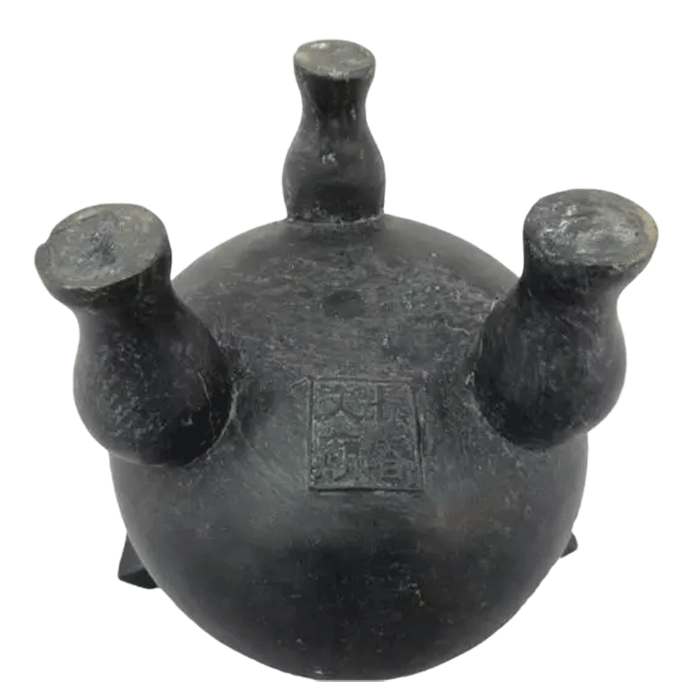
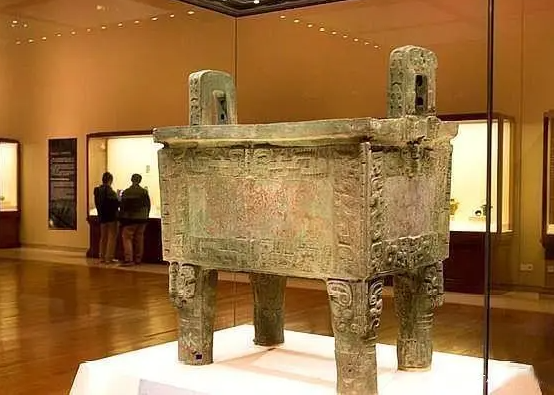
The most immediately striking feature of the Houmuwu Ding is its immense size. It is, without exaggeration, a goliath of the ancient world. The original vessel stands 133 cm (52.4 inches) tall, with a mouth measuring 110 cm (43.3 inches) by 79 cm (31.1 inches). Its total weight is a staggering 832.84 kilograms (1,836 pounds). To put this into perspective, it is the largest and heaviest single piece of bronzeware to have survived from anywhere in the ancient world.
This colossal scale speaks volumes about the power and resources of the late Shang Dynasty court. The mining, smelting, and transportation of over 800 kilograms of copper and tin alloy would have been a massive undertaking. The casting process itself was a feat of sophisticated engineering. Archaeologists believe the vessel was created using the piece-mold casting technique, which required the coordinated effort of dozens, if not hundreds, of skilled craftsmen. They would have needed to construct a massive clay model, create dozens of outer and inner mold pieces, and precisely manage the pouring of nearly a ton of molten bronze at a temperature exceeding 1,000°C. The fact that they could achieve this with such precision over 3,000 years ago is breathtaking.
When creating a replica, these dimensions are the starting point for authenticity. A full-scale reproduction is a commanding centerpiece for any grand hall, museum exhibit, or corporate lobby. However, scaled-down versions can also capture the essence and gravitas of the original while being more suitable for a wider range of display environments. At Luoyang Yichuan Bronze Craft Co., Ltd., we are equipped to handle projects of any scale. Our 3,000-square-meter facility supports everything from a single custom prototype to large production runs, allowing us to create a replica that perfectly fits your spatial and budgetary requirements.
Deciphering the Artistry: Symbolism and Decorative Motifs
Beyond its size, the Houmuwu Ding is a masterpiece of Shang Dynasty art. Its surface is richly decorated with motifs that are both aesthetically powerful and culturally significant. The main body of the rectangular cauldron is adorned with the iconic *taotie* (饕餮) masks, a zoomorphic design featuring a pair of large, staring eyes, but often no lower jaw. This mysterious and somewhat intimidating face is a hallmark of Shang and Zhou dynasty bronzes. Scholars believe the *taotie* may have served a protective or apotropaic function, warding off evil spirits during ritual ceremonies. For an in-depth look at period-specific designs, you can explore a summary of the characteristics of the bronze wares of the Spring and Autumn and Warring States periods.
Flanking the *taotie* are stylized one-legged dragons known as *kui* (夔龍). These creatures are depicted in profile, adding a dynamic sense of movement to the vessel's otherwise static and imposing form. The four legs of the ding are also decorated with animal motifs, and the two large, upright handles are adorned with two tigers facing each other, their jaws closing around a human head—a powerful and enigmatic scene that has fascinated art historians for generations.
Recreating this intricate decoration requires immense skill. At our foundry, we utilize the traditional lost-wax casting method, a technique renowned for its ability to capture fine details. This process, combined with the meticulous hand-chasing and finishing work of our 30-plus skilled artisans, ensures that every line of the *taotie* and every scale of the *kui* dragon is rendered with crisp precision. This commitment to detail is fundamental to producing a truly authentic and visually compelling Simuwu Ding replica.
The Challenges and Solutions in Creating a High-Fidelity Replica
For any B2B buyer—be it a museum curator, an interior designer, or a film production company—sourcing a high-quality bronze replica comes with a distinct set of challenges. The success of the project hinges on accuracy, material integrity, and the supplier's reliability. Creating an exceptional Simuwu Ding replica is a complex process that demands expertise at every stage.
Challenge 1: Achieving Proportional Accuracy
The imposing presence of the ding is a direct result of its carefully balanced proportions. A flawed replica might get the basic shape right but fail to capture the subtle curves and the relationship between the body, legs, and handles. Our process begins with detailed analysis of the original's dimensions, often using 3D modeling to create a perfect digital blueprint. This ensures that whether we are producing a 1:1 scale model or a smaller version, the final piece maintains its authentic and powerful aesthetic.
Challenge 2: Replicating the Authentic Patina
A shiny, new bronze vessel does not look like a 3,000-year-old artifact. The beautiful green and blue-green patina of ancient bronzes is the result of centuries of oxidation. Recreating this look artificially is an art form. One of the most common pain points for buyers is inconsistent patina color matching, especially across multiple pieces in a bulk order. Our master artisans are experts in chemical patination, able to create a wide range of finishes from a deep, archaeological green to a more subtle antique bronze. We pride ourselves on our ability to achieve consistent and natural-looking results that meet precise client specifications. To learn more about our custom work, feel free to explore how you can customize a bronze sculpture from sculpmart.com.
Challenge 3: Ensuring Structural Integrity and Safe Transport
A large bronze sculpture is a significant investment, and its safe delivery is paramount. The two large handles and four legs of the ding are potential points of failure if not cast and attached properly. We use a premium Cu-Sn bronze alloy for superior strength and durability. Furthermore, every piece undergoes a rigorous quality inspection before shipment. We have developed export-compliant protective packaging solutions specifically designed for fragile and heavy sculptures, addressing another key sourcing pain point and ensuring your investment arrives in perfect condition, anywhere in the world.
Sourcing Your Bronze Replica with Confidence
When you commission a bronze artwork, you are placing your trust in the skill and professionalism of the manufacturer. At Luoyang Yichuan Bronze Craft Co., Ltd., we have built our reputation on a foundation of quality, reliability, and master craftsmanship. Our operations are governed by an ISO 9001 certified quality management system, a guarantee that we adhere to the highest international standards in every aspect of our production.
We understand the diverse needs of our B2B clients. Whether you require a single, breathtaking centerpiece or a large run of bronze home decor arts, we have the capacity and flexibility to deliver. We offer a minimum order quantity (MOQ) starting from just one piece for custom sculptures, making museum-quality art accessible for specialized projects. For casting defects, we offer a free replacement policy, and our after-sales support includes guidance on patina touch-ups and long-term care.
By partnering with us, you are not just buying a Simuwu Ding replica; you are collaborating with a team of dedicated artisans who are passionate about the legacy of Chinese bronze art. We invite you to learn more about our company and our commitment to excellence.