Sanxingdui Bronze Head Replica: Ritual Features & Meaning
Procure an Authentic Sanxingdui Bronze Head Replica for Your Collection or Exhibit
The discovery of the Sanxingdui civilization in China's Sichuan province unearthed a collection of artifacts so alien and sophisticated that they reshaped our understanding of the ancient world. Among the most iconic of these treasures are the monumental bronze heads, whose enigmatic expressions and exaggerated features continue to captivate archaeologists and art lovers alike. These are not mere portraits but powerful ritual objects, imbued with the beliefs of a long-lost culture. Understanding their ceremonial significance is key to appreciating their profound artistic and historical value.
For museums, cultural institutions, and private collectors, acquiring a faithful reproduction of these masterpieces offers a tangible connection to this mysterious chapter of human history. This article delves into the known ritual features of the Sanxingdui heads and explores how modern craftsmanship can authentically recreate their power and presence. At Luoyang Yichuan Bronze Craft Co., Ltd., we specialize in transforming historical reverence into tangible, high-fidelity bronze art, ensuring every detail reflects the spirit of the original.
Unveiling the Enigmatic Sanxingdui Civilization
Before examining the artifacts themselves, it is essential to understand the context from which they emerged. The Sanxingdui culture flourished in the Sichuan Basin from approximately 2800 to 1100 BCE, contemporary with the Shang Dynasty that dominated the Central Plains of China. For decades, the Shang were considered the sole cradle of Chinese Bronze Age civilization. The discoveries at Sanxingdui shattered this narrative, revealing a separate, highly advanced society with a unique artistic and technological tradition.
The most significant finds were made in 1986, when archaeologists uncovered two large "sacrificial pits." These pits were not tombs but repositories filled with thousands of artifacts, including objects of bronze, gold, jade, and ivory. The items appeared to have been intentionally broken or burned before being buried, suggesting a massive, conclusive ritual event. This act of deliberate burial is our primary clue to the objects' function; they were likely sacred items decommissioned and offered to gods or spirits. The bronze heads, along with full-body statues and masks, were central components of this incredible hoard. The sudden disappearance of this vibrant culture, coupled with its unique artistic output, makes it one of the great mysteries of world archaeology. To learn more about these discoveries, you can explore the wonders of Sanxingdui: the bronze wares from the mysterious culture.
An Analysis of the Bronze Heads' Distinctive Features
The ritualistic nature of the Sanxingdui heads is encoded in their physical form. Their design deviates sharply from the naturalistic human representations found in other cultures, pointing toward a symbolic, otherworldly purpose. Every element, from the shape of the eyes to the casting technique, contributes to their sacred aura.
Exaggerated Facial Proportions
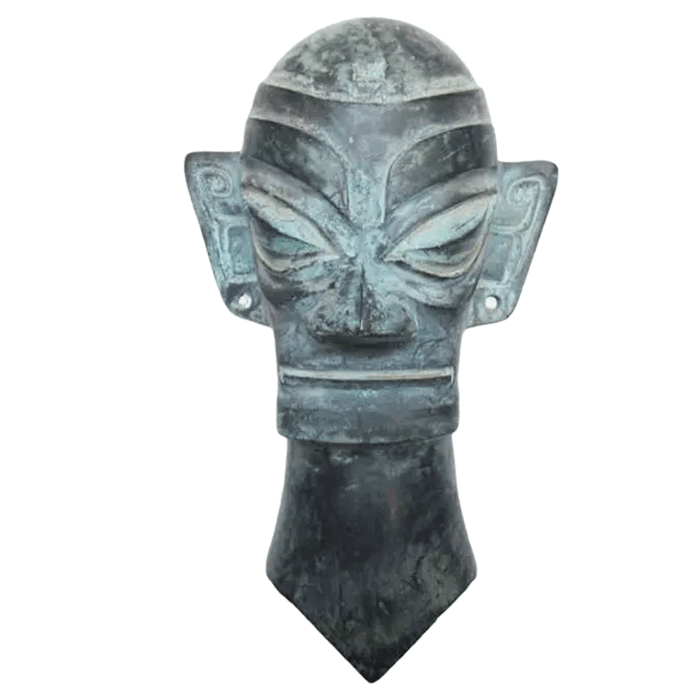
The most striking aspect of the Sanxingdui heads is their non-human proportions. The faces are elongated and angular, dominated by colossal, stylized features. The eyes are particularly noteworthy; some are almond-shaped and massively oversized, while others protrude from their sockets in a columnar fashion. These "visionary" eyes are often interpreted by scholars as representing a supernatural ability to see into the spirit world, a power attributed to deities, shamans, or mythical ancestors. The ears are equally exaggerated, often stylized with cloud-like swirls, suggesting an ability to hear prayers or otherworldly whispers. The noses are sharp and prominent, and the mouths are wide and thin, set in a severe, impassive line. This combination of features creates an impression of immense power and serene authority, far removed from the mortal realm.
The Significance of Masks and Adornments
Further evidence of ritual use comes from adornments found with the heads. Several of the larger heads were originally covered with fitted masks made of gold foil, a precious material that would have signified immense status or divinity. The contrast between the gleaming gold and the dark bronze would have been visually stunning, especially in fire-lit ceremonies. Additionally, many heads feature small, square perforations on the earlobes, forehead, or temples. Archaeologists believe these holes were used to attach external ornaments—such as feathers, banners, or perhaps even larger, more elaborate bronze appendages—that have long since disintegrated. These attachments would have completed the ritualistic "costume" of the figure, transforming it into a fully realized icon for ceremonial display.
Hollow Casting and Abstract Geometry
From a technical standpoint, the heads are masterpieces of bronze casting. They are not solid but were cast hollow using a sophisticated piece-mold technique. This not only conserved valuable bronze but also made the large heads light enough to be mounted on poles or wooden torsos, which likely stood in temples or at ceremonial sites. The artistic style is one of severe, abstract geometry. The features are composed of sharp lines, flat planes, and clean curves, conveying a sense of divine order and immutability. This abstract quality is a deliberate artistic choice, meant to represent a concept or a spirit rather than a specific individual. The focus is on the symbolic power of the image, a hallmark of ritual art across many ancient cultures.
The Ritual Context: Theories on Function and Purpose
While the absence of written records from the Sanxingdui culture means we can never be certain of the heads' exact function, their archaeological context provides strong clues. The manner of their discovery in sacrificial pits, combined with their unique form, supports several overlapping theories about their role in Sanxingdui society.
Representations of Ancestors or Deities
One prevalent theory is that the heads represent a pantheon of gods or a lineage of deified ancestors. In this view, each head may have been a specific entity, mounted on a body and dressed in ceremonial regalia to receive worship and offerings. The variety in size and facial features among the discovered heads could correspond to different ranks or identities within a spiritual hierarchy. This practice of creating icons for worship was a common practice in ancient chinese bronze sculpture, although the Sanxingdui style remains utterly unique.
Icons for Shamanistic Practices
The otherworldly appearance of the heads, particularly the piercing, all-seeing eyes, strongly suggests a connection to shamanism. Shamans were spiritual intermediaries who were believed to traverse the barrier between the physical and spiritual worlds. The heads could be representations of powerful shamans, or perhaps tools used during shamanic rituals to invoke spirits or channel divine energy. The impassive, mask-like faces would serve as a neutral vessel for a spirit to inhabit during a ceremony, with the attached ornaments adding to the transformative effect.
Mass Sacrificial Offerings
The final, undeniable role of these heads was as sacrificial objects. Their deliberate breakage and burial in the pits indicate they were part of a solemn, large-scale event. This could have been a ritual to consecrate a new temple, a desperate offering to appease angered gods during a time of crisis (such as flood or invasion), or a final ceremony to decommission all sacred items as the population prepared to abandon their capital. Whatever the reason, the act of surrendering these precious, labor-intensive objects to the earth speaks to their immense cultural and spiritual importance.
Crafting an Authentic Replica: The Luoyang Yichuan Bronze Craft Co., Ltd. Process
Recreating a masterpiece like a Sanxingdui head requires more than just technical skill; it demands a deep respect for the original artifact's historical and cultural weight. At Luoyang Yichuan Bronze Craft Co., Ltd., we combine ancient techniques with modern precision to produce replicas that honor this legacy. Our process is designed to meet the exacting standards of collectors, exhibitors, and cultural projects worldwide.
The Lost-Wax Casting Method: A Bridge to the Past
Our foundation is the traditional lost-wax casting method, an ancient technique that allows for exceptional detail and complexity. This process, while refined over centuries, remains fundamentally the same as that used by Bronze Age artisans. It begins with a precise master model from which a wax duplicate is made. This wax model is then encased in a ceramic shell, melted out to create a perfect negative mold, and finally filled with molten bronze. We use a premium bronze alloy (Cu-Sn) to ensure the final piece has the correct color, weight, and long-term stability, mirroring the materials of the originals.
Precision in Detail and Patina
Our team of over 30 skilled craftsmen, including bronze-casting masters and finishing artisans, is dedicated to capturing every nuance of the original. Each replica undergoes meticulous hand chasing and polishing to sharpen the geometric lines and smooth the surfaces. A critical step is the application of the patina. The authentic Sanxingdui artifacts have a rich, mottled coloration developed over 3,000 years of burial. Our artisans are experts at creating consistent, custom patina finishes that replicate this ancient, excavated look or achieve any other antique or modern aesthetic required by the client. This solves a common sourcing pain point by guaranteeing color consistency across multiple pieces in a large order.
From Single Prototype to Bulk Orders
Our 3,000-square-meter facility is equipped to handle projects of any scale. We understand that sourcing needs vary, which is why we support everything from the creation of a single, museum-quality prototype to large-scale production runs for architectural installations or corporate art programs. With a minimum order quantity starting from just one piece for custom works, we provide the flexibility to test a design or commission a unique centerpiece. For every project, we offer the option to customize a bronze sculpture from sculpmart.com to your exact specifications, ensuring the final product perfectly aligns with your vision.
Partnering for Quality and Reliability in Bronze Art Sourcing
Choosing a manufacturing partner for significant cultural or artistic projects requires confidence in their quality, reliability, and expertise. Luoyang Yichuan Bronze Craft Co., Ltd. is committed to being that trusted partner. Our operations are governed by an ISO 9001 certified quality management system, and all our products are manufactured to comply with rigorous export quality inspection standards for art crafts.
We are dedicated to solving the most common pain points in custom bronze art sourcing. Our expertise ensures exact replication of complex antique forms, consistent patina color matching across entire production runs, and the use of export-compliant protective packaging designed to safeguard fragile and intricate sculptures during international transit. Every piece undergoes a final quality inspection before shipment. We stand behind our craftsmanship with a guarantee of free replacement for any casting defects and provide after-sales support, including guidance on patina touch-ups and long-term restoration.
With an annual output of over 50,000 bronze art pieces, our capacity and experience make us a premier choice for sourcing a Sanxingdui Bronze Head Replica or any other custom bronze artwork. Contact us to discuss how our master craftsmen can bring your project to life with unparalleled authenticity and quality.