Sanxingdui Bronze Head Replica Feature Guide
How to Read Sanxingdui Bronze Head Replica Features Before Selecting a Design
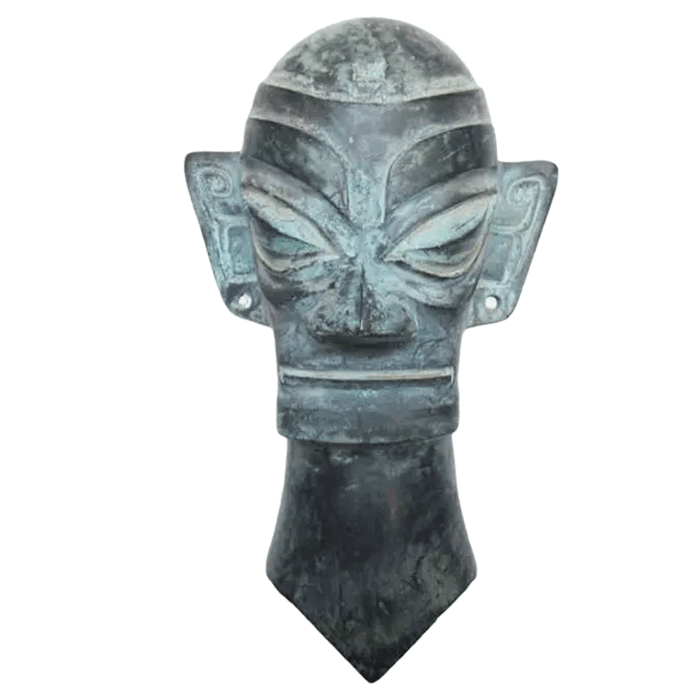
Sanxingdui bronze heads are among the most recognizable objects of early Chinese bronze culture. Their enlarged eyes, sharply modeled ears, commanding facial planes, and distinctive green or dark patinas create a visual language that differs substantially from later ritual bronzes of the Central Plains. For museum gift buyers, gallery curators, and importers, understanding these features is important before choosing a reproduction design, approving a sample, or specifying a custom display piece.
A replica should not be evaluated only by whether it looks old. A successful bronze reproduction should communicate the original object’s sculptural character while clearly remaining a modern work made for display, education, retail, or collection. The best early-stage evaluation combines historical observation with practical sourcing questions: What reference is being interpreted? Which features are essential to the design? How should the surface look at the intended scale? What production method can support consistent quality across a small or larger order?
This guide explains how to assess key visual and manufacturing cues without treating every bronze head as identical. It also helps buyers create clearer specifications for custom projects, museum-inspired collections, and curated bronze décor programs.
Understanding the Sanxingdui Bronze Head Replica as a Design Category
Before assessing details, it is useful to distinguish between an archaeological original, a museum-authorized reproduction, an interpretive replica, and a bronze artwork inspired by Sanxingdui visual culture. These categories may have different rights, documentation requirements, design freedoms, and market uses. Buyers should request clear product descriptions and avoid language that suggests a modern casting is an ancient object.
For early evaluation, the most useful question is not simply, “Does it look antique?” Instead, ask whether the piece accurately conveys the defining sculptural vocabulary associated with the chosen reference. A well-developed reproduction should have coherent proportions, intentional surface treatment, and details that work together rather than a collection of exaggerated features.
Sanxingdui-related bronze heads are often recognized by several visual characteristics:
- Prominent eyes that may appear wide, extended, raised, or strongly framed.
- Large ears with deliberate contours and visible separation from the head.
- A long, sculptural nose bridge that anchors the central facial structure.
- Defined brows, mouth, and cheek planes that create a powerful frontal expression.
- Hair, headgear, mask elements, or other features depending on the selected reference.
- Complex patina effects that may include dark brown, black, green, blue-green, or layered oxidation-inspired tones.
These characteristics should be read as a complete composition. Enlarged eyes alone do not make a design convincing if the brow, nose, cheeks, and ears are poorly proportioned. Likewise, a heavily green finish cannot compensate for a weak facial structure. Buyers should begin by looking at silhouette and facial geometry before moving to surface color.
For broader historical context, curators and sourcing teams can consult this overview of Sanxingdui bronze wares. Comparing different ancient bronze traditions can also help a buyer understand why Sanxingdui-inspired heads should not be treated as generic Chinese bronze decorations.
Read the Facial Structure Before Judging the Patina
The facial structure is the primary indicator of whether a bronze head design has visual discipline. When reviewing product photographs, drawings, clay models, or wax patterns, inspect the face from the front, side, and three-quarter views. A supplier should be able to provide these angles because a head that appears strong from the front may have an underdeveloped profile or poorly resolved ear placement.
Eye Form and Orientation
The eyes are usually the first feature noticed by viewers. In Sanxingdui-inspired designs, they may be dramatically enlarged, projected, or framed by thick upper and lower contours. Their unusual scale creates a ritual and symbolic presence rather than a naturalistic portrait effect.
When evaluating a replica, check whether both eyes are aligned in height, angle, depth, and projection. Slight hand-finished variation can be appropriate, but obvious asymmetry may reduce the quality of the work unless it is deliberately present in the selected reference. The eye shape should also remain readable at the final display distance. A small tabletop reproduction may require carefully simplified edges, while a larger lobby sculpture can retain deeper recesses and more pronounced relief.
Brow, Nose, and Cheek Planes
The brow and nose create the central axis of the face. A strong brow line helps establish the intense expression associated with these bronze heads, while the nose should transition naturally into the forehead and cheeks. If the nose is too narrow, too rounded, or positioned without clear facial planes, the result may look like a conventional modern portrait rather than a historically informed bronze interpretation.
Cheek planes should support the eyes and mouth without becoming excessively smooth. Lost-wax casting can preserve subtle modelled transitions, while hand chasing after casting can refine edges, correct minor surface irregularities, and strengthen selected details. Buyers reviewing a prototype should look for controlled transitions rather than sharpness everywhere. The visual goal is sculptural clarity, not mechanical uniformity.
Ears and Outer Contour
The ears are important because they contribute significantly to the head’s silhouette. In many Sanxingdui-inspired forms, they are noticeably large and distinctly shaped. A buyer should review whether the ears have adequate thickness, whether their outer edges are cleanly cast, and whether their connection to the head appears structurally sound.
At this stage, scale matters. Delicate ear extensions or thin decorative elements may need adjustment when a design is reduced in size. A responsible production discussion should identify where details may be strengthened to support casting, finishing, packing, and transport while preserving the overall character of the reference.
Evaluate Surface Texture, Casting Detail, and Patina Layers
After the form has been assessed, surface quality becomes the next major consideration. Ancient bronzes often show complex visual effects caused by age, burial conditions, corrosion, cleaning history, and conservation treatment. A contemporary bronze reproduction should not attempt to misrepresent those natural processes. Instead, it may use an antique-style patina to create depth and historical atmosphere appropriate for a modern decorative or educational object.
Premium Cu-Sn bronze alloy and traditional lost-wax casting provide a suitable foundation for detailed sculpture. In the lost-wax process, the original model is translated into a wax pattern, invested in a mold, and cast in molten bronze. This method is particularly useful for facial relief, ear contours, hair textures, and complex sculptural profiles that would be difficult to achieve through simpler manufacturing methods.
When inspecting product samples or detailed photographs, buyers should consider the following surface indicators:
- Detail retention: Fine lines around the brows, eyes, ears, and mouth should remain visible after casting and polishing.
- Surface continuity: Broad facial planes should look intentional, without distracting pits, rough seams, or unfinished transitions.
- Chasing quality: Hand chasing should clarify key contours rather than create random scratch marks.
- Patina distribution: Dark and green tones should be balanced across prominent and recessed areas.
- Finish suitability: The final appearance should match the display environment, whether a museum gift shop, gallery, private collection, hospitality interior, or cultural venue.
Patina is especially important for importers who need a consistent appearance across multiple units. A hand-applied antique finish will naturally contain some variation, but buyers can still establish acceptable color ranges by approving a reference sample. For example, a project specification may identify whether the desired finish is predominantly dark brown, blackened bronze, muted green, or a layered green-brown antique effect. Clear approval standards are more useful than asking for a vague “ancient bronze color.”
Understanding material terminology is also helpful when comparing suppliers. This explanation of the difference between bronze and brass can support more informed sourcing conversations about alloy selection and visual finish expectations.
Check Scale, Base Design, and Display Practicality
A bronze head may be visually compelling in a photograph but unsuitable for its intended retail or exhibition setting. Buyers should assess the complete object, including dimensions, weight, base, mounting method, viewing height, and protective packaging requirements. These factors directly affect pricing, shipping, installation, and customer handling.
Choosing an Appropriate Scale
Small reproductions can work well as premium museum gift items, desk sculptures, or collectible objects. Medium-sized versions may suit gallery displays, cultural retail collections, and interior décor programs. Larger heads can serve as focal pieces in hotel lobbies, exhibition entrances, cultural centers, or themed commercial spaces.
However, scale changes the way details must be made. In a compact piece, overly deep eye cavities or very thin ears may not reproduce cleanly. In a large sculpture, shallow details can look weak from a distance. Buyers should therefore request measurements for the overall head, face width, base footprint, and any projections that affect packing dimensions.
Base Construction and Stability
The base should support the visual concept as well as physical stability. A minimal dark base may suit a contemporary gallery setting, while a more substantial plinth can create a museum-inspired presentation. The base material, color, fastening method, and label area should be discussed during the design stage.
For import programs, it is also wise to determine whether the sculpture will be shipped as one assembled unit or with a separate base. A separate base may improve packing efficiency for some designs, but it creates an installation requirement at destination. The best choice depends on sculpture size, weight distribution, and the buyer’s intended customer experience.
Companies purchasing a wider collection can compare related forms through these Chinese bronze sculptures, including pieces that may complement a bronze head display with vessels, figures, or other heritage-inspired works.
Use Reference Documentation to Define What “Accurate” Means
Accuracy is not a single universal standard. It depends on the project objective. A museum-oriented program may require close adherence to a designated reference image, documented dimensions, and carefully specified features. A gallery may prefer a contemporary interpretation that preserves the distinctive eye and ear language while changing scale, base, or patina. A commercial interior project may prioritize visual impact, durability, and coordination with surrounding décor.
Before requesting a quotation or prototype, buyers should assemble a practical reference package. This may include licensed photographs, sketches, dimensions, required viewing angles, finish examples, logo placement needs, and notes identifying features that cannot be changed. Where a source image is not available in sufficient detail, the buyer should state which elements are interpretive rather than exact.
A useful specification package can include:
- The intended product category, such as collectible, gallery sculpture, museum gift item, or large decorative artwork.
- Reference images from front, side, rear, and three-quarter views when available.
- Target dimensions and acceptable dimensional tolerances.
- Required alloy and casting approach, if specified by the project.
- Patina direction with sample color references or approved finish photographs.
- Base style, label plate requirements, and mounting details.
- Packaging expectations for export handling and fragile projections.
- Quantity, delivery destination, and any required inspection documentation.
This information helps prevent misunderstandings between a buyer’s design team and the production workshop. It also makes sample approval more meaningful because the prototype can be reviewed against stated criteria rather than personal impressions alone.
Ask the Right Supplier Questions During Early Evaluation
Early supplier discussions should focus on production capability, communication, and quality control rather than only unit price. Luoyang Yichuan Bronze Craft Co., Ltd. is located in Yichuan County, Luoyang, Henan Province, within a region associated with more than 3,000 years of bronze culture. The company operates a 3,000-square-meter production area with more than 30 skilled craftsmen, including bronze-casting masters and finishing artisans.
Its production capability supports single custom prototypes as well as bulk production runs, with annual output exceeding 50,000 bronze art pieces. Custom sculpture orders can begin from one piece, while bulk order terms can be discussed according to size and design complexity. This flexibility can be useful for buyers who want to approve one sample before developing a wider retail or exhibition program.
For a detailed custom request, buyers may use the option to customize bronze sculpture with reference materials, dimensions, preferred finish, and intended quantity. The production team can support hand chasing, polishing, and patina finishing in antique or modern visual styles.
During evaluation, ask practical questions such as:
- Can the supplier work from supplied drawings, photographs, or a physical reference?
- Will a wax model, clay model, digital design, or prototype approval step be used?
- How will prominent ears, eye projections, or thin details be protected during export packing?
- What finish sample can be approved for patina color matching?
- What inspection is completed before shipment?
- How are casting defects handled after delivery?
Luoyang Yichuan Bronze Craft Co., Ltd. performs quality inspection before every shipment and offers free replacement for casting defects. The company also provides after-sales support for patina touch-ups and restoration guidance. These services are relevant when bronze pieces will be displayed long term or transported through multiple stages of international distribution.
Make a Confident Selection Through Structured Comparison
When several designs are under consideration, use a comparison sheet rather than relying only on general visual preference. Score each option according to facial proportions, eye and ear definition, surface detail, patina direction, scale suitability, base stability, packaging needs, and fit with the intended customer or exhibition audience.
| Evaluation Area | What to Review | Why It Matters |
|---|---|---|
| Reference fidelity | Key eye, ear, nose, and facial features | Maintains the intended cultural and visual character |
| Casting quality | Relief clarity, edges, surface continuity | Supports a refined final presentation |
| Patina control | Color range, layering, consistency | Helps align products across an order |
| Display design | Scale, base, mounting, viewing angle | Improves practical use in retail or exhibition settings |
| Export readiness | Protective packing and inspection process | Reduces risk for fragile sculptural details |
A carefully selected Sanxingdui-inspired bronze head can become more than a decorative item. It can function as an educational object, a curated cultural product, or a focal point within a broader collection of Chinese bronze art. By reading form before finish, defining the reference clearly, and confirming production details early, museum buyers, curators, and importers can make more reliable sourcing decisions.
For organizations seeking a capable bronze workshop with ISO 9001 quality management certification and export-oriented inspection standards for art crafts, Luoyang Yichuan Bronze Craft Co., Ltd. combines traditional lost-wax bronze methods with hand finishing and custom development support. The result is a practical path from reference selection to an export-ready bronze artwork designed for the intended market and display environment.