Meaning of Chinese Bronze Patterns: Motif and Placement
Meaning of Chinese bronze patterns can be read through motif, placement, and vessel form.
Chinese bronze patterns are rarely decorative details without structure. On ritual vessels, mirrors, incense burners, and other bronze objects, the position of a motif can help a researcher understand how the maker organized the surface, emphasized the vessel’s form, and created a visual hierarchy. For collectors, museum visitors, designers, and sourcing teams reviewing catalogue images or reproduction references, reading a pattern requires more than naming an animal mask or identifying a geometric band.
A useful initial approach is to examine three connected questions: What is the motif? Where is it placed? How does it relate to the shape and function of the object? A motif on a vessel’s neck may work differently from the same motif on its foot, handles, lid, or central body. The surrounding borders, symmetry, relief depth, and patina appearance can also affect how the decoration is perceived.
Because ancient Chinese bronze traditions developed across long periods and regions, no single interpretation should be applied to every object. Motif names and symbolic readings may vary between scholarly sources, museum catalogues, and later decorative traditions. Initial object research is therefore best treated as a process of visual comparison, period awareness, and careful documentation rather than a search for one fixed definition.
Start with the vessel before naming the pattern
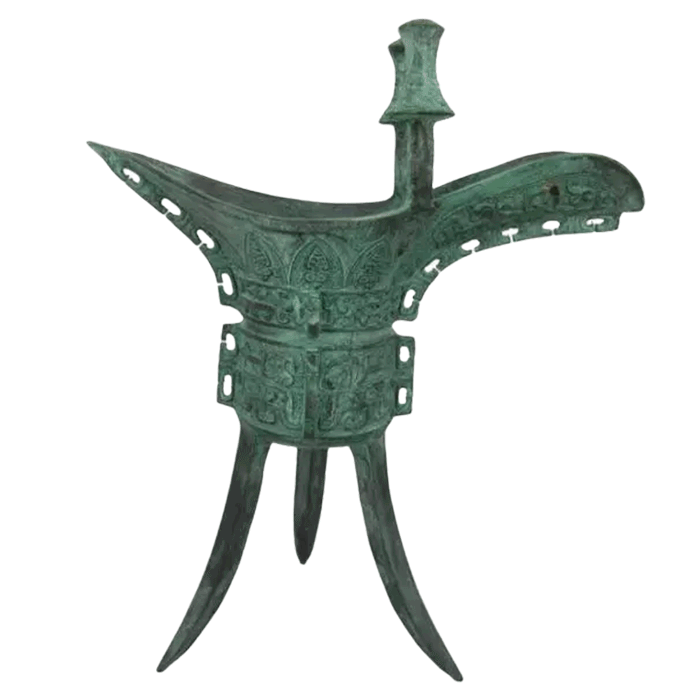
The shape of a bronze object provides the first framework for interpreting its decoration. A ding, zun, hu, gui, jue, or other vessel type has its own proportions, openings, handles, feet, and zones for ornament. These structural features guide where a pattern can appear and how it is seen when the object is viewed from different angles.
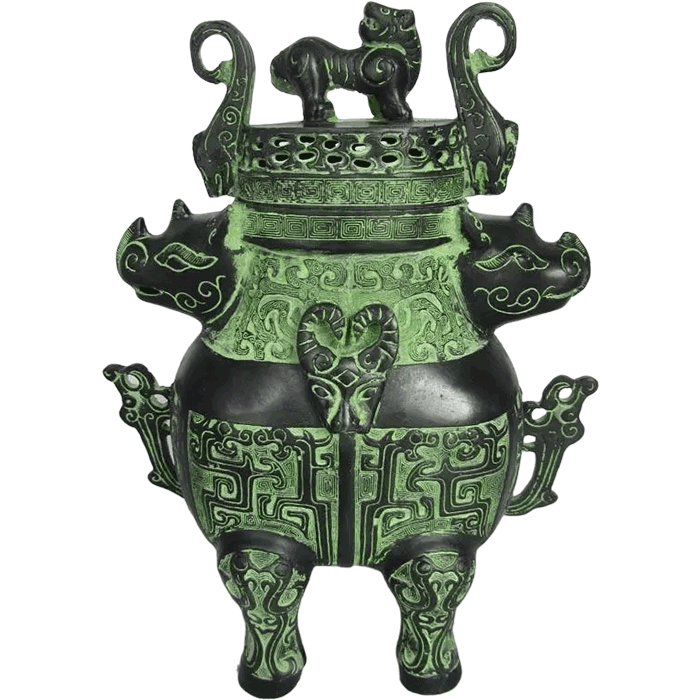
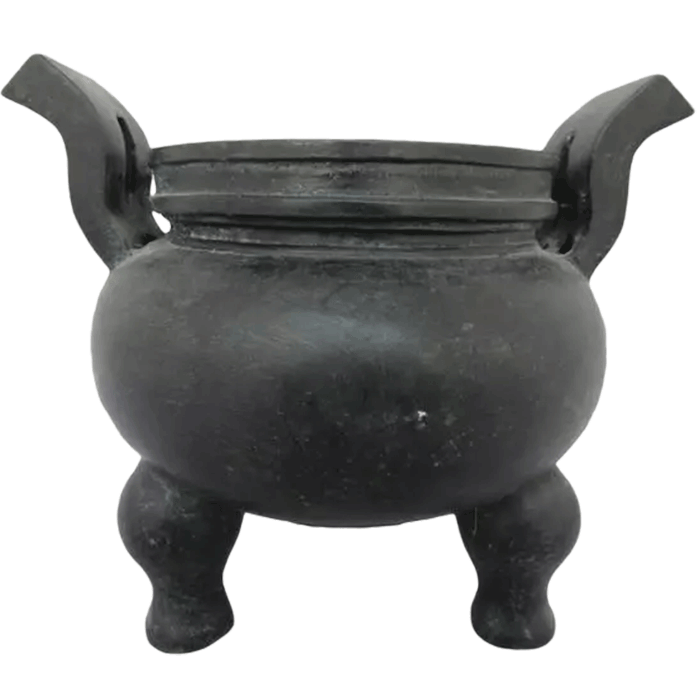
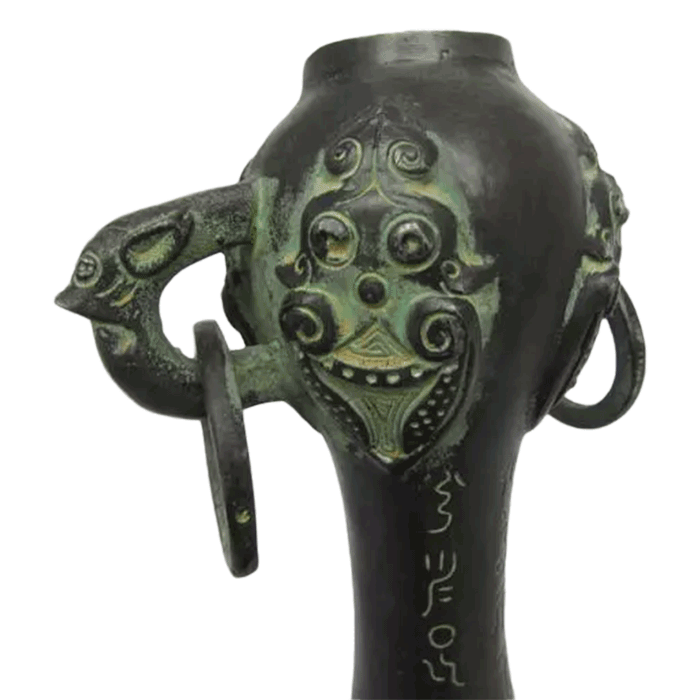
For example, a tripod vessel naturally separates into an upper body, a central belly, a lower section, and legs. Each area may receive distinct decoration. The upper zone may carry a prominent mask-like motif, while the legs may use simplified animal forms, flanges, or repeated lines that reinforce vertical movement. A tall vase-shaped object may instead emphasize a long central register, allowing bands of ornament to unfold around the body.
Before identifying any individual motif, make a short object record:
- Record the vessel type, overall silhouette, and visible dimensions.
- Identify major structural parts, including rim, neck, shoulders, body, foot, handles, lid, and legs.
- Note whether decoration is arranged in horizontal bands, vertical panels, medallions, or all-over fields.
- Look for raised flanges, ridges, cast seams, or framed panels that divide the surface.
- Observe whether the vessel is visually balanced from all sides or designed with a principal viewing face.
This process prevents a common research mistake: isolating a motif from the object that carries it. A curled creature, for instance, may be a handle terminal, a supporting leg design, or a repeated border unit rather than the central decorative subject. Its placement changes its visual importance.
For background on vessel categories and their visual differences, the reference page on several bronze wares can help researchers become familiar with common forms before comparing decorative programmes.
Identify major motif families with visual caution
Many Chinese bronze surfaces combine animal imagery, abstract forms, spirals, linear patterns, and small filling motifs. When working from a catalogue photograph, avoid forcing every line into a named category. Instead, begin by separating large, dominant imagery from the smaller motifs that fill surrounding spaces.
Mask-like faces and frontal compositions
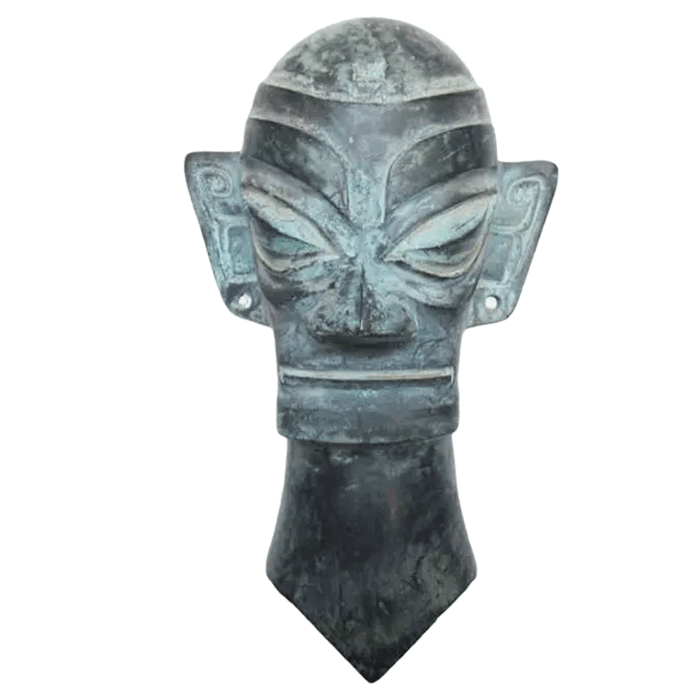
One of the most recognized decorative arrangements on early ritual bronzes is the frontal mask-like composition often described as a taotie. It is typically organized around a central vertical axis, with paired eyes and mirrored elements on either side. Horns, ears, brows, fangs, or curled forms may be suggested through relief lines, although individual examples differ substantially.
The importance of this composition lies partly in its symmetry. Rather than reading like a naturalistic animal portrait, it often turns the vessel’s surface into a controlled, facing image. When placed on the main body or shoulder, it can establish a visual focal point and make the vessel appear to confront the viewer.
Birds, dragons, and elongated creatures
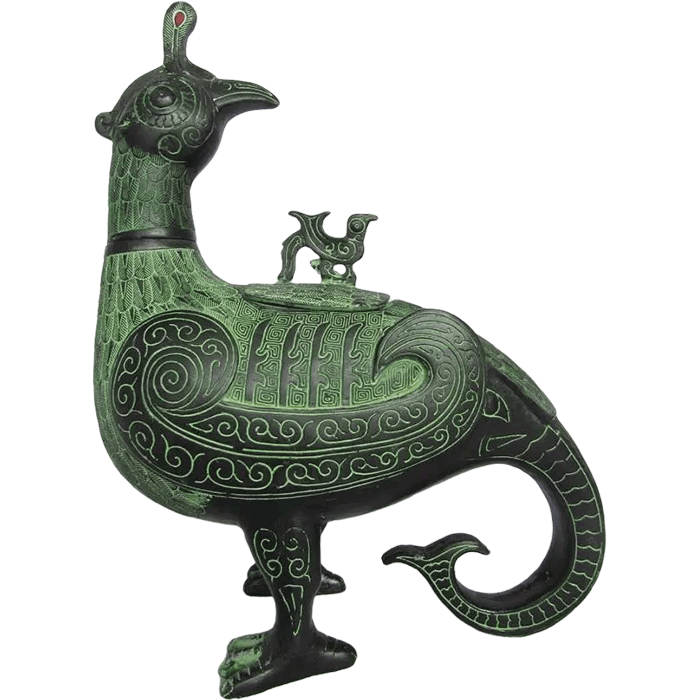
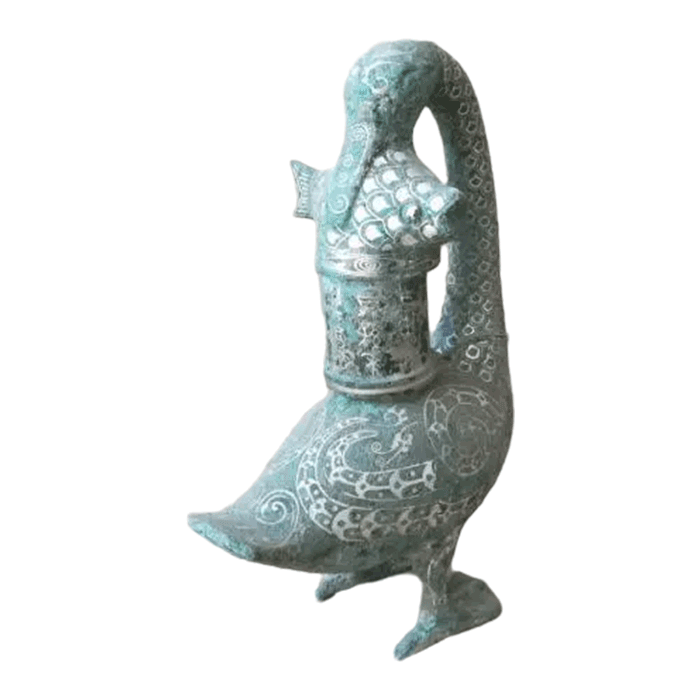
Bird forms, dragon-like forms, and other elongated creatures may appear as full figures, paired profiles, coiled lines, or integrated parts of a larger composition. Their bodies can be stretched to follow a curved vessel wall, wrapped around a handle, or repeated across a narrow band. In such cases, the contour of the bronze is inseparable from the design.
A bird placed near a lid, spout, or high shoulder may visually draw attention upward. A long creature positioned around a body band may lead the eye horizontally around the vessel. On handles and attachments, animal forms can also make a functional component appear intentional and sculptural rather than separate from the overall design.
Thunder patterns, spirals, and geometric grounds
Dense spirals and squared or curling line patterns are often used as backgrounds or secondary fields. They can increase visual richness behind a larger mask or animal image, especially on bronzes with layered relief. Although these patterns may appear subordinate, they are essential for judging the complexity and clarity of a casting.
In a good catalogue image, look closely at whether the ground pattern remains legible around the principal motif. If the background is overly shallow, blurred, or inconsistent, it may reduce the contrast that gives the main imagery definition. For reproduction research, this distinction is useful when describing desired relief depth and surface texture.
Read placement as a system of visual hierarchy
The Meaning of Chinese bronze patterns becomes clearer when placement is treated as part of the message. A vessel is a three-dimensional object, so a photograph showing only one frontal view may conceal important side, rear, or underside decoration. Whenever possible, review multiple angles and determine whether the design repeats, changes, or becomes simpler away from the main face.
The following table offers a practical starting point for reading common placement zones.
| Placement zone | What to examine | Research value |
|---|---|---|
| Rim and neck | Narrow bands, repeated units, inscriptions, or small creatures | Shows how the maker frames the opening and transitions into the body |
| Shoulder | Prominent masks, animals, or raised flanges | Often provides a major visual focal point on rounded forms |
| Central body | Large panels, symmetrical faces, or continuous registers | Usually contains the most visible decorative programme |
| Handles and attachments | Animal heads, loops, profile creatures, and terminal details | Connects ornament to functional structure |
| Foot and legs | Vertical lines, simplified masks, claws, or supporting animals | Explains how the design visually anchors the vessel |
| Lid or finial | Knobs, birds, animals, and radial arrangements | Indicates whether the top was intended as an independent focal area |
Raised flanges deserve particular attention. These vertical ridges may divide a vessel into sections or emphasize an axis through a mask-like composition. In photographs, they can appear as simple borders, but on the physical object they change how light falls across the relief. When a design is organized around flanges, the vessel often reads as a sequence of framed surfaces rather than one continuous field.
Also consider the relationship between a motif and the vessel’s widest point. Decoration placed at the widest area can make the object appear more stable and substantial. Decoration that climbs toward a narrow neck may create upward movement. These are visual effects rather than universal symbolic rules, but they are valuable observations for catalogue comparison and custom design briefs.
Use symmetry, repetition, and direction to interpret the composition
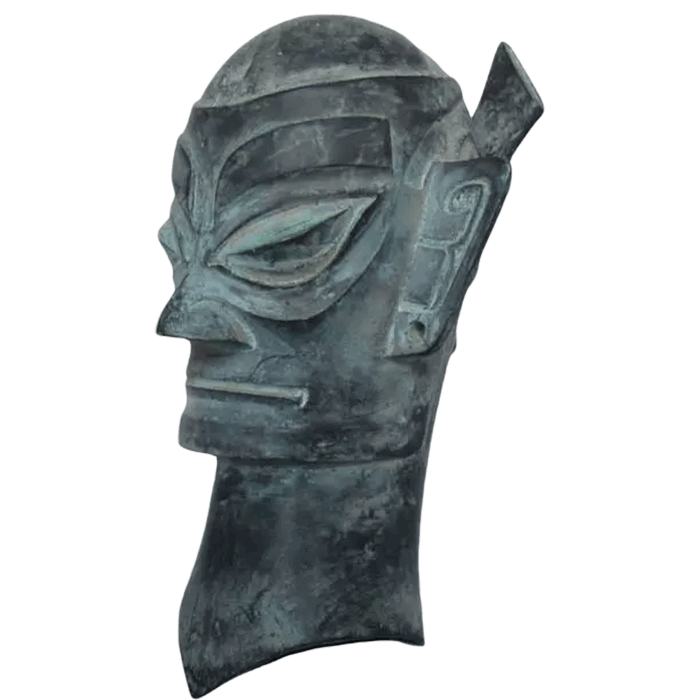
Chinese bronze ornament often relies on ordered repetition. A motif may mirror across a central axis, recur at equal intervals, or travel around the vessel in a continuous sequence. This organization helps researchers distinguish an intended pattern from isolated marks caused by wear, corrosion, lighting, or image compression.
Start by locating the strongest axis. On a frontal mask composition, the axis may run vertically through the center of the face. On a round vessel, several repeating axes may divide the surface into panels. On a mirror, the central knob can organize the entire back design into rings or radiating groups.
Then examine direction. Are animal forms facing inward toward a central feature, outward toward the edges, or moving in a continuous procession? Do curls lead the eye upward, downward, or around the circumference? Direction can reveal how the maker intended a viewer to scan the object.
- Find the dominant motif or central panel.
- Trace the nearest borders, flanges, or relief lines around it.
- Check whether the same structure appears on the opposite side.
- Identify repeated units and count them where visibility allows.
- Compare the treatment of front, side, and rear zones.
- Record any intentional asymmetry, such as a handle, spout, inscription, or lid feature.
Symmetry should not be confused with exact mechanical duplication. Hand finishing, wear, casting variation, and photographic perspective can create small differences. In antique reference material, irregularities may be part of an object’s history. In a newly made bronze artwork, however, a client may request either close visual balance or a deliberately hand-worked character. Those requirements should be stated clearly during design review.
Separate historical observation from modern reproduction choices
Researchers reviewing antique bronzes and buyers commissioning reproductions should distinguish between what is visible on an original object and what must be specified for a new work. A catalogue image may show dark recesses, green corrosion, polished high points, or uneven coloration resulting from age and environment. These visual characteristics should not automatically be copied without discussing the desired finish.
For a reproduction or inspired custom piece, a useful brief includes the vessel type, reference images, motif locations, relief height, desired scale, finish direction, and areas requiring close visual fidelity. It is also important to state whether the objective is an exact replication of a supplied reference or an original work that draws from selected traditional motifs.
Luoyang Yichuan Bronze Craft Co., Ltd. produces bronze sculptures, vessels, mirrors, incense burners, Buddhist statues, and custom bronze artworks in premium Cu-Sn bronze alloy. Traditional lost-wax casting can be combined with hand chasing, polishing, and patina finishing to support detailed decorative surfaces. For projects requiring a reference-based design, teams can customize a bronze sculpture with supplied drawings, dimensions, and image references.
When selecting a patina direction, describe the target in observable terms. Rather than asking for an “old look” alone, specify whether the surface should be dark brown, green-toned, layered, matte, lightly polished on raised details, or closer to a modern bronze appearance. This helps reduce ambiguity when matching the appearance of a reference image.
For broader visual comparison, reviewing Chinese bronze sculpture can help identify how traditional bronze language is adapted across decorative objects and sculptural forms.
Build a practical research sheet for catalogues and reference images
A structured research sheet improves communication between researchers, designers, purchasers, and bronze makers. It is especially useful when a source image is incomplete, when multiple references must be combined, or when a custom object requires carefully placed ornament on several surfaces.
Include the following fields in an initial research sheet:
- Object identification: vessel type, source title, collection reference, and approximate period if available.
- Overall form: height, width, proportions, opening shape, foot shape, handles, legs, and lid.
- Primary motifs: mask-like forms, birds, dragons, animal heads, spirals, geometric bands, or inscriptions.
- Motif placement: identify exactly where each motif begins and ends on the object.
- Composition: frontal, radial, continuous, mirrored, panelled, or asymmetrical.
- Relief description: low relief, high relief, incised line, raised flange, openwork, or sculptural attachment.
- Surface direction: antique-style patina, modern polish, dark recesses, highlighted edges, or mixed finish.
- Priority notes: specify which details require close reproduction and which may be adapted.
The Meaning of Chinese bronze patterns is most useful when it informs this kind of disciplined observation. Instead of treating a bronze surface as a collection of isolated symbols, researchers can describe a coherent relationship among image, placement, form, and finish.
Questions to ask before finalizing an interpretation
Before concluding that a particular motif has a fixed meaning, test the interpretation against the whole object. Is the form clear enough to identify? Does the motif repeat in the same way elsewhere? Could a supposed animal image be part of a larger mask composition? Is the apparent pattern affected by patina, corrosion, shadow, or a low-resolution photograph?
It is also helpful to compare the object with related vessel forms rather than relying on one image. The visual history of bronzes includes ritual containers, weapons, musical instruments, mirrors, sculpture, and later decorative works. A motif that appears central on one form may serve as a secondary border on another. Resources covering ancient Chinese bronze wine vessels can provide additional context when examining form-specific decoration.
For custom bronze sourcing, clear research at the beginning reduces later revisions. Luoyang Yichuan Bronze Craft Co., Ltd. supports projects from a single custom prototype to negotiable bulk production quantities based on size and design complexity. The company operates from Yichuan County, Luoyang, Henan Province, with a 3,000-square-meter production area and more than 30 skilled craftsmen. Each shipment receives quality inspection, and support is available for casting-defect replacement as well as patina touch-up and restoration guidance.
By reading motifs together with their placement, researchers can move from simple visual recognition to a more complete understanding of bronze design. This approach creates stronger catalogue notes, more accurate reference comparisons, and clearer specifications for historically informed bronze artworks.
===