Jue vs Zun: Understanding Chinese Bronze Wine Vessels
Understanding the Distinctions Between Jue and Zun Chinese Bronze Wine Vessels
Ancient China, a civilization rich in artistic and cultural heritage, left behind an extraordinary legacy of bronze artistry. Among the most historically significant and aesthetically captivating artifacts are the bronze vessels, particularly those designed for ritualistic wine consumption. For collectors, curators, and enthusiasts venturing into the intricate world of antique Chinese bronzes, deciphering the specific forms and functions of these vessels is crucial. Two prominent types that often draw both admiration and confusion are the Jue and the Zun. While both served as vessels for wine during ceremonial events, their distinct designs, purposes, and symbolic representations offer a fascinating glimpse into the rituals and craftsmanship of their eras. This article aims to provide a comprehensive guide to identifying the unique characteristics of the Jue and the Zun, shedding light on their historical context and the enduring artistry that defines them.
Luoyang, a city steeped in 3,000 years of bronze culture, serves as a testament to this profound legacy. As a leading manufacturer rooted in this very heritage, Luoyang Yichuan Bronze Craft Co., Ltd. understands the nuances of these historical forms, blending traditional craftsmanship with modern design principles to keep the art of Chinese bronze alive. Our expertise extends from replicating the intricate details of ancient ancient chinese bronze wine vessel forms to crafting contemporary custom bronze artworks, all while adhering to the highest quality standards.
The Enduring Legacy of Chinese Bronze Wine Vessel Craftsmanship
The history of bronze casting in China spans millennia, originating during the Xia dynasty and reaching its zenith during the Shang and Zhou dynasties (c. 1600–256 BCE). During these periods, bronze was not merely a material but a symbol of power, status, and spiritual connection. Bronze vessels were central to ancestor worship, state rituals, and banquets, serving as conduits between the human and divine realms. The meticulous craftsmanship involved in their creation, from mining and smelting to casting and finishing, represents one of the peak achievements of ancient Chinese technology and art.
Each type of bronze vessel was meticulously designed for a specific function within these elaborate rituals. Wine vessels, in particular, held immense importance, reflecting the belief that fermented beverages could facilitate communication with ancestors and deities. The forms of these vessels, such as the Jue and the Zun, were not arbitrary; they evolved over centuries, influenced by cultural practices, aesthetic preferences, and technological advancements. The intricate patterns, zoomorphic motifs, and inscriptions found on these bronzes often narrate stories of their owners, significant events, or philosophical beliefs, making each piece a historical document in itself.
At Luoyang Yichuan Bronze Craft Co., Ltd., we draw upon this rich heritage, employing skilled craftsmen, including revered bronze-casting masters and finishing artisans, to continue this tradition. Located in Yichuan County, Luoyang, our 3,000 square meter production area is a hub where the ancient lost-wax method is meticulously applied to premium bronze alloy (Cu-Sn). This dedication ensures that every piece, whether a faithful chinese bronze sculpture or a custom creation, embodies the spirit and quality of its historical predecessors. Our commitment extends to robust quality management, being ISO 9001 certified, and ensuring all products comply with export quality inspection standards for art crafts, guaranteeing both authenticity and durability.
Decoding the Jue: Form, Function, and Symbolism
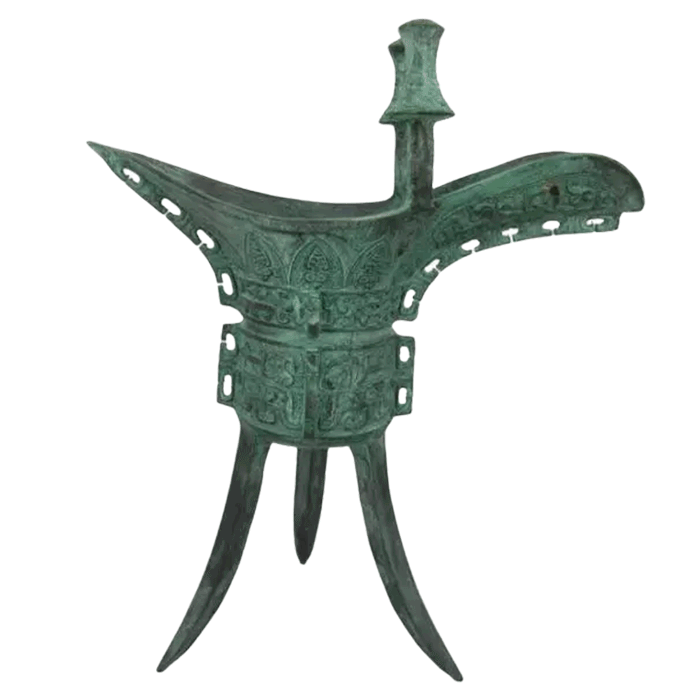
The Jue (爵) is perhaps one of the most recognizable and distinctive forms among ancient Chinese bronze vessels. Its unique tripod design, often likened to a bird, makes it instantly identifiable. The primary function of the Jue was for warming and pouring wine during ritual ceremonies. Its specific design elements are all deeply purposeful:
Key Characteristics of a Jue:
- Tripod Legs: A defining feature, the Jue stands on three splayed legs, which are typically slender and pointed. This design allowed the vessel to be placed directly over a heat source to warm the wine.
- Spout (Liu): Extending from the rim, the Jue features a long, curved spout, known as a liu, designed for pouring the warmed wine. This spout often has a sharp, upward curve.
- Fin (Wei): Opposite the spout, a broad, flat fin, or wei, balances the vessel and sometimes served as a handle or a counterweight.
- Handle (Pan): A loop handle, called a pan, is typically present on one side, positioned at a right angle to the spout and fin, facilitating ease of handling.
- Mushroom-shaped Caps (Zhu): On top of the rim, usually above where the handle connects, two small, mushroom-shaped caps, or zhu, are often found. Their exact function is debated, but they may have been used to lift the vessel with tongs or simply served as decorative elements or indicators of status.
- Decoration: Jue vessels are often adorned with intricate patterns, such as taotie (mythical beast) masks, cicada motifs, and geometric designs, reflecting the artistic styles of the Shang and early Zhou dynasties.
Historically, Jue vessels were predominantly used during the Shang and early Western Zhou dynasties. Their widespread discovery in tombs and ritual sites underscores their importance in the elite society of the time. The Jue was not merely a functional object; it was imbued with symbolic meaning, representing the user's status, power, and their connection to ancestral spirits. The act of warming and pouring wine from a Jue was a solemn ritual, believed to honor the ancestors and ensure the prosperity of the lineage.
Unveiling the Zun: Majesty, Stability, and Diverse Forms
The Zun (尊) represents another significant category of Chinese Bronze Wine Vessel, though it encompasses a wider range of forms and functions compared to the Jue. The primary role of a Zun was as a ceremonial wine container, used for storing or presenting wine during important rituals. Unlike the Jue, the Zun is characterized by its stability and often monumental presence.
Key Characteristics of a Zun:
- Stable Base: Zun vessels are typically sturdy and stable, designed to stand firmly on a flat surface. They usually have a flared foot-ring or a solid, heavy base.
- Wide Mouth: Many Zun vessels feature a wide, flaring mouth, which could be used for filling or for displaying the wine.
- Varied Shapes: The Zun category is remarkably diverse. While some Zun take on a tall, slender form with a trumpet-shaped mouth (often referred to as gu-shaped Zun), others are cast in the shape of animals.
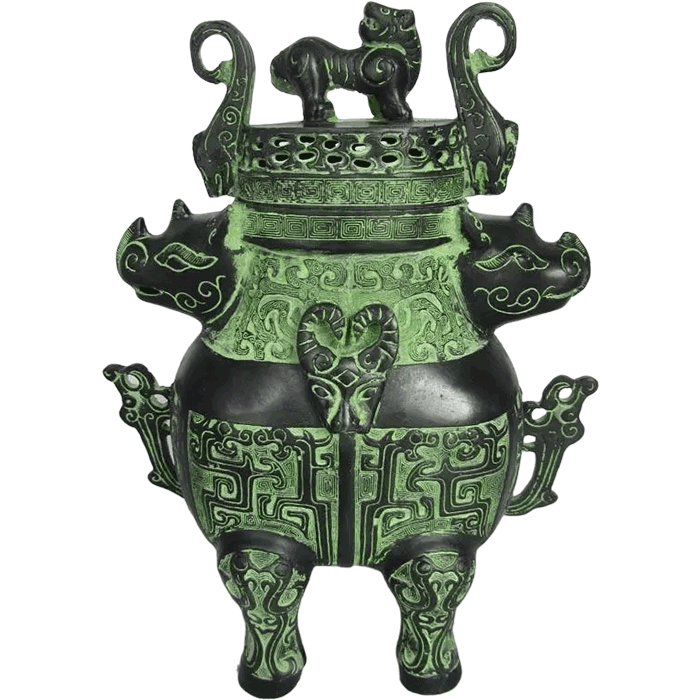
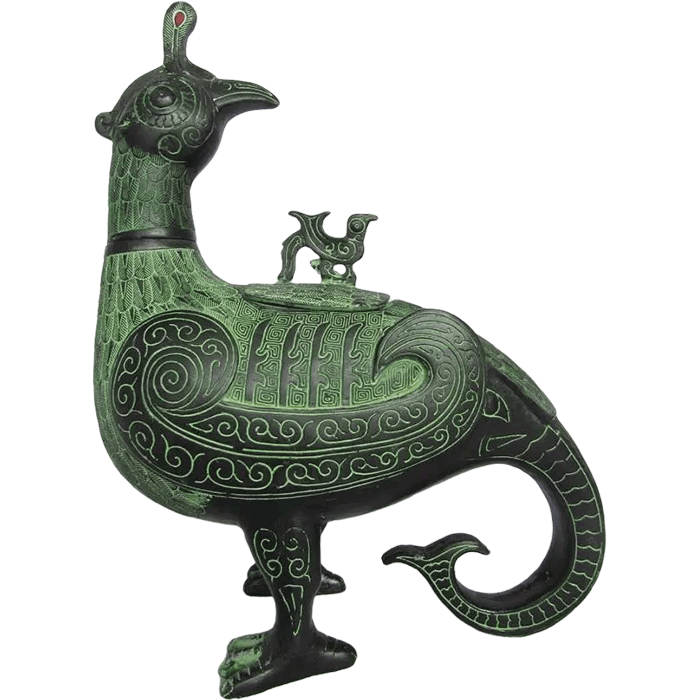
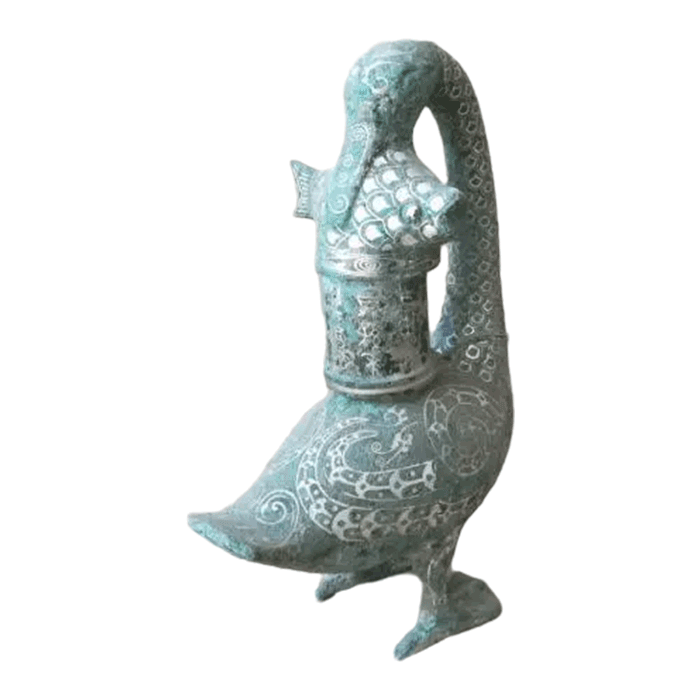
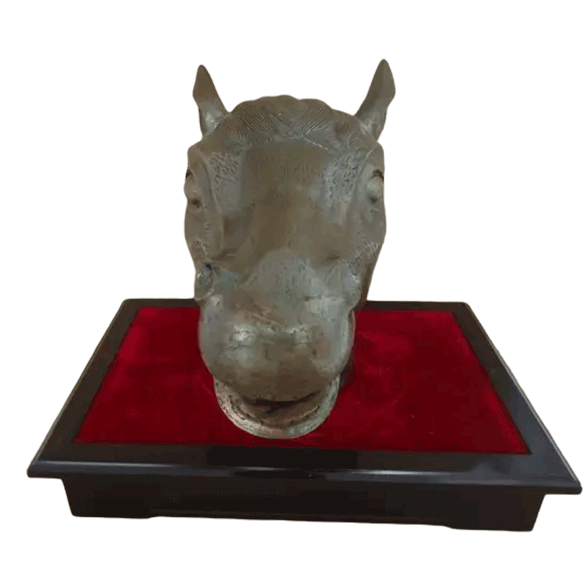
- Animal Zun: A particularly striking sub-category, animal Zun take the form of elephants, rhinos, oxen, birds, or mythical creatures. These animalistic vessels are highly sculptural, often featuring removable lids or openings on their backs for filling and pouring. The intricate details and realistic (or fantastical) portrayal of these animals demonstrate exceptional artistic skill.
- Decoration: Zun vessels are frequently elaborately decorated with zoomorphic motifs, geometric patterns, and intricate relief work, often covering the entire surface. The animal Zun, in particular, integrates the decoration directly into the vessel's form.
- Function: Primarily used for holding and presenting wine, rather than warming it. They were often part of larger sets of ritual bronzes.
Zun vessels were prominent throughout the Shang and Zhou dynasties, with animal Zun becoming particularly popular during the Western Zhou period, showcasing a shift towards more expressive and complex forms. These vessels symbolized not only wealth and status but also the spiritual power associated with the animals they depicted. The grandeur and stability of the Zun made it a fitting centerpiece for significant ritual offerings, embodying the solemnity and majesty of the ceremonies.
Key Distinctions: Jue vs. Zun at a Glance
While both the Jue and the Zun are essential components of ancient Chinese wine rituals, their fundamental differences in shape, function, and symbolism make them distinct categories. Understanding these distinctions is key to appreciating the diversity and ingenuity of bronze age craftsmanship.
Comparative Analysis:
| Feature | Jue (爵) | Zun (尊) |
|---|---|---|
| Primary Function | Warming and pouring wine | Storing and presenting wine |
| Overall Shape | Tripod, often resembling a bird; distinctive spout and fin | Varied; typically stable and voluminous, often trumpet-shaped or animalistic |
| Legs/Base | Three pointed, splayed legs for heating | Stable foot-ring or heavy, solid base; no legs for heating |
| Spout/Opening | Long, curved pouring spout (liu) and balancing fin (wei) | Wide, flaring mouth or an opening on the back (for animal Zun) |
| Handle | Single loop handle (pan) | Often no integrated handle; animal Zun might have small handles or features for lifting |
| Heating Capability | Designed to be heated over a flame | Not designed for direct heating |
| Common Periods | Shang and early Western Zhou dynasties | Shang and Zhou dynasties (broader range, including animal forms) |
In essence, the Jue is engineered for direct interaction with heat and the act of serving, while the Zun is crafted for display and communal storage. Both testify to the sophisticated understanding of metallurgy and ritual practice prevalent in ancient China, and both are magnificent examples of the broader category of chinese bronze antique forms.
The Art of Bronze Crafting: From Ancient Tradition to Modern Replication
The creation of these intricate bronze vessels, whether a Jue or a Zun, was an incredibly complex and labor-intensive process in ancient times, requiring immense skill and resources. Today, the art of bronze casting continues, sustained by companies like Luoyang Yichuan Bronze Craft Co., Ltd., which honor the traditions while meeting contemporary demands.
Our company prides itself on upholding the authenticity and quality of traditional Chinese bronze craft. We exclusively use premium bronze alloy (Cu-Sn), which is cast using the revered lost-wax method. This ancient technique, perfected over millennia, allows for the creation of incredibly detailed and intricate forms, ensuring that every curve, motif, and textural element of the original designs is faithfully reproduced. After casting, each piece undergoes meticulous hand chasing and polishing by our skilled artisans, bringing out the inherent luster of the bronze.
The final touch is the patina finishing, available in a variety of antique or modern looks. This crucial step not only enhances the aesthetic appeal but also contributes to the preservation of the bronze, replicating the aged beauty of centuries-old artifacts or offering a contemporary finish. Our dedication to quality extends beyond the workshop; every shipment undergoes rigorous quality inspection to ensure perfection. We stand by our craftsmanship with a free replacement policy for any casting defects and provide comprehensive after-sales support, including guidance for patina touch-ups and restoration.
We understand the unique challenges faced by collectors, curators, and businesses seeking custom bronze art. Our services are specifically designed to address common pain points:
- Exact Replication: We excel at the precise replication of antique bronzes, capturing every intricate detail and historical nuance.
- Consistent Patina Color Matching: Achieving uniform and accurate patina finishes across multiple pieces, a critical aspect for collections and exhibitions, is our specialty.
- Export-Compliant Protective Packaging: Recognizing the fragility and value of bronze sculptures, we provide robust, export-compliant packaging that ensures safe transit globally.
With an annual output of over 50,000 bronze art pieces, Luoyang Yichuan Bronze Craft Co., Ltd. is equipped to handle diverse project scales, from a single custom prototype to extensive bulk production runs. Our minimum order quantity for custom sculptures starts from just one piece, offering unparalleled flexibility, while bulk orders are negotiable based on the specific size and design complexity. Whether you are looking to acquire a historical reproduction of a Chinese Bronze Wine Vessel or commission a unique contemporary bronze artwork, our team is dedicated to bringing your vision to life. For those interested in creating a bespoke piece, we invite you to customize a bronze sculpture with us.
Conclusion
The Jue and the Zun stand as magnificent testaments to the artistic prowess and ritualistic sophistication of ancient China. While both are quintessential Chinese Bronze Wine Vessel forms, their distinct designs and functions offer a captivating study in historical object typology. The Jue, with its three legs and pouring spout, was a vessel for warming and serving, embodying active participation in ritual. The Zun, with its stable base and often grand, varied forms, served as a majestic container for display and communal offerings. Understanding these subtle yet significant differences enriches our appreciation for the profound cultural narratives embedded within these enduring works of art.
At Luoyang Yichuan Bronze Craft Co., Ltd., we are honored to perpetuate this rich legacy. Our commitment to traditional methods, combined with stringent quality controls and a deep understanding of historical forms, positions us as a premier partner for those seeking authentic and high-quality bronze art. We invite you to explore the possibilities of bringing these ancient forms, or new artistic expressions, into your collection or project, confident in the knowledge that you are engaging with masters of a craft refined over three millennia.