Identifying Jue Mold Sections From Casting Evidence
How Casting Evidence Reveals the Mold Sections of an Ancient Chinese Ritual Wine Vessel Jue
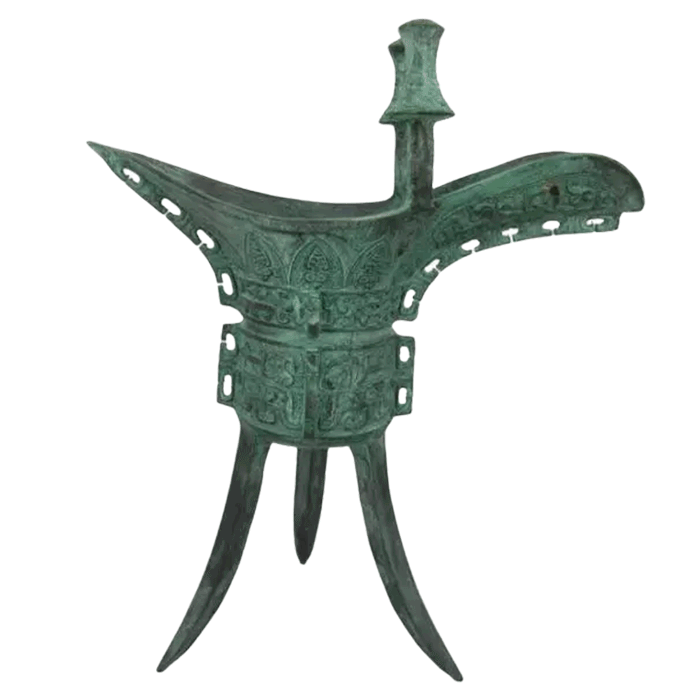
For buyers and educators researching bronze reproductions, the small physical clues left behind by the casting process often say more than any sales description. A well-made Jue vessel — with its three splayed legs, tubular spout, and twin cap-posts — carries visible fingerprints of the mold that shaped it. Understanding these fingerprints allows a researcher to judge whether a modern reproduction was built using genuine piece-mold or lost-wax techniques, and whether the foundry paid attention to the structural logic of the original Shang and Zhou dynasty prototypes.
This article walks through the practical evidence — seams, wall thickness, core marks, and surface texture — that indicates how a Jue's mold was sectioned, and what this means for buyers evaluating quality in custom bronze reproduction work.
Why Mold Structure Matters for a Jue Reproduction
The original bronze-casting tradition in ancient China relied primarily on piece-mold casting, where a clay model was used to press multiple outer mold sections, which were then reassembled around a core before molten bronze alloy was poured in. A Jue, with its asymmetrical spout, handle, and three angled legs, required a mold divided into several interlocking sections rather than a single simple two-part shell. This complexity is part of why the vessel is considered a benchmark piece for evaluating a foundry's technical skill.
When a modern workshop reproduces this vessel using the traditional lost-wax method, the seams and surface evidence will differ from piece-mold casting, but they still leave identifiable traces. Readers comparing reproductions should look for these traces rather than relying on visual style alone, since patina and surface color can be replicated far more easily than internal casting logic.
The Role of the Legs and Spout in Mold Division
The three legs of a Jue are typically the first clue. On authentic ancient pieces, the mold was often divided so that leg seams run vertically along the outer edge of each leg, meeting the body at a slightly irregular junction. A reproduction that shows perfectly symmetrical, machine-smooth leg seams — with no variation at all — likely was cast in a modern rubber or silicone mold rather than through a hand-built ceramic shell process. Genuine hand-finished casting, even when using investment techniques today, tends to show slight asymmetry consistent with hand-chased correction after the pour.
Reading Seam Lines and Flash Marks
Flash lines — the thin ridges of excess metal that seep into the gaps between mold sections — are one of the most reliable indicators of how many mold pieces were used. On the body of a Jue, seam evidence commonly appears:
- Along the vertical midline of the belly, where two main body sections met
- At the base of the spout, where a separate small mold piece was needed to form the narrow channel
- Around the handle attachment point, often disguised within a decorative band or taotie motif
- At the top of each leg, where leg molds joined the body mold
On a faithful reproduction, a skilled finishing artisan removes flash lines through hand chasing and polishing, but subtle traces often remain under close inspection or under raking light. Buyers should ask suppliers whether these seam areas were hand-finished or left as cast, since the finishing process significantly affects both authenticity and price.
Wall Thickness as Supporting Evidence
Uneven wall thickness is another sign of authentic mold-based construction. Ancient Jue vessels typically show slightly thicker walls near the base and thinner walls near the rim, a natural consequence of how molten bronze alloy flows and cools inside a multi-part mold. A modern casting that shows perfectly uniform wall thickness throughout may have been produced using a simplified single-mold shortcut, which sacrifices historical accuracy for speed. Reproductions intended for museum-quality display or serious collectors should replicate this variation deliberately, not eliminate it.
Core Marks and Interior Surface Clues
Because a Jue is hollow, its interior surface can reveal even more about mold construction than the exterior. Ancient piece-mold casting used a separate clay core held in place by small bronze or clay spacers, which sometimes left faint square or rectangular depressions on the interior wall — commonly called core marks or chaplet marks. While a reproduction using the lost-wax method may not require identical core spacers, a workshop that understands this history will often replicate subtle core-mark textures for pieces meant to closely mirror antique construction.
Interior surface roughness is also telling. A rough, slightly porous interior is consistent with traditional casting methods and high-temperature bronze alloy pours, while an unnaturally smooth interior suggests a modern shortcut process, such as centrifugal casting, that was never part of the historical Jue-making tradition.
Patina Consistency Across Mold Seams
One area where reproduction quality is easiest to judge is patina behavior across seam lines. Because ancient bronze corrodes uniformly over centuries, seams disappear beneath a consistent patina layer. On a newly cast reproduction, applied patina should be color-matched and evenly absorbed across all seam areas, including the harder-to-reach spout base and handle junctions. Uneven patina pooling at a seam line is often a sign that the underlying metal surface was not properly finished before chemical treatment, a detail worth raising directly with any bronze supplier during sourcing discussions.
What This Means for Buyers Comparing Suppliers
For procurement teams, universities, and cultural institutions sourcing an Ancient Chinese Ritual Wine Vessel Jue reproduction, casting evidence provides an objective way to evaluate craftsmanship claims that go beyond marketing photos. Questions worth asking a prospective foundry include:
- Which casting method is used — lost-wax, piece-mold, or a hybrid approach?
- Are seam lines hand-chased and polished, or left mechanically smooth?
- Does wall thickness vary naturally across the body, base, and legs?
- Is patina applied evenly across all seam and junction areas?
- Can the workshop provide close-up photos of the interior surface before finishing?
A supplier confident in its process should be able to answer these questions in detail and provide supporting images. Luoyang Yichuan Bronze Craft Co., Ltd. produces bronze vessels including ding, zun, hu, and Jue-style pieces using premium bronze alloy and traditional lost-wax casting, with hand chasing and patina finishing available in antique or modern styles, and welcomes detailed technical questions from research-stage buyers evaluating chinese bronze handicrafts for institutional or collector use.
Historical Context Behind Jue Construction
Understanding mold sectioning is easier with background on how bronze vessel technology evolved across Chinese dynasties. The Jue belongs to an early category of ritual wine vessels that predates many of the more elaborate ding and zun forms, and its comparatively simple silhouette actually demanded more precise mold engineering because of the thin legs and narrow spout. Readers wanting a broader view of how this technology developed can review a detailed account of the evolution of bronze culture over 2000 years, which traces how casting sophistication increased from early wine vessels through the elaborate ritual sets of the Zhou dynasty.
It is also useful to compare the Jue against other classical vessel types to understand shared mold-construction principles. A comparison of drinking and pouring vessels used in ancestral rites is available in this overview of the ancient chinese bronze wine vessel category, which discusses how different vessel shapes required different mold-sectioning strategies depending on their ritual function.
Applying This Knowledge to Custom Orders
Buyers planning a custom reproduction — whether for a museum education program, a cultural exhibit, or a private collection — benefit from sharing reference photographs of original excavated pieces with their chosen foundry. A workshop experienced in replicating antique bronze forms can discuss mold-section planning directly, including how many sections will be used, where seams will be hidden within decorative bands, and how the interior surface will be treated. This kind of technical conversation is a strong indicator of a foundry's genuine expertise, as opposed to a supplier simply working from a single generic mold template.
For teams exploring a fully custom piece, reviewing how the process works from prototype to bulk casting can help set realistic expectations around timeline and finishing options. Details on scope, from single prototype pieces to larger production runs, are outlined on the page to customize a bronze sculpture from sculpmart.com, which covers how design references, mold planning, and patina specifications are typically handled for ritual vessel reproductions.
Final Notes on Evaluating Casting Authenticity
Identifying mold sections on a Jue is ultimately about pattern recognition — learning to spot the small irregularities that separate a carefully hand-finished reproduction from a mass-produced approximation. Seam placement, wall thickness variation, interior surface texture, and patina consistency across joints all tell a coherent story about how the piece was actually made. A reproduction that gets these details right, produced using a premium copper-tin bronze alloy and finished by experienced artisans, offers a far more accurate representation of the Ancient Chinese Ritual Wine Vessel Jue tradition than one judged on surface appearance alone.
Buyers who take the time to ask detailed casting questions, request close-up interior photographs, and compare seam evidence against known archaeological examples will be far better positioned to select a supplier capable of meeting both educational and collection-grade standards.