Identify Bronze Jue Forms by Spout, Legs, and Posts
How to Identify a Bronze Jue by Its Spout, Legs, and Posts
Among the ritual wine vessels of ancient China, few shapes are as instantly recognizable—or as frequently misidentified—as the tripod pouring vessel commonly translated as "jue." For decor buyers, museum replica resellers, and collectors sourcing historically accurate bronze pieces, learning to read the three defining structural elements of this vessel is essential. Spout shape, leg configuration, and the small vertical posts near the rim each carry specific dating and regional signatures that separate an authentic reproduction from a generic tripod cup. This guide breaks down each feature so you can evaluate a piece with confidence before committing to a production order.
What Makes a Vessel a Genuine Jue Form
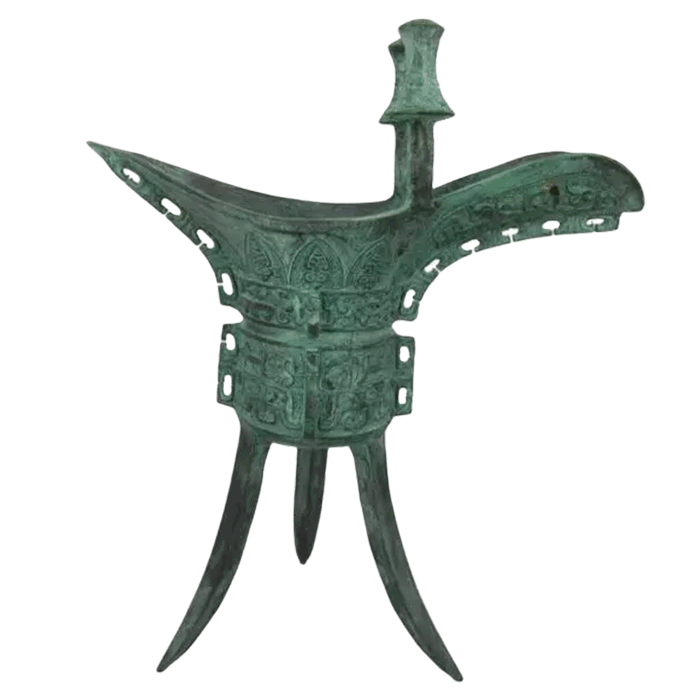
Unlike the flat-bottomed gu (wine goblet) or the deep-bodied zun, the jue is defined by three simultaneous features: an elongated pouring spout on one side, a pointed tail on the opposite side, three splayed legs supporting a rounded belly, and two small mushroom-shaped posts standing near the rim. When all three elements appear together in correct proportion, the piece can be confidently classified within this vessel family. Reproductions that omit the posts, flatten the spout, or replace the tripod legs with a solid base are stylistic simplifications rather than historically faithful casts.
Because these vessels date primarily from the late Neolithic Erlitou culture through the early Western Zhou period, buyers evaluating replicas should expect surface treatment, wall thickness, and casting seams consistent with lost-wax or piece-mold techniques of that era. For background on how these forms evolved across dynasties, see this overview of the evolution of bronze culture over 2000 years.
Reading the Spout: Function and Chronology
Long, Narrow Spouts of Early Forms
Early examples from the Erlitou and early Shang periods typically show a slender, sharply angled spout with a straight or slightly upturned tip. This narrow channel was functional—used for pouring warmed wine into a secondary vessel—and its length relative to the vessel body is one of the clearest chronological markers. A spout that is disproportionately short or overly wide often signals a later stylization rather than an accurate replica of the earliest known forms.
Broader, Curved Spouts of Later Periods
By the middle and late Shang dynasty, spouts became broader and more gently curved, often decorated along the rim with small relief bands. Buyers sourcing a Bronze Jue intended to represent this later phase should look for a spout that flares gradually rather than terminating in a sharp point, along with decorative motifs such as taotie masks extending onto the spout's underside.
Understanding the Tripod Legs
Leg Shape and Stance
The three legs of an authentic form are not merely structural—they are splayed outward at a specific angle that gives the vessel its characteristic stability and silhouette. Early legs tend to be thin, blade-like, and slightly bowed; later Shang and Zhou examples show thicker, more columnar legs, sometimes cast with raised ridges or simple banding. When evaluating a replica, check whether the legs meet the body at a natural curve rather than a blunt right angle, since an inaccurate leg-to-body transition is one of the most common shortcuts in mass-produced pieces.
Casting Seams as a Quality Indicator
Because traditional lost-wax casting produces a single continuous pour, well-made reproductions show minimal visible seam lines along the legs. This is one area where production method matters directly to buyers: pieces cast using premium bronze alloy (Cu-Sn) through the traditional lost-wax method typically display cleaner leg junctions and more even wall thickness than vessels produced through simplified sand-casting shortcuts.
The Posts: A Detail Often Overlooked
The two small posts—sometimes called "caps" or "pillars"—rising from the rim near the spout are perhaps the most frequently omitted detail in lower-quality replicas, yet they are one of the most historically significant. Scholars generally agree these posts served either a ritual function related to filtering wine through cloth, or a practical role allowing the vessel to be lifted with tongs during heating. Regardless of original purpose, their presence, height, and cap shape (flat disc versus mushroom dome) are strong dating indicators.
Reproductions intended for serious replica resellers should replicate the post placement precisely—typically positioned at the base of the spout rather than centered on the rim—and match the cap style appropriate to the historical period being represented. A piece marketed as an early-period Bronze Jue with late Zhou-style domed posts is a mismatch that knowledgeable buyers will notice immediately.
Surface Finish and Patina Considerations
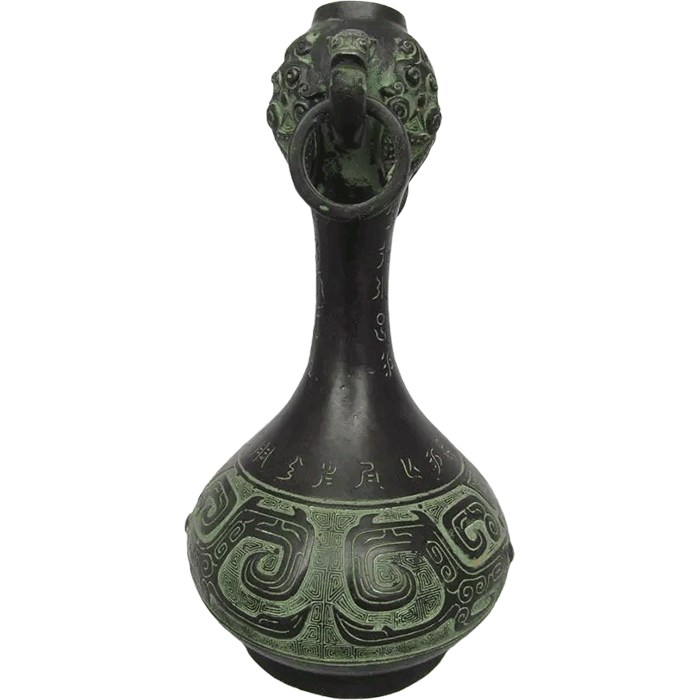
Beyond structural accuracy, surface treatment determines whether a replica reads as museum-grade or decorative-only. Authentic excavated vessels typically display a mottled green-to-brown patina with occasional malachite or azurite crusting, rather than a uniform single-tone coating. When sourcing reproductions, ask whether the manufacturer offers hand-applied patina finishing rather than a sprayed chemical wash, since hand chasing and layered patina work produce far more convincing depth and color variation across the spout, legs, and posts.
This is an area where production capability directly affects outcome quality. Luoyang Yichuan Bronze Craft Co., Ltd. produces over 50,000 bronze art pieces annually from its 3,000-square-meter facility in Yichuan County, Luoyang, with more than 30 skilled craftsmen—including bronze-casting masters and dedicated finishing artisans—handling each stage from wax modeling through final patina work. This scale allows for both single custom prototypes and larger production runs without sacrificing the hand-finishing detail that distinguishes an accurate reproduction from a generic casting.
Sourcing Considerations for Resellers and Decor Buyers
Matching Reference Pieces
Resellers working from museum catalog images or auction records should provide the manufacturer with clear reference photography showing the spout angle, leg stance, and post placement of the target original. Because exact replication of antique bronzes depends heavily on accurate measurement and proportion, working from a documented reference rather than a general description produces far more reliable results.
Quality Assurance Before Shipment
Given that these vessels are cast with thin-walled legs and a delicate spout, transit damage is a real risk. Buyers should confirm that any supplier performs quality inspection before every shipment and offers export-compliant protective packaging designed for fragile bronze sculptures. A supplier operating under an ISO 9001 quality management system, with products meeting export quality inspection standards for art crafts, offers an additional layer of assurance for buyers who cannot inspect pieces in person before shipment.
Minimum Order Flexibility
Because replica resellers often need to test a single sample before committing to bulk inventory, working with a manufacturer that accepts a minimum order quantity from one piece for custom sculptures allows for lower-risk evaluation. Bulk pricing can then be negotiated once the sample's spout curvature, leg proportion, and patina finish have been confirmed against the buyer's reference standard.
Comparing Jue Forms to Related Vessel Types
Buyers new to bronze vessel sourcing sometimes confuse the tripod pouring form with related wine vessels such as the gu, zhi, or jiao, which share some surface decoration but differ significantly in leg structure and spout presence. For a broader introduction to how these vessel categories relate to one another, this summary of ancient Chinese bronze wine vessel types is a useful reference point before finalizing a design brief. Understanding these distinctions helps buyers communicate precise specifications to their manufacturer, reducing the chance of receiving a piece that resembles but does not accurately represent the intended historical form.
It's also worth noting that decorative motifs found on jue vessels—particularly taotie masks and geometric banding—appear across many other bronze categories, from ding tripods to zun vases. Buyers assembling a themed collection may find it useful to review the broader range of chinese bronze sculpture offerings to ensure stylistic consistency across a multi-piece order.
Custom Reproduction and Restoration Support
For buyers requiring a specific historical variant not available as a standard catalog item, custom bronze artwork production allows for adjustment of spout length, leg thickness, and post height to match a particular archaeological period or regional style. Manufacturers offering this flexibility typically request detailed reference images or measurements before quoting a custom casting run. Those interested in this process can review how to customize a bronze sculpture from sculpmart.com to understand the typical workflow from reference approval through final patina finishing.
After-sales considerations also matter for long-term inventory holders. Suppliers offering free replacement for casting defects, along with after-sales support for patina touch-ups and restoration guidance, provide meaningful protection for resellers holding stock over extended periods, particularly for pieces displayed in retail environments where surface finish may need periodic refreshing.
Final Checklist Before Ordering
- Confirm spout length and curvature match the intended historical period.
- Verify leg stance, thickness, and body transition are proportionate and free of blunt casting seams.
- Check that both rim posts are present, correctly placed, and styled appropriately for the period represented.
- Request hand-applied patina rather than uniform chemical coating for a more authentic surface.
- Confirm export-compliant packaging and pre-shipment inspection are included in the order process.
A correctly identified Bronze Jue—one where spout, legs, and posts align with historical proportion—signals a manufacturer capable of precise reproduction work rather than generic decorative casting. For buyers and resellers building a catalog of historically credible bronze pieces, these three structural checkpoints remain the fastest and most reliable way to evaluate a vessel before placing a production order.