How to Spot Modern Marks on Antique Style Chinese Bronze
Discover how to identify modern production marks on an antique style Chinese bronze.
For gallerists, interior designers, and collectors, sourcing high-quality bronze reproductions requires a discerning eye. The value and appeal of a piece lie not just in its form, but in the authenticity of its creation process. An exceptional reproduction channels the spirit of its ancient predecessor, showcasing the artistry of traditional techniques. Conversely, a poorly made replica often reveals its modern, mass-produced origins through subtle but distinct casting and finishing marks. Understanding these differences is crucial for making informed procurement decisions, ensuring the pieces you acquire meet the standards your own clients expect.
This guide provides a detailed examination of the marks, textures, and finishes that differentiate masterfully crafted reproductions from inferior imitations. Drawing on the deep heritage of Luoyang's 3,000-year-old bronze culture, we will explore the tell-tale signs left by both ancient casting methods and modern manufacturing shortcuts. By learning to identify these key indicators, you can better assess the quality of bronze artworks and partner with a supplier who honors the integrity of traditional craftsmanship. As a company dedicated to preserving these techniques, we believe that transparency and education are a cornerstone of building trust with our B2B partners.
The Legacy of Traditional Chinese Bronze Casting
To identify modern deviations, one must first understand the authentic methods. Ancient Chinese bronzes were primarily created using two sophisticated techniques: piece-mold casting and the lost-wax method. Both were labor-intensive processes that left characteristic marks, which high-quality reproductions seek to either replicate faithfully or artfully finish to the highest standard.
Piece-Mold Casting
Dominating the Shang and Zhou dynasties, the piece-mold technique was a marvel of ancient engineering. Craftsmen would first create a clay model of the desired object. Then, an outer layer of clay was packed around the model and allowed to dry. This outer layer was carefully cut into sections (pieces) and removed. The original model was often shaved down to become the core, or a new, smaller core was made. The outer mold pieces were then reassembled around the core, leaving a cavity between the two. Molten bronze was poured into this cavity through gates, with chaplets (small bronze spacers) used to hold the core in place.
This intricate process left several distinct marks:
- Mold Seams: Faint, sometimes irregular vertical lines where the outer mold pieces met. On authentic ancient pieces, these seams were often meticulously filed and polished, but faint traces might still be visible under close inspection.
- Chaplet Traces: Small, squarish or rectangular marks on the surface where the chaplets were located. After casting, these spacers would fuse with the object and were often filed down, but their ghostly outlines can remain.
- Sprue and Gate Marks: Remnants from the channels where molten bronze was poured in and gases escaped. These were typically cut off and polished, but their location can sometimes be deduced.
Understanding the evolution of bronze culture over 2000 years provides essential context for recognizing the nuances of these historical production methods and the artifacts they produced.
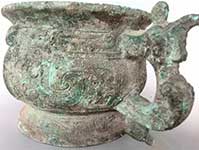
The Lost-Wax Method (Cire Perdue)
The lost-wax method, which gained prominence later, allowed for more complex and detailed designs. At Luoyang Yichuan Bronze Craft Co., Ltd., we use this traditional method to achieve the highest level of detail and artistic integrity in our custom and bulk productions. The process involves:
- Creating a model in wax.
- Covering the wax model with a clay or plaster mold, leaving channels for pouring and venting.
- Heating the mold to melt and drain away the wax (hence "lost-wax").
- Pouring molten bronze into the now-empty mold cavity.
- Breaking the mold to reveal the bronze casting.
Because the mold is destroyed in the process, each lost-wax casting is unique. This method produces a seamless object, free from the piece-mold lines described above. However, it still requires sprues for the bronze to enter, which must be cut off and the area meticulously chased and polished by hand. The quality of this finishing work is a key indicator of a superior-quality reproduction.
Hallmarks of Modern Manufacturing Shortcuts
While advanced technology can aid in creating faithful reproductions, shortcuts aimed at reducing cost and time often leave tell-tale signs that detract from the piece's authenticity and value. These are the marks B2B buyers should be vigilant for when assessing the quality of a potential supplier's work.
Unrefined Seams and Mold Lines
Modern mass production often uses silicone or multi-part rigid molds that can be reused hundreds of times. While efficient, these molds leave sharp, uniform, and often prominent seam lines. In low-quality reproductions, these lines are frequently left as-is or are only superficially ground down, leaving a flat, untextured area that disrupts the flow of the design. A master craftsman, by contrast, will meticulously chase these areas by hand, re-inscribing patterns and textures to completely integrate the line into the surrounding surface. When inspecting a piece, run your fingers along any suspected seam lines. A high-quality finish will feel seamless and integrated, while a poor finish will feel like a distinct ridge or a jarringly smooth patch.
Evidence of Modern Tools
The finishing process reveals much about a sculpture's origins. Look closely at the fine details, crevices, and base.
- Drill Marks: Modern power drills leave perfectly circular, smooth-sided holes. Ancient holes, if present, were often created with more rudimentary bow drills, resulting in less perfect, slightly tapered openings.
- Grinding and Filing: Electric grinders or belt sanders leave uniform, parallel striations on the surface. While ancient bronzes were also filed and polished, the marks left by hand tools are typically less uniform and have a more organic, multi-directional quality. A high-end reproduction will use hand-finishing to avoid these machine-made patterns.
- Lathe Marks: On perfectly circular components like the foot of a vase or the base of a censer, look for very fine, concentric circles. These are a clear sign that the part was finished on a modern lathe, a tool unavailable to ancient artisans.
Artificial and Inconsistent Patination
Patina—the surface coloration that develops on bronze over time—is one of the most difficult aspects to replicate authentically. True antique patinas are built up in micro-layers over centuries, resulting in a deep, complex, and slightly translucent finish. Our artisans specialize in creating rich, stable patinas using traditional chemical and heat application techniques that mimic this natural aging process.
Inferior reproductions often feature a simple, paint-like surface or a hastily applied chemical patina that exhibits the following flaws:
- Uniformity: The color is too flat and even across the entire piece, lacking the subtle variations in hue and texture that would occur naturally.
- Pooling: Liquid chemical patinas can pool in crevices and detailed areas, resulting in dark, opaque blotches that look unnatural.
- Lack of Adhesion: A poorly applied patina may easily flake or scratch off, revealing the bright, raw bronze underneath. A properly applied patina is a stable chemical conversion of the bronze surface itself.
A key service we provide is exact patina color matching, ensuring consistency across bulk orders or alignment with a client's specific design palette. This level of control is only possible through expert application, not shortcuts.
Assessing Quality in High-End Bronze Reproductions
The goal of a superior reproduction is not to deceive, but to celebrate the original's artistry through faithful and skilled craftsmanship. When evaluating a potential piece for your collection or inventory, shift your focus from "old versus new" to "well-made versus poorly-made." An exceptional modern chinese bronze sculpture will proudly display the mark of the artist's hand.
At Luoyang Yichuan Bronze Craft Co., Ltd., our ISO 9001 certified quality management system ensures every piece meets rigorous standards. Before any shipment, each item undergoes a thorough inspection. We check for casting integrity, the quality of the surface chasing and polishing, and the consistency of the patina. This commitment to quality is how we solve common sourcing pain points for our clients, guaranteeing that every piece, from a single custom prototype to a large production run, is a worthy tribute to its cultural heritage. The presence of skilled hand-finishing is not a flaw; it is the signature of quality that distinguishes true craft from simple manufacturing.
Partnering for Excellence in Bronze Art Sourcing
Navigating the world of bronze reproductions can be complex. The difference between an object of lasting beauty and a disappointing imitation often lies in the details discussed above. By learning to recognize the signs of quality craftsmanship—seamless finishing, meticulous hand-chasing, and masterful patination—you can elevate your offerings and build a reputation for excellence.
Our facility, spanning 3,000 square meters and staffed by over 30 skilled artisans, is dedicated to upholding the highest standards of the craft. We leverage the traditional lost-wax method and premium bronze alloys to create pieces that are both historically resonant and impeccably finished. Whether you require an exact replication of a specific antique vessel or want to customize a bronze sculpture from sculpmart.com, our team has the expertise to bring your vision to life. With a minimum order quantity starting from just one piece for custom projects, we provide a flexible and reliable sourcing solution for discerning B2B clients worldwide. We stand behind our work, offering free replacement for any casting defects and providing after-sales support for restoration and care, ensuring a partnership built on quality and trust.