How to Scale a Simuwu Ding Replica From Museum Dimensions
How to Scale a Simuwu Ding Replica From Museum Dimensions
Exhibit planners and product development teams tasked with commissioning a Simuwu Ding replica face a specification problem before any design work begins: how do you translate the dimensions of a national treasure — originally housed in the National Museum of China — into a scaled bronze piece that reads correctly at a smaller or larger size? This is not a simple percentage reduction. Wall thickness, leg proportion, surface relief depth, and casting tolerances all behave differently as scale changes, and getting the ratios wrong produces a replica that looks correct on paper but feels wrong in the room. This guide walks through the specification decisions that should be locked down before a foundry begins pattern-making.
Understanding the Original Reference Dimensions
The historical Simuwu Ding (also recorded as Houmuwu Ding) is the largest known ancient Chinese bronze vessel, standing roughly 133 cm tall, measuring about 110 cm by 79 cm at the rim, and weighing over 800 kilograms in its original form. Before specifying a scaled version, planners should document the four reference measurements that govern proportion: overall height, rim length and width, leg height-to-body ratio, and wall thickness at the rim versus the base. These four numbers, not the overall height alone, determine whether a scaled Simuwu Ding replica will look authentic or subtly distorted.
Teams researching the vessel's historical context often find it useful to review documented case studies of similar large-vessel reproductions, such as the discussion in houmuwu square cauldron, which covers the casting characteristics of square-form ding vessels and why their proportions differ from round tripods.
Why Linear Scaling Alone Fails
A common specification mistake is applying a single scale factor uniformly — for example, deciding a replica will be "40% of original size" and multiplying every dimension by 0.4. This works for overall height and footprint, but it does not work for wall thickness, relief depth on the taotie motifs, or the diameter of the ear handles. If wall thickness is scaled linearly down to 40%, the resulting casting becomes structurally fragile and the surface patterns lose visual weight. Foundries experienced in lost-wax casting typically hold wall thickness within a narrower reduction band than the overall linear scale, compensating with alloy density and internal ribbing where needed.
Setting a Practical Scale Ratio for Exhibit Use
Most institutional and commercial buyers commissioning a Simuwu Ding replica fall into one of three practical scale bands, each suited to a different placement context.
- 1:1 or near full scale (100–133 cm height): Used for museum lobby displays, cultural center entrances, or flagship retail installations where the piece is the visual anchor of the space.
- Mid-scale (50–80 cm height): Common for corporate lobbies, university galleries, and hospitality venues where floor space is limited but the vessel still needs to read as a standalone sculptural object.
- Desktop or tabletop scale (20–40 cm height): Selected for gift editions, boardroom display pieces, or retail sample units intended for handling and close inspection.
Each band carries different specification requirements. A tabletop-scale piece needs simplified relief depth so the casting process can still resolve fine detail at small size, while a near full-scale piece needs internal structural planning to distribute the weight of the bronze alloy across the four legs without cracking during cooling.
Recommended Ratio Table for Planning Purposes
| Scale Band | Approx. Height | Typical Use Case |
|---|---|---|
| 1:1 (reference) | ~133 cm | Flagship museum or lobby centerpiece |
| 1:2 | ~65 cm | Gallery or corporate display |
| 1:4 | ~33 cm | Boardroom or retail showcase |
| 1:6 | ~22 cm | Desktop or gift edition |
These ratios are starting points for discussion with the casting team, not fixed rules — final proportions should always be confirmed against a physical prototype before committing to bulk production.
Specification Details That Affect Casting Accuracy
Once a scale band is chosen, the following details should be written into the design brief before pattern-making starts.
Relief Depth and Surface Detail
The taotie mask motifs and geometric bands on the original vessel have a relief depth that does not scale linearly at smaller sizes. Below roughly 1:6 scale, fine relief tends to fill in during casting unless the wax pattern is cut slightly deeper than a strict linear reduction would suggest. This is a decision the modeling team makes during prototype review, and it is one reason a single approved prototype should be signed off before any bulk order proceeds.
Leg Proportion and Structural Balance
The four legs of a Simuwu Ding replica bear the entire weight of the vessel. At smaller scales, leg diameter needs a slightly larger ratio relative to body width than the original vessel exhibits, otherwise the casting risks tipping or leg fracture during shipping. This is a structural correction, not a cosmetic one, and it should be flagged explicitly in the specification document sent to the foundry.
Alloy Composition and Patina Matching
Premium Cu-Sn bronze alloy is standard for museum-grade reproductions because it holds patina color more predictably than lower-tin mixes. When the goal is close visual matching to the original vessel's oxidized surface, the patina formula should be specified alongside the alloy ratio — antique green-brown finishes and darker archaic tones require different chemical treatment sequences, and color consistency across a multi-unit order depends on batching the patina application rather than treating each piece individually.
For teams comparing sourcing options, background on alloy behavior is covered in the difference between bronze and brass, which explains why bronze alloy is preferred over brass for archaeological reproduction work.
Working With a Foundry: What to Include in the Brief
A complete specification brief for a Simuwu Ding replica order should include the following elements before quoting begins:
- Target scale band and confirmed overall height
- Reference photographs or drawings of the rim, ear handles, and leg detail
- Desired patina finish (antique or modern) with reference color samples if available
- Quantity — single prototype versus bulk order, since MOQ starts at one piece for custom sculptures but pricing and lead time shift once quantity increases
- Shipping destination, since export-compliant protective packaging needs to be planned around the piece's leg structure to prevent transit damage
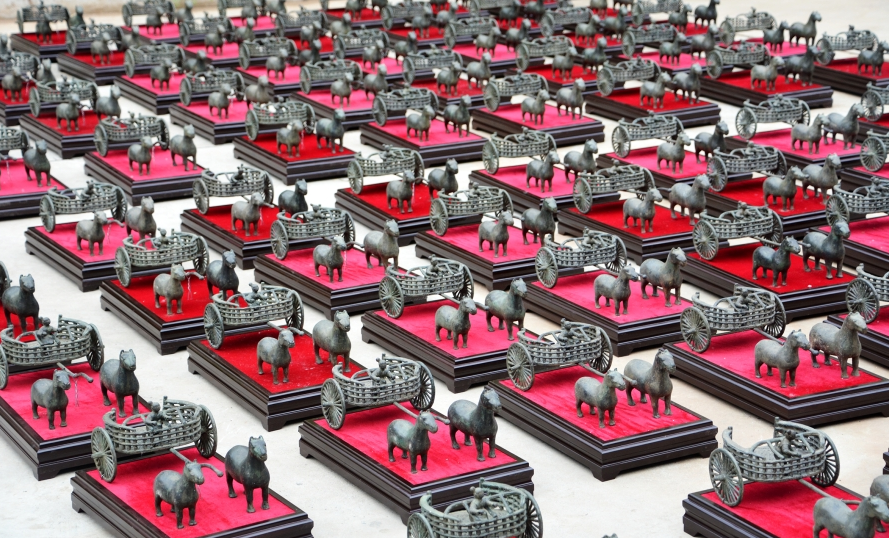
Because casting a large vessel involves the traditional lost-wax method, hand chasing, and multi-stage polishing, a factory with dedicated bronze-casting masters and finishing artisans is better positioned to hold tolerance across a full production run than a workshop that only handles small decorative items. A facility with ISO 9001 quality management certification and pre-shipment inspection procedures also reduces the risk of receiving a batch with inconsistent patina color, which is one of the more common complaints among buyers who source large custom bronze orders internationally.
Teams unfamiliar with how museum replicas are typically commissioned may find it helpful to browse examples of chinese bronze sculpture production, or to review the process for how to customize a bronze sculpture from initial brief to finished piece.
Prototype Review Before Bulk Commitment
Regardless of scale, a single approved prototype should precede any bulk order. This step lets the exhibit planning team physically inspect wall thickness, leg stability, relief clarity, and patina color under actual lighting conditions rather than relying on renderings. Casting defects are far easier to correct at the prototype stage than after a full production run has begun, which is why factories offering free replacement for casting defects typically build the prototype-approval step into their standard workflow rather than treating it as an optional add-on.
During prototype review, it is worth measuring the piece against the original reference table again — height, rim dimensions, leg ratio, and wall thickness — to confirm the foundry's interpretation of the brief matches the intended scale band. Small deviations at this stage compound quickly if they are carried into a 20 or 50-unit order.
Finishing and Long-Term Care Considerations
Once casting is approved, chasing and polishing determine how the surface reads under gallery lighting versus daylight. Antique-style patina tends to perform better in low, warm lighting typical of museum settings, while a modern brushed or lacquered finish reads more clearly under bright retail lighting. Buyers should also ask about after-sales support for patina touch-ups, since bronze surfaces exposed to handling or fluctuating humidity may need periodic restoration guidance, particularly for pieces placed in high-traffic public areas.
For planners researching the broader historical context of large bronze vessels before finalizing a design brief, background material such as the evolution of bronze culture over 2000 years provides useful framing for why certain proportions and motifs were standardized in ancient casting practice, which in turn explains why accurate scaling matters for a faithful reproduction.
Summary Checklist for Specification Teams
- Confirm four reference dimensions from the original vessel, not just overall height
- Select a scale band appropriate to placement context and floor space
- Adjust wall thickness and leg proportion non-linearly as scale decreases
- Specify alloy composition and patina finish explicitly in the brief
- Approve a single prototype before committing to bulk casting
- Plan export-compliant packaging around leg and rim vulnerability
Following this sequence gives exhibit planners a defensible specification document before design development starts, reducing the back-and-forth that typically occurs when scale decisions are made informally. A well-specified Simuwu Ding replica brief protects both the visual authenticity of the piece and the production timeline once casting begins. Teams looking for further reference on related vessel types can also review chinese bronze antique collections to compare proportion conventions across different ding and zun forms before finalizing their own specification.