How to Read a Western Han Goose-Fish Bronze Lamp's Details
How to Read the Painted Details of a Western Han Goose-Fish Bronze Lamp
Collectors, museum educators, and décor buyers researching Han dynasty lighting fixtures often encounter one recurring form: a bronze lamp shaped like a goose holding a fish in its beak, its body doubling as a smoke-filtering vessel. Recognizing the documented visual cues on this artifact type helps buyers distinguish accurate reproductions from generic "ancient style" castings. This guide walks through the surface details worth studying before you commission or purchase a replica.
The Historical Form Behind the Design
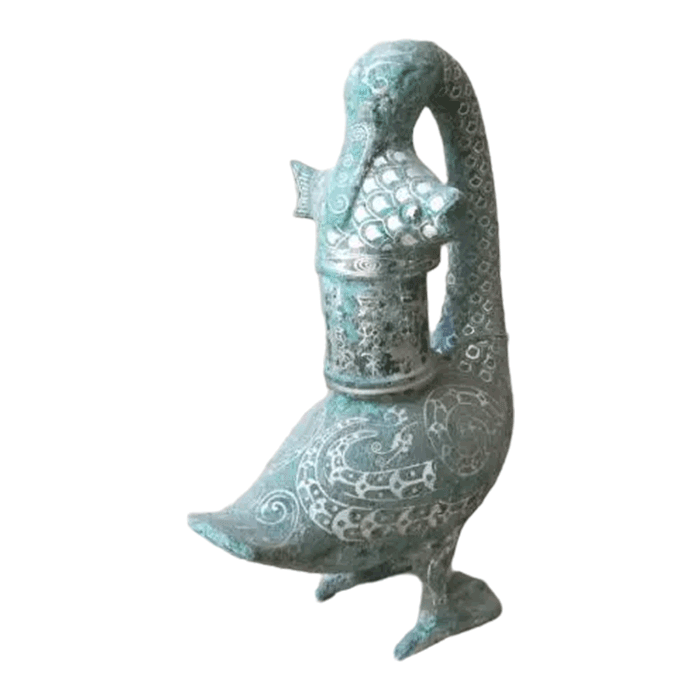
The original object belongs to a broader family of Han dynasty animal-form oil lamps designed with functional smoke management in mind. The goose's neck and the fish held in its beak are not purely decorative — together they form an internal flue that channels lamp soot down into the hollow body, where it dissolves in water rather than staining the room. This engineering detail is one of the clearest markers separating a well-researched casting from a purely ornamental figurine.
For readers who want the broader timeline of Han-era bronze innovation, our overview of the evolution of bronze culture over 2000 years places this lamp form alongside other functional bronzes of the period, including lantern designs discussed in our piece on the Changxin Palace Lantern and Bronze Galloping Horse.
Proportions to Check First
Before examining surface finishing, check the overall stance: the goose's neck should curve in a gentle S-shape rather than a sharp angle, and the fish should appear naturally gripped rather than glued-on or disproportionately small. These proportional choices reflect the original casting logic and are the first thing an experienced bronze-casting workshop verifies against reference photographs.
Reading the Surface: Patina, Chasing, and Painted Layers
The "painted" appearance associated with this lamp type usually comes from a combination of natural oxidation layering and, in some excavated examples, residual pigment traces on the feathers and scales. When evaluating a reproduction, look for these specific features:
- Feather chasing lines: Fine, overlapping incised strokes across the goose's neck and wings, hand-finished rather than stamped in a single uniform pattern.
- Fish scale texture: Slightly raised, staggered scale rows that catch light differently depending on viewing angle — a sign of hand chasing rather than mold-only casting.
- Patina gradient: A believable reproduction shows uneven color depth, darker in recessed chasing lines and lighter on raised surfaces, mimicking decades of natural oxidation rather than a flat, single-tone wash.
- Base and joint seams: On the original vessel type, the body, neck, and fish were cast or joined with visible but controlled seams; overly smooth, seamless modern castings often signal a simplified low-cost mold rather than a faithful lost-wax reproduction.
Color Matching Challenges
Matching an antique-style patina consistently across multiple units is one of the more difficult aspects of sourcing this lamp form in volume — a buyer ordering ten pieces for a museum gift shop or a hospitality project needs each lamp to carry the same tone family, not ten slightly different shades. This is a common pain point we address directly in production: our patina specialists apply finishing in controlled batches so that antique or modern-look tones stay consistent piece to piece.
How This Lamp Form Is Cast Today
Reproducing the goose-fish lamp accurately requires the same lost-wax casting method used for many classical Chinese bronze vessels. At Luoyang Yichuan Bronze Craft Co., Ltd., each piece begins as a wax model refined by hand before being cast in a premium Cu-Sn bronze alloy, then hand-chased and finished with either an antique or a modern patina depending on the client's project. Our workshop, based in a 3,000-square-meter production facility in Yichuan County, Luoyang, employs more than 30 skilled craftsmen — including dedicated bronze-casting masters and finishing artisans — which allows us to hold consistent detail quality whether we're producing a single museum-grade prototype or a batch order for a hospitality chain.
This same lost-wax process underlies other documented bronze forms we produce, from Chinese bronze sculpture pieces to ritual vessel reproductions. If you're researching how casting techniques evolved across dynasties, our article on the Zenghouyi Chime Bell and Qinshihuang Mausoleum Bronze Chariots and Horses covers related casting achievements from the same broader bronze tradition.
Why Lost-Wax Casting Still Matters for This Form
Because the goose's neck and the fish's body are hollow and interlocking, mold-based casting alone tends to flatten the fine chasing details described above. Lost-wax casting allows each wax prototype to be individually refined by hand before the bronze pour, which is why our workshop maintains this traditional approach for pieces like the Western Han Goose-Fish Bronze Lamp rather than switching to faster but less detailed production shortcuts.
Sourcing a Reproduction: What to Verify Before Ordering
Whether you're a collector commissioning one museum-quality replica or a décor buyer placing a bulk order for a themed interior project, a few sourcing questions help protect your investment:
- Can the supplier match a reference photo? Ask for a prototype or detailed proofing photos of the feather chasing and fish scale texture before full production.
- What is the minimum order quantity? Custom bronze sculpture work at our facility starts from a single piece, so collectors don't need to commit to a large batch just to obtain one accurate reproduction; bulk orders are quoted separately based on size and design complexity.
- Is there a quality inspection step before shipment? Every order passes inspection before it leaves our facility, with free replacement offered for casting defects, so buyers aren't left absorbing the cost of a flawed piece.
- How is the piece packaged for export? Fragile cast details like the goose's neck need protective, export-compliant packaging to survive international shipping without damage to the chasing work.
If you'd like to see how the custom process works for a project like this, our page on how to customize a bronze sculpture from sculpmart.com outlines the steps from reference approval to final finishing.
Displaying and Maintaining the Piece
Once a reproduction arrives, display considerations matter as much as sourcing. Avoid placing bronze lamp reproductions in direct sunlight or high-humidity rooms, both of which accelerate uneven patina shifts over time. If the surface finish becomes dull or scratched after years of display, a professional touch-up is usually preferable to home polishing, which can strip the intentional patina layering described earlier in this guide. Our after-sales support includes guidance on patina touch-ups and restoration for pieces we've produced, so buyers aren't left guessing how to maintain the finish years down the line.
For collectors interested in placing this lamp form within a broader décor context — alongside other Han-era inspired pieces — our home bronze decor collection includes complementary vessel and sculpture styles that pair well with animal-form lighting pieces from the same period.
A Note on Provenance Language
When marketing or describing a reproduction of this lamp, it's worth being precise with language: a workshop-made piece should be described as a reproduction or replica, not as an antique. This distinction matters both for export compliance and for maintaining trust with collector clients who rely on accurate provenance descriptions when building a reference collection.
Final Thoughts for Buyers at the Research Stage
Reading the painted and cast details of this lamp type — the feather chasing, the fish scale texture, the patina gradient, and the seam work — gives buyers a practical checklist for evaluating any reproduction before committing to an order. A workshop with ISO 9001 quality management certification, documented casting capacity of over 50,000 bronze art pieces annually, and a flexible minimum order quantity starting at a single custom piece is generally better positioned to deliver an accurate, consistent result than a generic supplier working from a single stock mold.
For readers comparing this lamp form against other documented Han and pre-Han bronze artifacts, our archive of historical bronze articles — including pieces on several bronze mirrors and other functional bronze wares — provides useful reference context for evaluating authenticity markers across different artifact categories.