How to Identify a Western Han Goose-Fish Bronze Lamp
How to Identify a Western Han Goose-Fish Bronze Lamp
For museum curators, cultural-gift buyers, and decor importers researching Han-dynasty lighting artifacts, distinguishing an authentic design from a generic replica requires attention to specific structural, material, and surface details. This guide walks through the defining characteristics that experts and serious collectors use to evaluate this category of bronze lamp, and explains what to look for when sourcing a reproduction crafted to museum standards.
Historical Background of the Goose-and-Fish Lamp Form
Bronze lamps shaped as a goose holding a fish in its beak emerged during the Western Han period (206 BCE–9 CE), a time when bronze casting had matured into a highly sophisticated craft serving both ritual and domestic purposes. Unlike ceremonial vessels such as ding tripods or zun wine containers, these lamps were designed as functional lighting devices for elite households, and their zoomorphic form reflected a broader Han aesthetic that blended naturalism with symbolic meaning. The goose was associated with seasonal migration and fidelity, while the fish represented abundance — together forming a motif thought to bring good fortune to its owner.
Archaeological excavations from Han tombs in Shanxi and Henan provinces have unearthed several examples of this lamp type, most notably specimens now housed in major Chinese museums. Readers interested in the broader trajectory of bronze artistry across dynasties may find useful context in this overview of the evolution of bronze culture over 2000 years, which traces how functional and ceremonial bronze forms evolved side by side.
Defining Structural Features of the Design
Identification begins with the overall silhouette. Genuine examples of this lamp type share a consistent set of structural elements that reproductions must replicate precisely to be considered accurate.
The Goose Body and Fish Detail
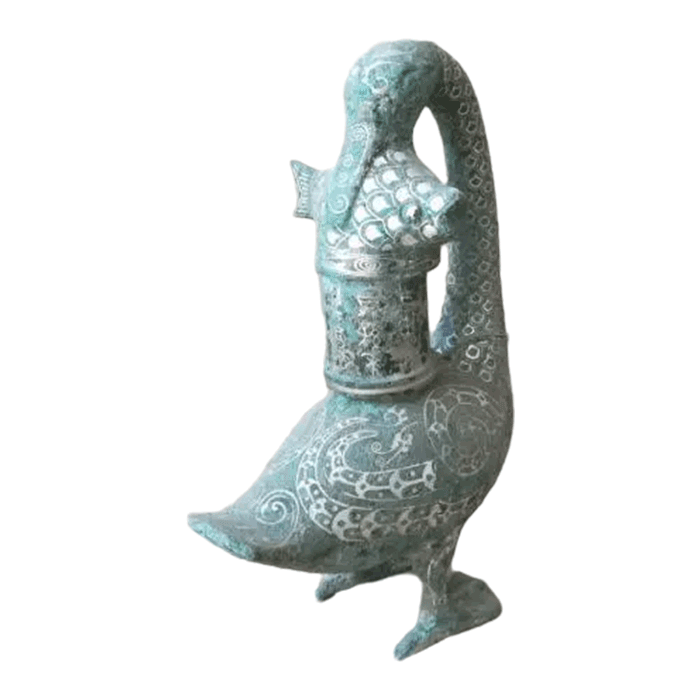
The goose stands on webbed feet with its neck curved gracefully backward, holding a fish in its beak. The fish's body typically forms the lamp's shade or reflector, connected to the goose's head through a hinge or socket that allows the shade to rotate — a functional detail that also served to direct light and reduce glare. The proportions matter: authentic Han-period casting shows a naturalistic curve in the neck rather than an exaggerated or stylized bend, and the feathers are rendered with fine incised lines rather than deep, cartoonish grooves.
The Smoke-Filtering Mechanism
One of the most technically significant features of the Western Han Goose-Fish Bronze Lamp is its internal smoke channel. The goose's body is hollow and connects to the fish-shaped shade, allowing lamp smoke to travel upward through the neck and be filtered before dispersing — an early example of functional environmental design in ancient metalwork. When evaluating a piece, check whether this hollow chamber is present and whether the shade can still pivot; static, solid-cast replicas that only mimic the outer form without this functional cavity are a strong indicator of a purely decorative reproduction rather than a historically faithful one.
Materials, Casting Technique, and Patina Clues
Authentic period bronzes were cast using a copper-tin (Cu-Sn) alloy, and this composition directly affects both weight and surface aging. A well-made reproduction should use the same premium bronze alloy rather than lightweight zinc or brass substitutes, since alloy composition influences how the patina develops over time and how the piece resists corrosion.
Traditional lost-wax casting — the same method used to produce the original Han-period lamps — leaves subtle surface characteristics that sand-casting cannot fully replicate: slightly uneven wall thickness, fine surface texture from the wax model, and crisp definition in small details like feather lines or facial features. Reproductions cast with modern industrial molds often show overly uniform surfaces or soft, blurred detailing in these areas.
Patina is another key identifier. Genuine excavated bronzes typically display a mineralized, malachite-green or earth-toned patina formed through centuries of burial, with color variation across the surface rather than a flat, uniform tone. Reproductions intended for display or gifting purposes usually replicate this look through hand-applied chemical patination, and the quality of that process varies significantly between workshops. A well-executed antique-style finish should show believable depth and shading around raised details such as the feathers, beak, and feet, rather than a single flat color sprayed evenly across the surface.
Distinguishing Authentic Antiques from Decorative Reproductions
Museum buyers and decor importers rarely encounter true archaeological pieces on the open market, since most excavated examples are protected cultural relics housed in institutional collections. What is available for purchase and display are high-fidelity reproductions, and quality varies widely across suppliers. A few practical checkpoints help separate well-made reproductions from mass-produced novelty items:
- Weight and density: A genuine bronze alloy casting feels noticeably heavier than a plated or resin-composite piece of the same size.
- Joint construction: The shade should attach to the goose's beak through a functioning hinge or socket, not a fixed, glued connection.
- Surface consistency: Hand-chased detailing should show natural variation; perfectly symmetrical, machine-stamped feather patterns suggest a lower-grade cast.
- Patina depth: Look for layered coloring rather than a single uniform tone, especially in recessed areas.
- Base stability: The webbed feet and base should provide a solid, balanced stance, reflecting the structural engineering of the original design.
Buyers researching related Han and pre-Han bronze forms for comparison may also find it useful to review characteristics of ritual vessels from the same broader tradition, such as the pieces discussed in this summary of introduction to several bronze wares, which outlines how vessel form and function evolved across the Bronze Age into the Han period.
Sourcing a Museum-Quality Reproduction
For institutions and importers who want to display or gift a faithful rendition of this lamp form, sourcing from a workshop with genuine casting expertise matters more than surface appearance alone. Luoyang Yichuan Bronze Craft Co., Ltd. produces bronze reproductions using the traditional lost-wax method with Cu-Sn bronze alloy, supported by hand chasing, polishing, and patina finishing in either antique or modern styles. Each piece undergoes quality inspection before shipment, and the company's ISO 9001 quality management certification reflects a documented process for consistency across production runs, whether the order is a single custom prototype or a larger batch for retail distribution.
Because reproductions of this lamp type require precise replication of the internal smoke channel and rotating shade mechanism, working with a workshop experienced in complex hollow-cast forms reduces the risk of receiving a piece that looks correct externally but lacks the functional accuracy that curators and informed collectors expect. Buyers evaluating suppliers for this category can review examples of related craftsmanship among chinese bronze sculpture offerings, which illustrate the range of finishing techniques applied across different bronze artifact reproductions.
Custom color matching for patina is also worth discussing directly with a supplier before ordering, particularly for institutional buyers who need a reproduction to align visually with an existing collection or reference photograph. Workshops that offer customize a bronze sculpture services can typically adjust alloy ratio, surface texture, and patina tone to match specific documentation or excavation photographs, which is especially valuable when the goal is historical accuracy rather than a generic decorative piece.
Practical Checklist Before Purchase
Before finalizing an order, buyers should request the following from any supplier claiming to produce an accurate reproduction:
- Confirmation of alloy composition (Cu-Sn bronze rather than brass or zinc alloy).
- Photographic or video evidence that the shade rotates and the neck cavity is hollow.
- Sample images of the patina finish under natural light, showing tonal variation.
- Documentation of quality inspection procedures prior to shipment.
- Clarity on packaging methods for export, given the fragility of thin-walled cast components like the fish shade.
Buyers who want a broader sense of how ancient bronze forms are typically documented and cataloged for reference purposes may also find value in reviewing accounts of related archaeological finds, such as the Changxin Palace Lantern and Bronze Galloping Horse, another well-known Han-period bronze artifact that shares some functional design logic with the goose-and-fish lamp form.
Conclusion
Recognizing a well-made reproduction of the Western Han Goose-Fish Bronze Lamp comes down to verifying structural authenticity — the hollow smoke channel, rotating fish shade, and naturalistic proportions — alongside material quality and patina craftsmanship. For museum buyers, cultural-gift curators, and decor importers, working with a workshop that understands both the historical reference and the technical casting demands of this design ensures the final piece meets both aesthetic and functional expectations for institutional or retail display.