How Western Han Goose-Fish Bronze Lamps Adjust Light
The Western Han Goose-Fish Bronze Lamp Reveals How Ancient Engineers Controlled Light and Smoke
Long before electric dimmers or adjustable LED fixtures existed, artisans of the Western Han Dynasty (206 BCE–9 CE) had already solved a surprisingly modern problem: how to control the brightness and cleanliness of an open flame indoors. The answer took the shape of a bronze lamp cast as a goose holding a fish in its beak — a design so mechanically clever that museum curators and replica collectors still study its construction today. Understanding how this lamp actually adjusts light helps buyers evaluate the historical accuracy of any reproduction before adding one to a collection or exhibit.
The Original Design and Its Purpose
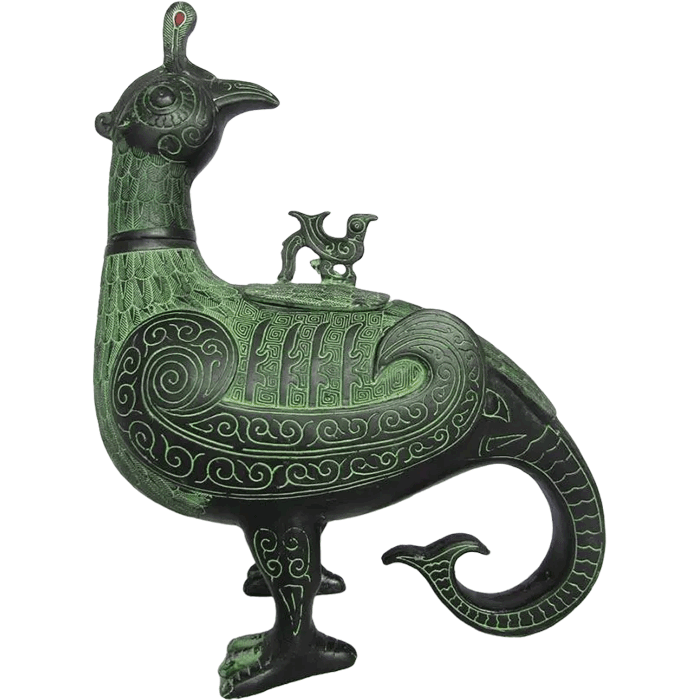
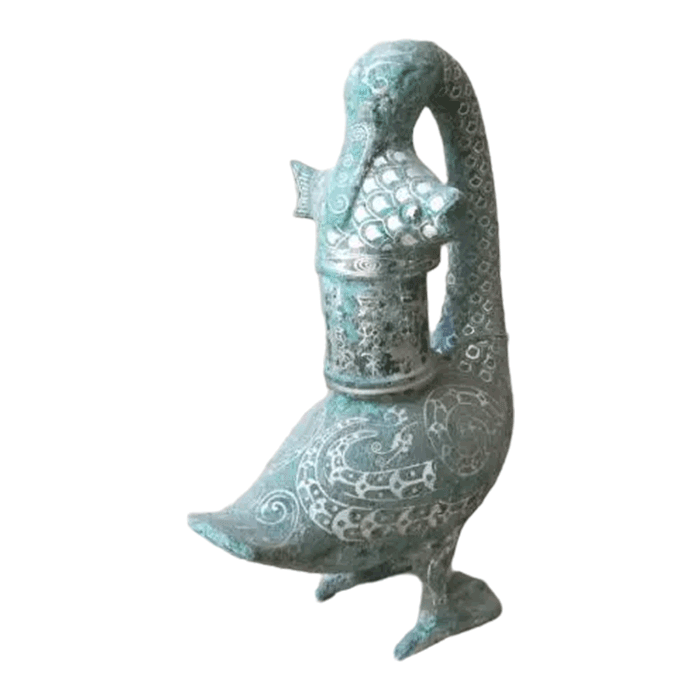
The lamp typically depicts a standing goose with its neck curved gracefully backward, holding a fish in its beak. The fish's body forms a hollow chamber that connects to the goose's neck and body, which are also hollow. This is not decorative flourish — it is the mechanism that made the lamp far more advanced than a simple oil dish on a stand.
When oil or fat was burned in the lamp's shallow dish, smoke rose upward. Instead of drifting freely into a room and blackening walls or irritating occupants, the smoke was channeled through the fish's mouth into the hollow neck and body of the goose. Water placed inside the goose's body chamber dissolved the soot particles, trapping much of the pollution before it could escape. This was an early form of indoor air filtration, built entirely from cast bronze components with no moving mechanical parts beyond removable panels for cleaning.
How the Western Han Goose-Fish Bronze Lamp Adjusts Light
Light adjustment on these lamps was achieved through a rotating shade system rather than any flame-control valve. The lamp's shade — often shaped as a curved bronze plate or a pair of sliding fan-like panels — could be rotated around the flame's housing. By turning the shade, a user could redirect where the light was cast, widen or narrow the visible flame opening, and reduce glare directed at a specific angle.
In some surviving examples and their scholarly reconstructions, the shade consists of two overlapping curved plates that slide along a circular track. Sliding one plate over the other narrows the exposed flame area, dimming the light and further limiting smoke escape. Opening the plates increases the visible flame surface, brightening the room. This sliding-shutter approach means the lamp offers layered control: rotation for direction, sliding plates for intensity, and the water chamber for smoke purification — three separate functions integrated into one cast bronze object.
It is worth noting that the lamp does not adjust the flame itself, such as by raising or lowering a wick. Instead, it manages how much of that flame is visible and how the resulting smoke is processed. This distinction matters for collectors evaluating reproductions, since an accurate replica should reproduce the sliding-shade geometry and the hollow smoke-channeling body, not just the external goose-and-fish silhouette.

Casting Techniques Behind the Original and Its Replicas
Reproducing this lamp accurately requires the same lost-wax casting discipline used on the original bronze vessels of the Han period. At Luoyang Yichuan Bronze Craft Co., Ltd., every custom piece — including replicas of historically documented lamps like this one — is cast in premium bronze alloy (Cu-Sn) using the traditional lost-wax method, then finished through hand chasing and polishing to recover fine surface details such as feather texture on the goose's body or scale patterns on the fish.
The hollow internal chambers required for smoke channeling present a particular casting challenge, since the wax core must be shaped precisely to leave clear, connected air passages between the fish's mouth, the goose's neck, and the body cavity. Craftsmen experienced in casting other hollow bronze forms, such as chinese bronze handicrafts and ceremonial vessels, apply similar core-and-mold techniques to keep these internal passages functional rather than purely decorative.
Patina finishing is the final step that determines whether a replica reads as museum-accurate or simply new. Antique-style patina finishing replicates the greenish-brown oxidation layers found on excavated Han bronzes, while a modern finish preserves a brighter bronze tone for decorative interiors. Both options are available depending on whether a buyer wants a piece for historical display or contemporary home decor.
Why This Design Still Matters to Replica Buyers
Museum-interested collectors and replica buyers often ask why a nearly 2,000-year-old lamp design deserves this level of engineering attention. The answer lies in what it reveals about Han-era metallurgy and environmental awareness — a civilization solving indoor air quality problems with pure mechanical ingenuity, long before the concept had a name. This context is part of a much longer story of Chinese metalworking innovation, discussed further in the evolution of bronze culture over 2000 years.
The Goose-Fish lamp is often compared to another famous Han-period lighting artifact, the Changxin Palace Lantern, which uses a similar smoke-channeling principle through a different sculptural form. Readers curious about that comparison can review the detailed breakdown in changxin palace lantern and bronze galloping horse, which outlines how Han artisans approached similar engineering problems across different lamp designs.
For collectors sourcing a reproduction, accuracy is not just about the exterior silhouette. A properly cast replica should replicate the internal smoke pathway, the sliding shade mechanism, and a patina finish appropriate to the display context — whether that's a museum-style exhibit or a private study. Buyers evaluating vendors should ask specifically whether the hollow chambers are functional or purely cosmetic, since this single detail separates a decorative statue from a historically faithful reproduction.
Sourcing an Accurate Reproduction
Because this lamp's value lies in mechanical fidelity as much as visual likeness, sourcing decisions should account for the foundry's casting capability, quality controls, and finishing options. Luoyang Yichuan Bronze Craft Co., Ltd. operates under an ISO 9001 quality management system, with products meeting export quality inspection standards for art crafts — a relevant assurance for institutions or collectors importing reproductions internationally.
The company's production facility in Yichuan County, Luoyang, Henan Province spans 3,000 square meters and employs more than 30 skilled craftsmen, including bronze-casting masters and finishing artisans capable of executing the fine hand chasing this lamp's feather and scale details require. With an annual output exceeding 50,000 bronze art pieces, the foundry supports both single custom prototypes — useful for museum consultation pieces or one-off commissions — and larger production runs for retail or gift markets, with MOQ starting from just one piece for custom sculptures.
Every order undergoes quality inspection before shipment, and casting defects are covered by free replacement, which matters when working with a design that depends on precise internal geometry rather than surface appearance alone. After-sales support also extends to patina touch-ups and restoration guidance, useful for buyers maintaining a piece over years of display. Readers interested in the technical range of what's possible can review options for a customize a bronze sculpture from sculpmart.com before finalizing specifications for a Goose-Fish lamp reproduction or a related Han-era lighting piece.
Comparing the Lamp to Other Han Bronze Vessel Types
The Goose-Fish lamp did not exist in isolation. It belongs to a broader family of functional Han bronze objects — vessels, mirrors, and incense burners — that combined ritual or practical use with sculptural artistry. Buyers researching this lamp often expand their interest to related categories, such as ding, zun, and hu vessels, or bronze mirrors used for both reflection and ceremonial display. A closer look at these related forms is available through the collection of several bronze mirrors, which shows how Han artisans applied similar casting precision to entirely different functional objects.
This broader context is useful when evaluating a foundry's overall capability. A workshop that can accurately reproduce the internal smoke channels of a Goose-Fish lamp should also demonstrate competence across other complex forms, including chinese bronze antique pieces and animal-form sculptures that require similarly hollow or articulated casting work.
Final Considerations for Museum and Collector Buyers
The Western Han Goose-Fish Bronze Lamp is a rare example of ancient functional design that still impresses engineers and historians alike. Its light adjustment system — a rotating, sliding shade paired with a water-filled smoke chamber — represents a level of thoughtful problem-solving that any faithful reproduction should honor in both form and function. For collectors and institutions evaluating a replica, the key questions remain the same: does the hollow body actually channel smoke, does the shade genuinely slide to adjust brightness, and does the finishing reflect an accurate historical patina or a clearly modern presentation. Foundries with documented quality certifications, transparent production capacity, and after-sales restoration support are generally better positioned to answer these questions with confidence rather than assumption.