How Does a Bronze Jue Heat Wine in Ritual Use?
How Does a Bronze Jue Heat Wine in Ritual Use?
Among the many vessel types that emerged from China's early Bronze Age, few carry as much ceremonial weight as the tripod wine cup known for its distinctive spout and tall legs. This vessel occupied a central role at ancestral offerings and court banquets during the Shang and Zhou dynasties, and its design reveals a surprisingly practical function: heating wine over direct flame before it was poured for ritual consumption. Understanding this mechanism gives museum-shop buyers, cultural retailers, and collectors valuable context when evaluating replica assortments for their collections.
The Structural Design That Enables Heating
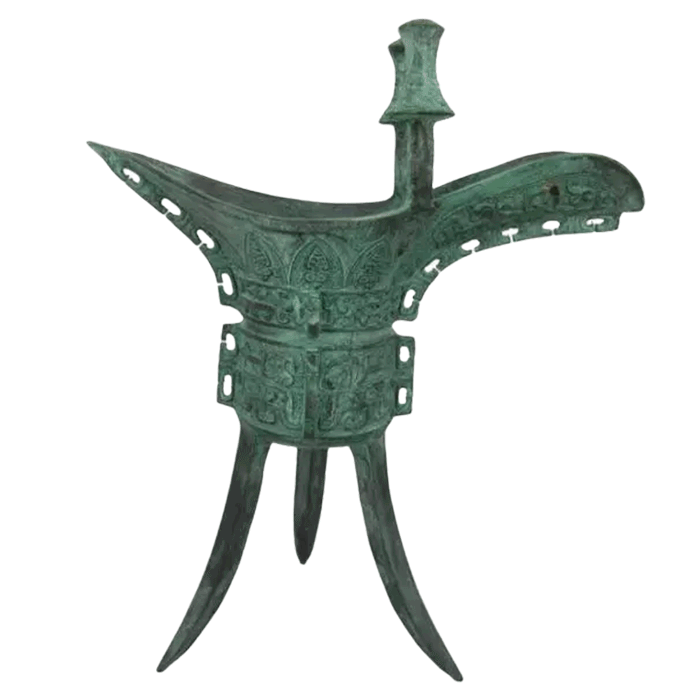
A traditional bronze wine vessel of this type is instantly recognizable by three tall, splayed legs, a deep rounded body, and two small mushroom-shaped posts rising near the rim. Unlike flat-bottomed drinking vessels, this shape was engineered with fire in mind. The elevated legs create space beneath the body, allowing hot coals or an open flame to be placed directly underneath the cup. The narrow waist and wide belly concentrate heat efficiently, warming the wine faster than a flat container ever could.
The long pouring spout on one side and the tail-like extension opposite it were not purely decorative. They balanced the vessel visually while also serving a functional role: once the wine had been warmed, the spout allowed controlled pouring during the ceremony without spilling the heated liquid on the officiant's hands. This combination of thermal engineering and ritual practicality is part of what makes this vessel form so significant to scholars studying the evolution of bronze culture over 2000 years.
Why Warm Wine Mattered in Ancient Ritual
In Shang and early Zhou ceremonial practice, wine was not simply a beverage — it was a medium of communication with ancestors and deities. Warming the wine was believed to release its aroma and potency more fully, making the offering more suitable for spiritual transmission. Cold wine was considered inappropriate for solemn rites, so heating became an essential preparatory step, performed by attendants who placed the vessel over a small brazier before the presiding nobleman or priest conducted the pouring ritual.
The Two Posts: A Functional Mystery Still Debated
One of the most discussed features of this vessel is the pair of small capped posts positioned near the rim. Several theories exist among bronze scholars:
- Heat protection theory: The posts may have prevented the user's fingers or a cloth from slipping too close to the scalding rim while lifting the heated vessel.
- Strainer support theory: Some researchers suggest the posts held a small cloth or filter in place to strain out sediment from fermented wine before pouring.
- Ceremonial marker theory: Others argue the posts simply denoted rank or ritual status, since more ornate examples appear in higher-status burials.
Regardless of the exact original purpose, the presence of these posts remains a defining identification feature, and reproducing them accurately is a mark of quality in any faithful replica.
From Ritual Vessel to Museum Reproduction
Today, cultural retailers and private collectors seek accurate reproductions of this vessel not to heat wine, but to preserve and display a tangible piece of early Chinese metallurgical achievement. Producing a convincing replica requires more than casting a similar silhouette — it demands attention to alloy composition, surface texture, and the subtle asymmetries found in hand-cast originals.
Casting Method and Material Accuracy
At Luoyang Yichuan Bronze Craft Co., Ltd., reproductions of ancient wine vessels are produced using the traditional lost-wax casting method with a premium copper-tin bronze alloy, closely matching the metal composition used in antiquity. This process allows fine surface details — including the taotie motifs, ring handles, and leg contours typical of Shang and Zhou vessels — to be captured with precision that stamped or molded alternatives cannot achieve. Our workshop, based in Yichuan County, Luoyang, Henan Province, is part of a region with over 3,000 years of continuous bronze-working heritage, giving our craftsmen an intuitive understanding of proportion and form that generic manufacturers often lack.
Patina Matching for Authentic Presentation
Buyers sourcing for museum shops or antique-style retail collections often require patina finishes that closely resemble excavated originals — deep malachite greens, earthy browns, or mottled oxidation patterns. Our finishing artisans apply hand chasing, polishing, and controlled patina treatments to achieve either an antique museum-replica look or a cleaner modern presentation, depending on the buyer's target market. Consistent patina color matching across a bulk order is one of the more difficult technical challenges in bronze reproduction, and it is addressed through standardized chemical treatment recipes and quality checks at each production stage.
Sourcing Considerations for Buyers and Collectors
For buyers in the early research stage of selecting a replica vessel assortment, several practical factors deserve attention before placing an order.
Order Flexibility
Because collectors and small retailers often want to test a design before committing to volume, we support custom orders starting from a single piece, with bulk production available once size and design complexity have been confirmed. This flexibility allows a museum shop to trial one prototype vessel alongside other pieces from our chinese bronze sculpture collection before scaling up.
Quality Assurance and Export Readiness
Every reproduction produced in our 3,000-square-meter facility passes internal quality inspection before shipment. Our operations follow an ISO 9001 quality management system, and finished pieces comply with export inspection standards required for art and craft goods. Fragile cast items, including tripod vessels with slender legs, are packaged using export-compliant protective materials designed to withstand international shipping conditions. In the rare event of a casting defect, we provide free replacement, along with after-sales guidance for patina touch-ups should a piece need restoration after years of display.
Comparing Vessel Types for Your Collection
This heating vessel is only one form within a much broader family of ancient bronze wine and ritual containers. Buyers building a themed collection often pair it with other classic forms such as ding tripods, zun wine containers, and hu vases, each representing different aspects of ancestral offering practices. Exploring our full range of bronze statues with different themes and ritual vessel reproductions can help retailers curate a more historically coherent product line rather than offering a single isolated piece.
| Feature | Historical Function | Replica Consideration |
|---|---|---|
| Tripod legs | Elevate vessel over flame for heating | Must support weight without warping during casting |
| Pouring spout | Controlled pouring after heating | Requires precise mold detail to avoid drips |
| Rim posts | Possible heat guard or strainer support | Fine casting needed to preserve mushroom-cap shape |
| Surface motifs | Symbolic and ritual identification | Hand chasing preserves motif sharpness |
Why This Vessel Remains Relevant to Modern Collections
The practice of warming ceremonial wine may belong to a distant era, but the object itself continues to fascinate collectors, historians, and retailers who want to share a piece of early Chinese civilization with their customers. A well-cast reproduction does more than decorate a shelf — it tells the story of ritual, craftsmanship, and social hierarchy in ancient China. For buyers who want to go deeper into related historical vessels and their ceremonial roles, our archive on introduction to several bronze wares offers further background useful for product descriptions and customer education.
Whether you are curating a museum gift shop, sourcing for an antique-style retail line, or building a private collection, understanding how this vessel functioned in its original ritual context adds depth to how you present it. A single well-documented reproduction can serve as a conversation piece, while a coordinated set spanning multiple vessel forms can anchor an entire bronze-themed collection. For buyers ready to move from research into sourcing, our team can help you customize a bronze sculpture or vessel reproduction suited to your specific display and budget needs.
Final Thoughts for Early-Stage Buyers
Researching how a ceremonial wine vessel actually functioned — rather than simply its appearance — equips buyers to make more informed sourcing decisions. The heating function of a bronze Jue explains its unusual proportions, its tripod stance, and the enduring fascination it holds for collectors of ancient Chinese metalwork. As you continue evaluating suppliers, look for workshops that combine traditional lost-wax casting, verified quality inspection, and flexible order volumes, since these factors directly affect both the historical accuracy and the commercial viability of the pieces you eventually bring to market.