Houmuwu Ding Bronze Reproduction: A Guide to Scaling
Crafting a Monumental Houmuwu Ding Bronze Reproduction with Structural Integrity
The Houmuwu Ding, originally known as the Simuwu Ding, stands as a titan of the ancient world—a testament to the incredible metallurgical skill of the Shang Dynasty. As the heaviest piece of ancient bronzeware ever discovered, its imposing form and intricate taotie motifs represent a pinnacle of artistic and technological achievement. For museums, cultural institutions, and corporations, commissioning a replica of this national treasure is a significant undertaking. However, creating a faithful, large-scale version presents engineering challenges that far exceed simple photographic enlargement. The primary concern is structural integrity; without a sophisticated approach, a scaled-up vessel can suffer from weak walls, distortion under its own weight, or catastrophic casting failure.
This article addresses the critical technical considerations for project managers and curators planning to commission a display-scale replica. We will explore how Luoyang Yichuan Bronze Craft Co., Ltd. combines time-honored casting traditions with modern engineering principles to produce a magnificent Houmuwu Ding bronze reproduction that is not only aesthetically precise but also structurally sound for generations of display. From material science to advanced casting logistics, we will detail the methodology required to overcome the physics of scaling and deliver a masterpiece worthy of its legendary inspiration.
The Engineering Challenge of Scaling a Ritual Bronze Vessel
The process of creating a large-scale replica of a historical artifact is governed by a fundamental principle of physics: the square-cube law. This law dictates that as an object's size increases, its surface area increases by the square of the multiplier, while its volume and weight increase by the cube. For example, doubling the height of the Houmuwu Ding would quadruple its surface area but increase its weight by a factor of eight. This exponential increase in mass places immense stress on the structure, particularly on the four supporting legs and the points where the handles join the main body.
A naive approach might suggest simply making the bronze walls proportionally thicker to handle the increased load. However, this strategy is deeply flawed. Drastically thicker walls would add even more weight, driving up material costs and exacerbating the structural stress. Furthermore, casting extremely thick sections of bronze is technically challenging. It can lead to problems like uneven cooling, which creates internal stresses, porosity (gas bubbles trapped within the metal), and shrinkage cracks, all of which compromise the casting's integrity. The original Houmuwu Ding was created using a complex piece-mold casting technique, but our modern, high-fidelity replicas utilize the lost-wax method. While lost-wax casting offers superior detail and surface finish, it requires a different engineering approach to manage the thermal and physical stresses inherent in a monumental project.
From Digital Blueprint to Physical Form
Our process begins not in the foundry, but in the digital realm. To ensure absolute fidelity and preempt structural issues, we start with high-resolution 3D scanning of the original artifact or meticulous modeling based on historical data. This digital blueprint becomes the foundation for all subsequent engineering.
Using Computer-Aided Design (CAD) software, our technicians can precisely scale the model to the client's required dimensions. More importantly, we employ Finite Element Analysis (FEA), a powerful simulation tool that applies virtual forces to the digital model. FEA allows us to visualize how the weight of the massive vessel will be distributed, identifying potential stress concentrations and weak points before a single gram of wax is carved. This data-driven approach allows us to make informed adjustments, such as subtly altering wall thicknesses in non-visible areas or designing internal reinforcements, ensuring the final structure is robust and stable.
A Methodical Approach to Structural Reinforcement and Casting
Successfully producing a large-scale Houmuwu Ding bronze reproduction is a matter of strategic planning and execution. Attempting to cast such a massive and complex object in a single piece via the lost-wax method would be impractical and fraught with risk. Instead, we adopt a sectional casting approach, a technique that ensures quality, precision, and structural soundness.
Casting in Sections for Flawless Execution
The digital model is intelligently divided into manageable sections—for instance, the main rectangular body might be split into four walls and a base, with each of the four legs and two handles cast as separate components. This method offers several key advantages:
- Improved Casting Quality: Smaller, individual sections are easier to manage in the foundry. This allows for better control over the molten bronze pour, more uniform cooling, and a significantly lower risk of casting defects like porosity or incomplete fills.
- Enhanced Detail: Working on smaller sections enables our artisans to achieve a higher level of detail and precision in both the wax model and the final bronze chasing. The intricate patterns of the original can be replicated with greater accuracy.
- Logistical Feasibility: The logistics of creating a ceramic shell, melting the wax, and pouring molten bronze for a multi-ton, single-piece casting are formidable. The sectional approach makes the entire workflow more manageable and safer for our team of over 30 skilled craftsmen.
Once cast, these individual bronze sections are handed over to our master finishing artisans. Using advanced welding techniques, they meticulously assemble the components. The seams are then ground down and "chased"—a process of tooling the metal surface by hand—to perfectly blend the joins. The skill of our artisans ensures that all evidence of the sectional assembly is completely erased, resulting in a final piece that appears as a single, monolithic casting.
The Unseen Strength: Internal Armatures
For truly monumental replicas intended for public or outdoor display, the bronze skin alone may not be sufficient to guarantee long-term stability. In these cases, we engineer a hidden internal support structure, or armature, typically fabricated from high-strength stainless steel. This internal skeleton is designed to bear the primary structural load of the sculpture, allowing the outer bronze casting to serve its aesthetic purpose without being subjected to excessive stress. This composite construction technique is a hallmark of modern large-scale sculpture, providing a combination of authentic appearance and contemporary structural engineering that ensures longevity and safety.
The Critical Role of Material Science and Foundry Expertise
The final quality of any bronze artwork is inextricably linked to the quality of the materials and the expertise of the people who work them. At our 3,000-square-meter production facility in Yichuan County, Luoyang, we maintain exacting standards for both. Our operations are ISO 9001 certified, a reflection of our commitment to a rigorous quality management system that governs every step of the production process.
Premium Bronze Alloy Selection
We cast exclusively with a premium bronze alloy (Cu-Sn), which provides the ideal combination of fluidity for casting intricate details, strength for structural integrity, and excellent corrosion resistance for long-term durability. The specific composition of the alloy is critical. The ratio of copper to tin and the inclusion of other trace elements can be adjusted to optimize tensile strength and hardness, ensuring the material itself is engineered for the demands of a large-scale sculpture. Understanding the subtle difference between bronze and brass and other copper alloys is fundamental to creating a lasting work of art. Our commitment to using high-purity, premium materials ensures that our replicas not only look authentic but also possess the material integrity to endure.
Mastering the Lost-Wax Process at Scale
The traditional lost-wax method is an art form in itself. The process—from creating the initial wax model, to building the multi-layered ceramic shell, to the dramatic moment of the bronze pour—requires years of experience to master. Our team of bronze-casting masters and finishing artisans possesses this deep knowledge. They understand how to manage the unique challenges of large-scale projects, such as calculating the complex gating and venting systems needed to ensure molten bronze reaches every part of the mold, and controlling the kiln temperature to cure the massive ceramic shells without cracking. This hands-on expertise is the crucial human element that technology alone cannot replace.
Ensuring Authenticity and Durability in Finishing and Delivery
The journey from molten metal to a finished masterpiece concludes with the critical stages of finishing and patina application. It is here that the true artistry and historical accuracy of the piece are brought to life. Our process is designed to solve common sourcing pain points for our B2B clients, including the exact replication of antique finishes and ensuring the safe arrival of fragile, high-value artworks.
Patina: The Art and Science of an Ancient Finish
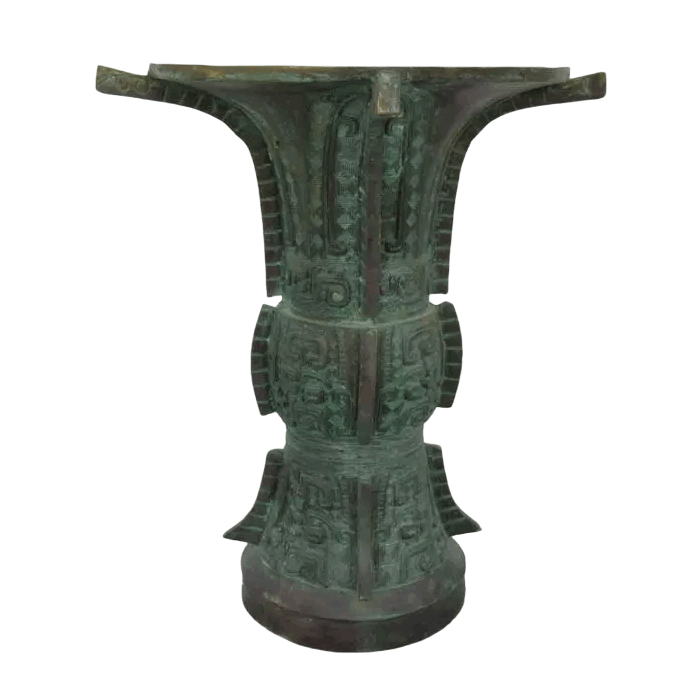
The patina is far more than just the color of the bronze; it is a complex chemical conversion of the surface that provides both an authentic aesthetic and a crucial protective layer against environmental corrosion. Achieving a consistent and historically accurate patina on a large surface is a significant challenge. Our artisans are masters of this craft, using carefully controlled application of various chemical compounds and heat to replicate the rich, layered appearance of ancient excavated bronzes. We specialize in consistent patina color matching, ensuring that whether you order a single prototype or a bulk production run, the finish is uniform and meets your exact specifications. For clients seeking a different aesthetic, we also offer a range of modern and custom patina finishes. This attention to detail is a hallmark of our work on ancient Chinese bronze sculpture.
Quality Assurance and Global Logistics
Before any artwork leaves our facility, it undergoes a rigorous quality inspection to ensure it meets our exacting standards and complies with all export quality inspection requirements for art crafts. We stand by the quality of our work, offering a free replacement for any piece with verifiable casting defects. Furthermore, we have developed specialized, export-compliant protective packaging solutions designed to safeguard even the most fragile and heavy sculptures during international transit. This meticulous approach to logistics mitigates the risk of damage, ensuring your investment arrives safely. Our after-sales support extends to providing guidance on patina touch-ups and long-term restoration, ensuring your replica remains in pristine condition.
In conclusion, creating a monumental Houmuwu Ding bronze reproduction is a complex endeavor that demands a seamless integration of historical reverence, artistic skill, and robust engineering. By leveraging digital analysis, a strategic sectional casting methodology, premium materials, and the irreplaceable expertise of our master craftsmen, we can successfully navigate the challenges of scale. For institutions looking to commission a truly impressive and enduring centerpiece, our proven process ensures the final product is a structurally sound and breathtakingly authentic tribute to one of antiquity's greatest treasures. We invite you to contact our specialists to discuss how we can customize your bronze artwork and bring your project to life.
</body>