Chinese Bronze Wine Vessel Guide: Jue, Zun and Guang
A Chinese Bronze Wine Vessel Guide to the Differences Between Jue, Zun and Guang
Jue, zun, and guang are three important forms within the long tradition of ancient Chinese ritual bronzes. Although all are commonly associated with wine culture, they differ clearly in silhouette, construction, likely use, decorative layout, and collecting appeal. For museum buyers, collectors, cultural-project purchasers, and decor importers, recognizing these distinctions is useful before comparing dynastic styles, inspecting replicas, or commissioning custom bronze artworks.
These vessels developed in periods when bronze objects served ceremonial as well as practical roles. Their shapes were not random: each profile created a different visual presence and reflected a distinct approach to pouring, presenting, heating, or storing fermented beverages. Today, accurate reproductions require more than a general “antique bronze” appearance. Proportions, handles, feet, spouts, lids, surface ornament, and patina all need to work together.
Why Jue, Zun, and Guang Are Often Compared
These three vessel types are frequently discussed together because they appear in studies of early bronze ritual culture and are closely linked with wine-related ceremonies. Yet they should not be treated as interchangeable categories. A jue is generally recognized by its spouted body and tall legs; a zun is typically a more upright vessel with an open mouth; and a guang is known for its covered form, pouring spout, and often elaborate animal-inspired decoration.
The differences matter commercially as well as historically. A compact jue can fit a display case, a scholar’s desk, a boutique interior, or a gift collection. A larger zun can function as a visual centerpiece in a lobby, exhibition space, garden room, or traditional-style hospitality setting. A guang, with its sculptural lid and complex relief, often appeals to buyers seeking a more narrative and visually dramatic object.
When evaluating a Chinese Bronze Wine Vessel for reproduction or decorative sourcing, buyers should first identify the intended vessel type. This decision affects the casting approach, pattern development, polishing access, patina treatment, packaging method, and final cost structure.
The Jue: A Tripod Cup With a Pouring Spout
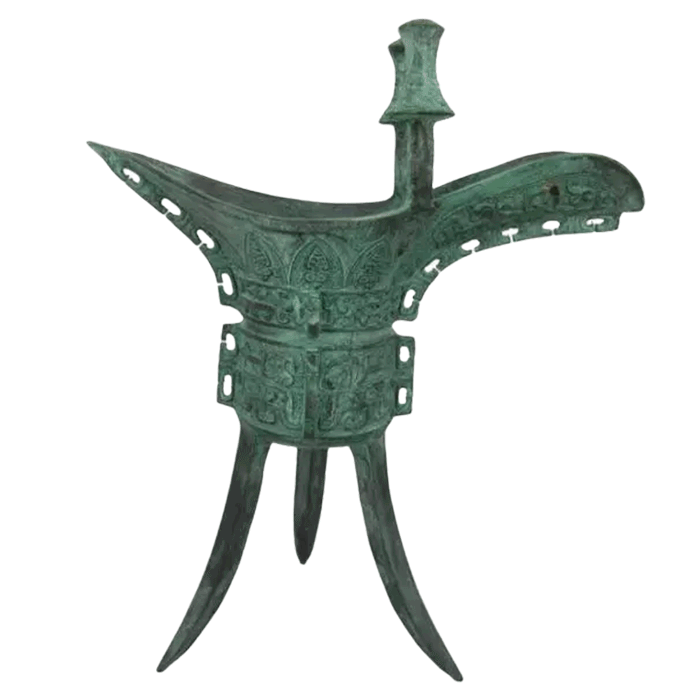
The jue is one of the most immediately recognizable early Chinese bronze forms. Its body is often cup-like, rising from three narrow legs. A projecting spout extends from one side, while the opposite side may feature a pointed tail-like projection. Many examples also include one or two upright posts near the rim. These posts are a signature detail, though their exact original function has been interpreted in different ways by researchers.
Key visual features of a jue
- A relatively small bowl or cup body.
- Three tall legs that create a tripod structure.
- A narrow pouring spout at the front.
- A pointed rear projection opposite the spout.
- One or two upright posts near the upper edge.
- A side handle on many examples.
The narrow, elevated profile gives the jue a refined and energetic appearance. In comparison with broader vessel forms, it has more negative space beneath the body because of its long legs. This can make a jue look lighter and more architectural, even when cast in substantial bronze.
Historically, jue vessels are often associated with the warming and pouring of wine. The tripod legs allowed the vessel to stand over heat, while the spout supported controlled pouring. For contemporary decorative reproductions, this functional background helps explain why the legs and spout should remain proportional. If the legs are too short, the object loses its characteristic elegance. If the spout is too wide or blunt, the profile no longer reads clearly as a jue.
Decoration on a jue is often concentrated around the body. Depending on the chosen reference style, buyers may request taotie-inspired masks, stylized animal motifs, geometric bands, leiwen-style backgrounds, or cleaner modern surfaces. A restrained design can highlight the vessel’s outline, while dense relief can create a stronger archaic character.
For buyers who want to understand how individual vessel categories relate to broader bronze traditions, this overview of several bronze wares provides useful context on the variety of historical forms.
The Zun: An Upright Vessel for Display and Ceremony
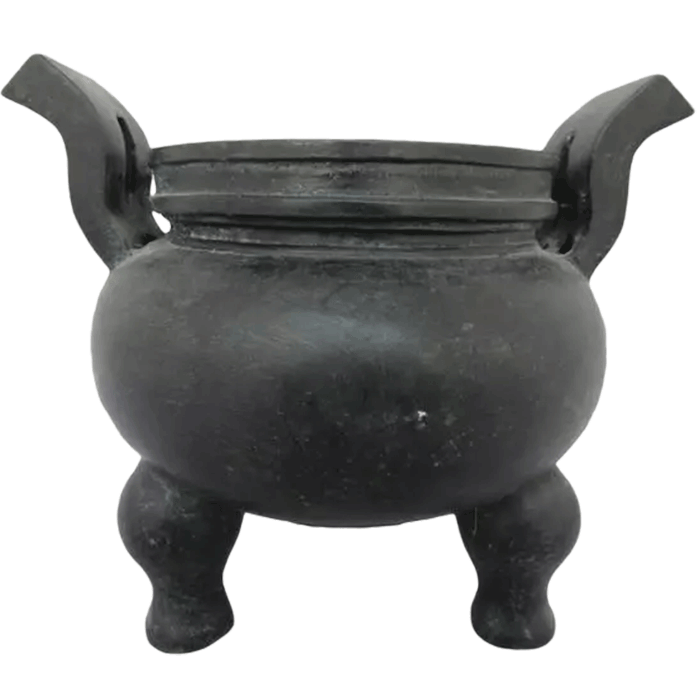
The zun generally differs from the jue through its taller, more vertical body and broader opening. Rather than relying on a long spout and tripod legs, a zun is usually designed around a strong upright silhouette. It may have a flared mouth, rounded shoulder, cylindrical or slightly tapered body, and a stable base. Some historical examples take zoomorphic forms, but the term is commonly associated with a larger ceremonial wine container or presentation vessel.
Key visual features of a zun
- An upright, vase-like or barrel-like profile.
- A broad or flared mouth.
- A body that may be cylindrical, rounded, or gently tapered.
- A stable foot or base rather than three long legs.
- Decorative bands arranged around the neck, shoulder, and body.
- Potential for larger scale than a typical jue.
The zun is especially valuable for interior buyers because its form translates naturally into architectural display environments. A medium or large bronze zun can provide vertical emphasis on a console, plinth, reception counter, or display pedestal. Its generous surface area also gives artisans room to apply more extensive decorative programs, including raised masks, dragons, birds, scrolling motifs, or custom emblems.
From a sourcing perspective, the shape of a zun requires careful attention to wall thickness and balance. A vessel with a large flared mouth can become visually heavy at the top if the body is not proportioned correctly. Conversely, a body that is too thin or too narrow may not support the visual authority expected from this vessel form. In custom projects, a scaled drawing or reference image is helpful for confirming height, mouth diameter, base diameter, and ornament placement before mold work begins.
Collectors also often assess the zun by studying period-specific changes in ornament and outline. Earlier styles can be more compact and richly patterned, while later interpretations may show different proportions or decorative preferences. Buyers researching these visual developments can explore bronze ware characteristics from the Spring and Autumn and Warring States periods.
For modern commercial settings, a zun does not need to be treated only as a strict historical reproduction. It can also be adapted as a decorative vase form, a ceremonial presentation object, or a cultural centerpiece. However, a buyer should clearly specify whether the objective is historical reference, museum-style display, traditional decor, or a contemporary bronze interpretation. The design standard should follow that purpose.
The Guang: A Covered Pouring Vessel With Sculptural Drama
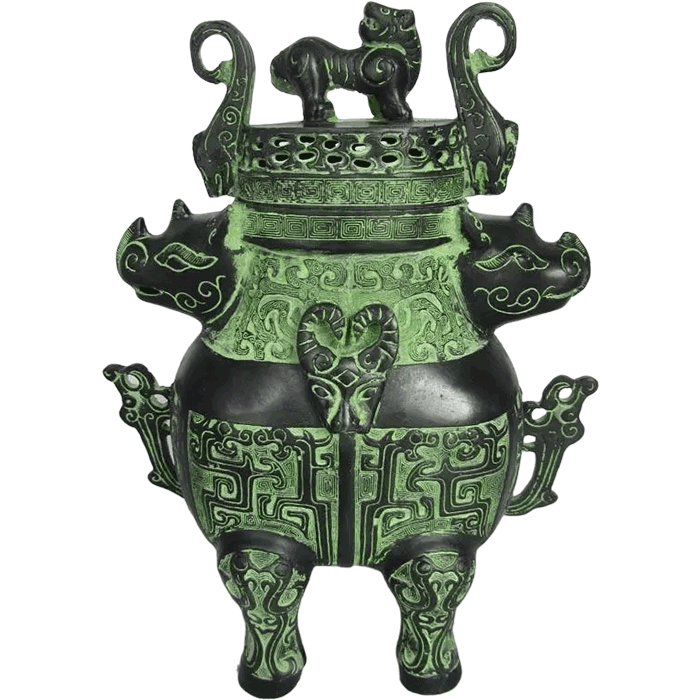
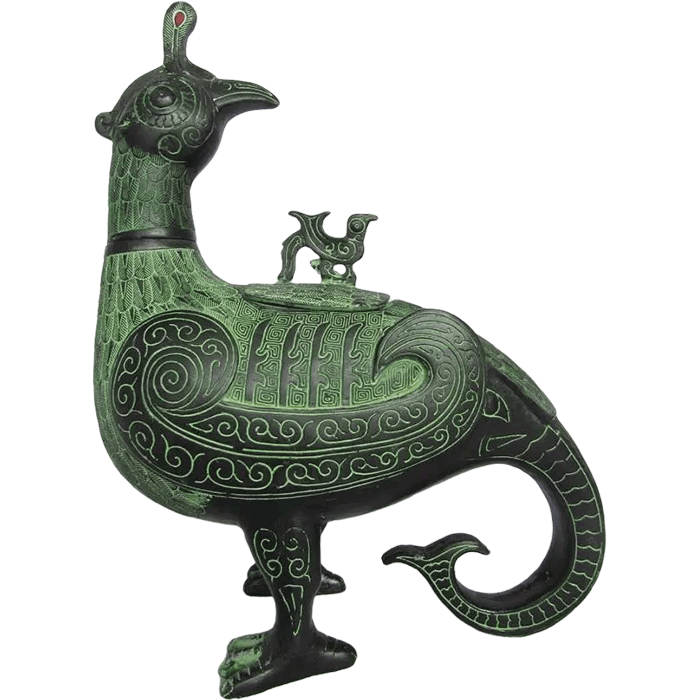
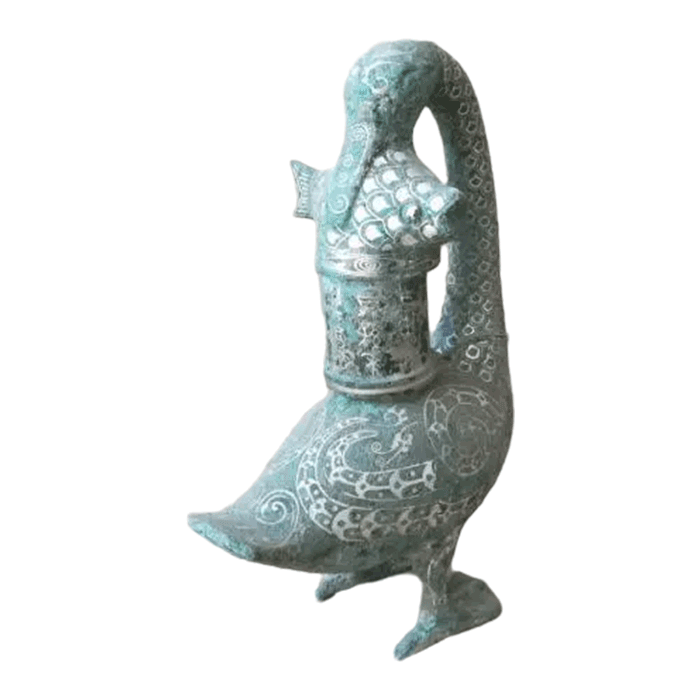
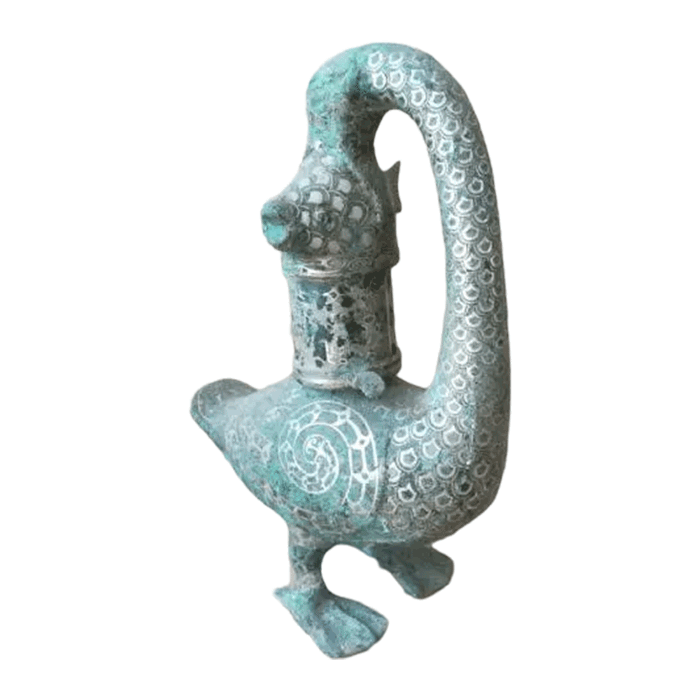
The guang is often the most visually elaborate of the three forms. It is commonly identified by an elongated body, a prominent pouring spout, a handle, and a fitted cover or lid. The lid may rise into an animal head, bird-like shape, or other sculptural feature, while the body can carry layered relief decoration. In many examples, the guang presents a strong directional form: one end is organized around the spout, and the other end may form a handle or animal-shaped terminal.
Key visual features of a guang
- An elongated covered body.
- A distinct pouring spout.
- A fitted lid, often with sculptural ornament.
- A handle at the rear or side.
- Complex relief decoration across multiple surfaces.
- Animal, bird, or mythical motifs in the lid and body design.
The presence of a lid is one of the clearest practical and visual distinctions between a guang and a typical jue or zun. The covered construction creates additional technical requirements for a replica. The lid must align with the vessel opening, sit securely, and maintain a consistent visual gap. If the lid includes raised animals, horns, ears, crests, or other projections, those details must also be protected during packing and transport.
A guang is frequently selected by collectors and decorative buyers who want a bronze object with strong narrative character. From one viewing angle, the spout may dominate; from another, the rear handle and lid sculpture become the focal point. This multi-sided quality makes the guang particularly suitable for freestanding display, where visitors can walk around the object rather than viewing it only from the front.
Its elaborate surface also makes finishing important. Hand chasing can refine cast details after the lost-wax process, while polishing can clarify selected edges and high points. Antique patina treatments can emphasize recessed ornament, whereas a more controlled modern finish can make the sculpture feel cleaner and more contemporary. The selected finish should support the intended design rather than conceal weak modeling or unclear decorative transitions.

A Direct Comparison of Form, Function, and Buying Considerations
| Feature | Jue | Zun | Guang |
|---|---|---|---|
| Overall silhouette | Small tripod cup with spout | Upright vase-like vessel | Elongated covered pouring vessel |
| Base structure | Usually three tall legs | Stable foot or base | Low body with supporting base or feet |
| Pouring element | Prominent front spout | Usually no long spout | Prominent spout beneath or beside lid |
| Cover | Generally open | Generally open | Typically covered |
| Decorative emphasis | Body bands and compact motifs | Neck, shoulder, and body panels | Lid, handle, spout, and full relief composition |
| Display character | Elegant and compact | Formal and monumental | Sculptural and narrative |
| Custom-production focus | Leg alignment and spout proportion | Balance, symmetry, and body scale | Lid fit, relief definition, and fragile projections |
In simple terms, choose a jue when the project requires a concise, tripod-based wine cup form. Choose a zun when the priority is an upright ceremonial vessel with a strong decorative surface. Choose a guang when the buyer wants a covered, sculptural pouring vessel with more complex three-dimensional details.
How to Evaluate Reproductions Before Placing an Order
For early-stage research, buyers should avoid judging a vessel only by color or by a single front-view photograph. A convincing reproduction depends on accurate form, credible ornament, sound casting, and a finish appropriate to the reference period or interior concept. The following review points can help organize a sourcing inquiry.
- Confirm the vessel category. Identify whether the reference is a jue, zun, guang, or another bronze form. Similar-looking objects can have important structural differences.
- Review multiple angles. Ask for front, side, rear, top, and detail views. This is especially important for guang lids, jue spouts, and vessel handles.
- Specify dimensions. Confirm total height, width, length, opening size, and base dimensions. A small change in leg height or mouth width can change the object’s visual balance.
- Define the ornament level. Decide whether the project needs crisp raised motifs, shallow textures, simplified patterns, inscription areas, or a smooth contemporary surface.
- Select the patina direction. Antique brown, dark bronze, green-toned oxidation effects, and modern polished finishes create very different results.
- Plan handling and installation. Determine whether the vessel will be displayed in a case, on a plinth, in a retail environment, or as part of a larger themed installation.
Luoyang Yichuan Bronze Craft Co., Ltd. produces bronze vessels, sculptures, mirrors, incense burners, Buddhist statues, and custom bronze artworks. The company uses premium Cu-Sn bronze alloy and traditional lost-wax casting, with hand chasing, polishing, and patina finishing available according to project requirements. Custom sculpture orders can begin from one piece, while bulk order arrangements can be discussed according to vessel size and design complexity.
For a buyer developing a broader collection rather than a single vessel, it may be useful to combine ritual vessel forms with related decorative categories. For example, Chinese bronze sculpture can complement vessel displays in cultural interiors, exhibition projects, and hospitality spaces.
Patina, Material, and Quality Requirements for Bronze Vessels
Bronze color is not merely a finishing choice. It influences how deeply patterns appear, how clearly the form reads under light, and whether the final object feels antique, ceremonial, rustic, or contemporary. A dark brown patina may suit a traditional interior. A green-toned patina can emphasize age-inspired visual character. A more even dark finish may be appropriate for modern display settings where the outline should remain the main focus.
Buyers should distinguish bronze from brass when reviewing material proposals, because the alloys, color tendencies, and finishing behavior differ. This explanation of bronze and brass differences can help purchasing teams establish clearer material specifications.
Luoyang Yichuan Bronze Craft Co., Ltd. operates under an ISO 9001 quality management system and produces over 50,000 bronze art pieces annually. Its production area in Yichuan County, Luoyang, Henan Province covers 3,000 square meters and includes more than 30 skilled craftsmen, including bronze-casting masters and finishing artisans. Quality inspection is carried out before shipment, and export-compliant protective packaging is available for fragile sculptures and detailed bronze artworks.
For custom vessel orders, buyers can provide a reference photograph, line drawing, dimensions, desired patina, and quantity. Where an antique-inspired object is required, the reference should show as much detail as possible, including the underside, rim, handle attachment, lid interior, decorative bands, and any inscription areas. This information supports more accurate replication planning and reduces uncertainty before production.
Choosing the Right Vessel Form for Your Project
Jue, zun, and guang each communicate a different aspect of bronze culture. The jue is compact, poised, and instantly recognizable through its legs and spout. The zun is upright, balanced, and well suited to larger ceremonial or decorative statements. The guang is covered, directional, and sculpturally expressive.
For museum-oriented research, begin with the form and period reference. For private collections, consider scale, surface detail, and how the object will be displayed. For decor import programs, prioritize consistent dimensions, finish samples, packaging requirements, and order quantities. For custom cultural installations, consider whether a vessel should stand alone or be coordinated with statues, mirrors, incense burners, or other bronze decor elements.
Understanding these distinctions gives buyers a stronger basis for evaluating design accuracy and selecting the right production approach. Whether the goal is a single custom prototype or a bulk decorative program, a well-defined vessel category is the first step toward a successful bronze project.