Chinese Bronze Wine Vessel Forms Identification Guide
Identify a Chinese Bronze Wine Vessel by Its Form Before You Source or Collect
Recognizing ancient-style bronze vessel forms from photographs, catalog listings, or supplier drawings is an important first step for buyers, collectors, museums, designers, and restoration projects. Form can reveal a vessel’s likely traditional category, its intended ritual or banquet-related use, and the details that should be preserved in a reproduction. It can also help a buyer communicate more accurately with a manufacturer when requesting a custom bronze artwork.
Wine-related bronzes from ancient China include a wide range of shapes rather than one single vessel type. Some were designed to heat fermented beverages, some to hold them, some to pour them, and some to drink from them. Their silhouettes may appear similar at first glance, especially in product photographs taken from a single angle. A careful review of the mouth, neck, body, foot, handles, spout, lid, and decorative layout makes identification more reliable.
This guide explains the major visual clues used to distinguish common wine vessel forms. It is intended for initial recognition and sourcing communication, not as a substitute for professional archaeological authentication, provenance research, or laboratory analysis.
Why Form Is the First Clue When Identifying Bronze Vessels
When a vessel is viewed in a product listing, the form is often more immediately useful than decorative pattern alone. Surface motifs can be copied across different categories, while core structural features usually remain associated with a vessel’s traditional purpose. For example, a vessel with a long pouring spout and a handle has a very different functional profile from a deep round basin with tripod legs.
Start by reviewing the overall outline. Ask whether the object is tall or low, open or covered, rounded or angular, and supported by a ring foot or by separate legs. Next, look for attachments. Handles, ears, knobs, spouts, suspension rings, and lids are not merely decorative additions; they are often the strongest indicators of vessel type.
For a sourcing inquiry, photographs should ideally include front, side, top, bottom, and close-up views of the handles and feet. A single frontal image can conceal a rear handle, an angled spout, or the actual depth of the body. Measurements should also be requested, including overall height, mouth diameter, maximum body width, foot diameter, and wall thickness where relevant.
Buyers seeking historical references may review ancient bronze wine vessels to compare broad categories and traditional terminology. For production requirements, form identification should then be translated into clear specifications such as dimensions, alloy expectations, finish direction, pattern placement, and whether the vessel is intended as a display piece, replica, decorative object, or functional non-food-contact artwork.
Chinese Bronze Wine Vessel Forms Commonly Seen in Listings
The following forms are among the most frequently discussed when identifying wine-related Chinese bronzes. Individual historical examples may vary by period, region, workshop tradition, and ceremonial context. Therefore, use these descriptions as practical visual guides rather than fixed rules for every surviving artifact or modern reproduction.
Jue: A Three-Legged Warming and Pouring Form
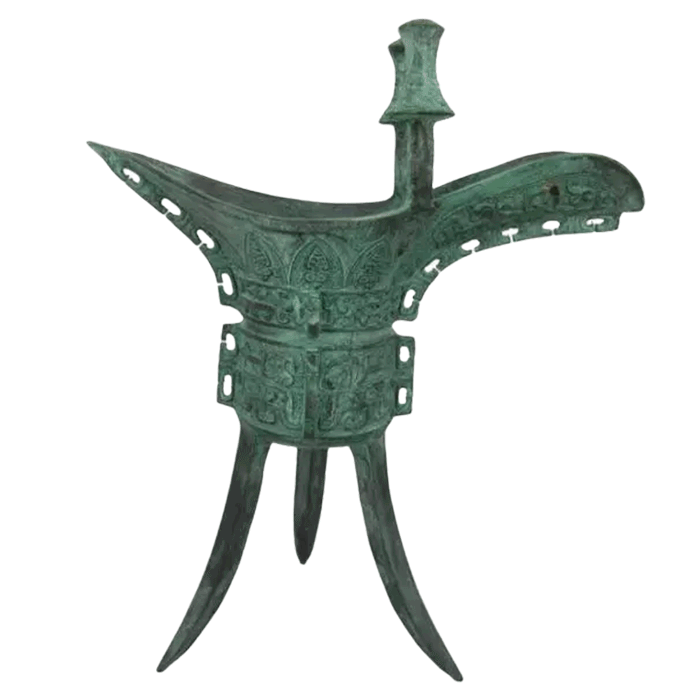
The jue is one of the most recognizable early wine vessel silhouettes. It usually has a deep cup-like body supported by three pointed or tapering legs. The body often includes a long forward spout for pouring and a rear handle for lifting. Two upright posts may rise from the rim, frequently with small caps at the top. These posts are a major visual clue and can make a jue easier to identify even in a low-resolution photograph.
When reviewing a listing, distinguish a jue from a generic tripod cup by confirming the spout, rear handle, and pair of posts. The legs should be individually defined rather than formed as a continuous pedestal. The vessel may carry animal-mask motifs, geometric bands, or relief decoration, but its identity is primarily established by the spouted, three-legged structure.
Jia: A Tall Tripod Vessel with an Open Upper Section
A jia is also a tripod wine vessel and can be confused with a jue because both may have three legs and two upright posts. The key difference is that a jia generally has a taller, more cylindrical body and a broader or more open upper section. It does not normally feature the pronounced pouring spout seen on a jue.
In profile, the jia often looks more vertical and architectural. The body may be divided into an upper bowl-like section and a lower column or expanded base, all supported by three legs. If a catalog image shows a tripod form with two posts but lacks a long spout, jia is a useful form category to consider.
He: A Lidded Vessel with a Spout and Handle
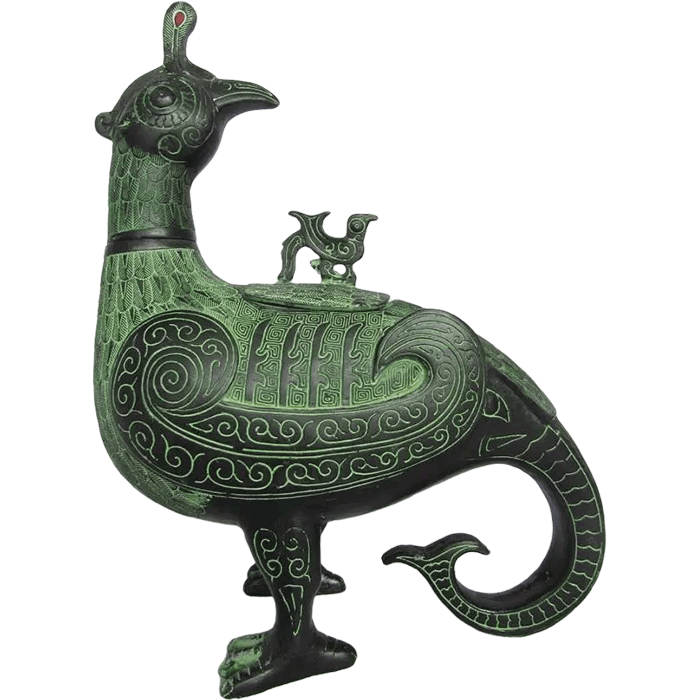
The he is generally identified as a pouring vessel. It often has a rounded, pear-shaped, or compressed body, a fitted lid, a spout, and a handle. Some examples may have animal-head terminals, curved handles, or elaborate sculptural features. The lid and spout are especially important: together they indicate that the vessel was designed to contain and pour liquid while helping protect the contents.
Modern decorative interpretations of the he may simplify the original structure. Before classifying a piece, inspect whether the lid is genuinely separate, whether the spout is open or only decorative, and whether the handle is located opposite the spout. These details affect both visual accuracy and practical manufacturing requirements.
Zun: A Tall Vessel with an Expanding Mouth
The zun is usually a tall vessel with a relatively narrow lower body and a mouth that flares outward. Its profile may be rounded, cylindrical, square, or sculptural depending on the historical style. A classic zun often has a strong vertical presence, making it popular for display, ceremonial-inspired interiors, hotel lobbies, cultural venues, and collector-focused decor.
To identify a zun in photographs, look first for the high body and broad opening. Unlike a hu, which often has a narrower neck and a more enclosed shoulder, the zun commonly emphasizes an open, expanded mouth. Some examples are plain in outline but richly patterned across the body, while others take zoomorphic forms.
For buyers comparing period-inspired designs, the article on several bronze ware forms can provide additional context for the variety of traditional vessel categories.
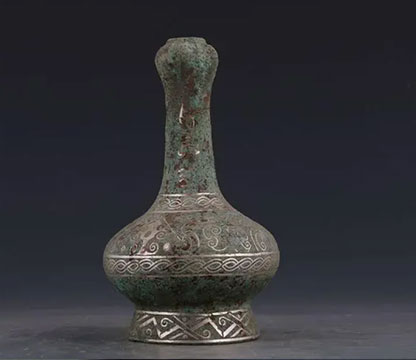
Hu: A Storage Form with a Narrow Neck and Full Body
The hu is a major vessel form recognized by its swollen or rounded body, narrower neck, and stable foot. It may be round, oval, or squared in cross-section. Many hu vessels have ring handles or animal-head attachments at the shoulders. The shape often resembles a formal storage jar or vase, with a contained silhouette rather than the open profile associated with a zun.
When identifying a hu, focus on the transition from shoulder to neck. A hu generally has a clearly defined neck above full shoulders, while its body remains substantial and balanced. If handles are present, they are often placed at the shoulders rather than attached as a single long grip extending from rim to body.
For a custom project, buyers should specify whether the requested hu is round, square, flattened, or elongated. These variations change mold design, casting complexity, weight distribution, and the placement of decorative bands.
You: A Covered Vessel with a Carrying Handle
The you is often distinguished by a lid and a prominent overhead handle. The handle typically rises above the vessel body and may pivot from loops or animal-head fittings on opposite sides. The body can be oval, rounded, or more angular, but the arched carrying handle is the most immediate identifying feature.
In a listing photograph, a you may be mistaken for an incense burner or covered container if the overhead handle is cropped out. Ask for a full-height image before making a classification. The lid should also be examined for its fit, knob, relief pattern, and alignment with the shoulder of the body.
Fangyi: A Rectangular or House-Shaped Covered Form
The fangyi is commonly recognized by its square or rectangular structure. Many examples have a lid that rises in a roof-like or architectural shape, creating a silhouette unlike the rounded profiles of hu and you vessels. Vertical corners, panels, and structured relief bands are important features.
This form may be described loosely as a rectangular ritual vessel in commercial listings. Buyers should check whether the term refers to a truly square-bodied, covered form or is simply being used for any angular bronze container. Clear reference images and measured drawings are especially useful when ordering a historically inspired fangyi reproduction.
Fanghu: A Square Vessel with a Narrow Neck
The fanghu is the square or rectangular counterpart of the hu. It generally has a boxier body, defined corners, a narrower neck, and a stable foot. Shoulder rings, relief panels, and geometric ornament are often used to emphasize its architectural design.
A fanghu should not be confused with a fangyi. The fanghu typically retains the vase-like proportions of a hu, while the fangyi is more likely to have a conspicuous fitted cover with a roof-like profile. In addition, the fanghu may have a more continuous body-to-neck transition, whereas a fangyi often appears divided into distinct structural sections.
How to Use Structural Details for Accurate Initial Identification
Once a likely form has been identified, use smaller construction details to test that first impression. The most helpful details are listed below.
- Mouth shape: Determine whether the opening is round, oval, square, flared, narrow, or divided by a spout.
- Neck profile: Check whether the neck is tall, short, constricted, absent, or strongly flared.
- Body geometry: Note whether the body is globular, pear-shaped, barrel-shaped, cylindrical, rectangular, or animal-shaped.
- Base construction: Identify a ring foot, flat base, three separate legs, four legs, or a pedestal-like support.
- Handle arrangement: Look for a rear handle, paired side rings, upright overhead handle, or no handle at all.
- Pouring features: A spout, beak, channel, or lip may indicate a vessel intended for serving or pouring.
- Lid design: Determine whether a cover is present, removable, hinged, domed, roof-shaped, or decorated with a central knob.
- Pattern zones: Observe whether motifs are arranged in horizontal bands, framed panels, shoulder zones, or around the legs.
Decoration can support identification, but it should not be the only basis for classification. Animal masks, stylized birds, dragons, taotie-inspired relief, cloud patterns, and geometric bands appear across many bronze object types. The form remains the more dependable starting point.
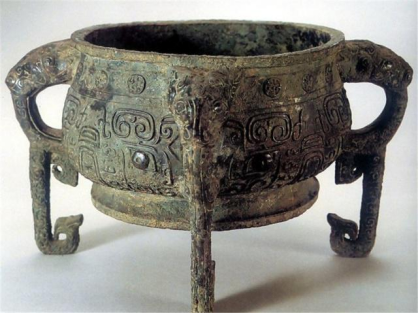
It is also useful to compare a vessel against related historic objects. For example, the Houmuwu square cauldron illustrates why a ding should not be casually classified as a wine vessel simply because it is bronze and has legs. A ding is generally recognized by its cooking or food-offering form, often with a deep body and tripod or four-legged support. Functional categories can overlap in broad ceremonial discussions, but precise form naming improves sourcing accuracy.
Separate Wine Vessels from Ding, Mirrors, and Incense Burners
Bronze product catalogs may present ritual vessels, decorative containers, censers, mirrors, and sculptural objects together. Buyers should avoid relying on the word “antique-style” alone. Instead, compare the structural features and intended use.
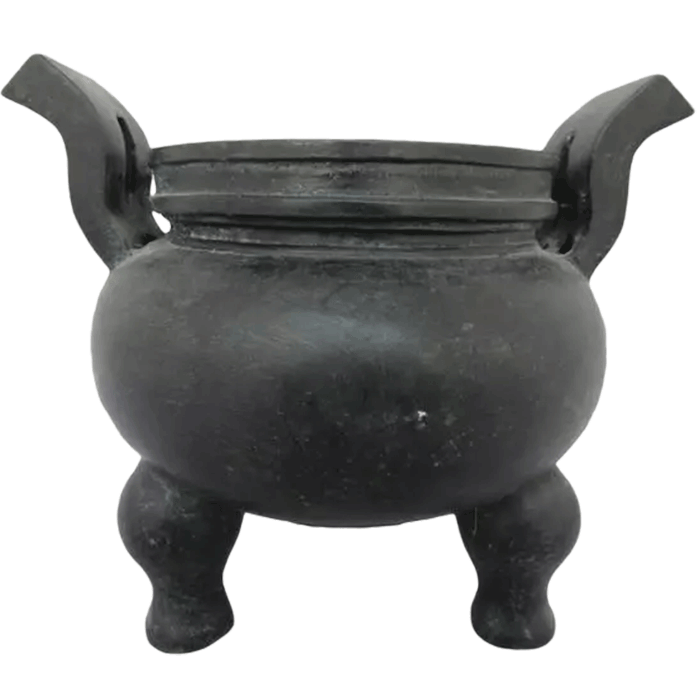
A ding usually has a round or square basin-like body supported by legs, often with paired upright handles near the rim. Its broad open top and substantial legs can make it visually imposing. A hu or zun, by contrast, is more vase-like and vertically proportioned. A jue is much smaller and more obviously equipped with a spout.
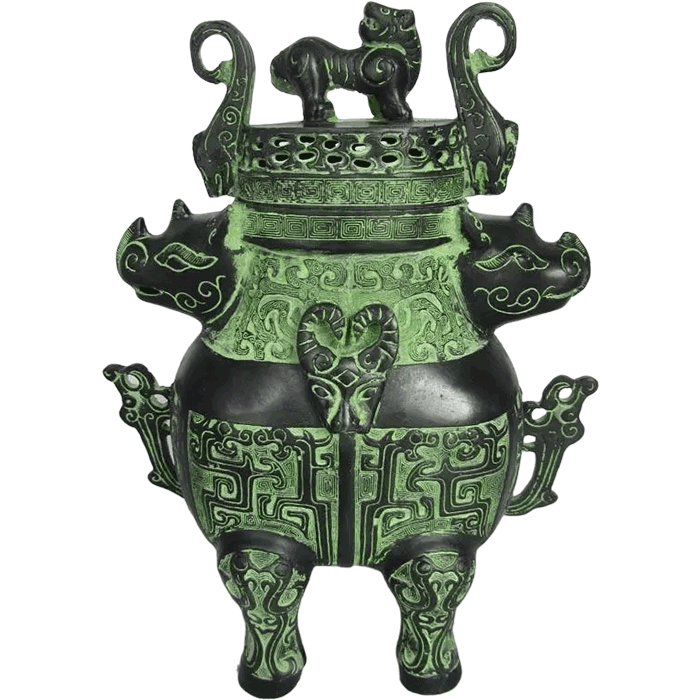
Bronze incense burners may have lids, feet, handles, and ornamental bodies, which can cause confusion with covered wine vessels such as he or you. However, censers often include perforations in the lid for incense smoke, a wide bowl form, or a censer-specific stand. If a piece is described for incense use, confirm whether it contains vent holes, an internal ash area, or a removable incense tray.
Bronze mirrors are generally flat, circular objects with a reflective face and patterned reverse. They belong to a different product category entirely, even when their reverse-side decoration uses similar ancient motifs. Buyers interested in this area can review traditional bronze mirror styles when comparing catalog items.
Practical Sourcing Questions for Custom Bronze Vessel Projects
Initial form recognition should lead to a more detailed sourcing brief. Luoyang Yichuan Bronze Craft Co., Ltd. produces bronze vessels including ding, zun, hu, tripods, and vases, as well as custom bronze artworks. The company uses premium Cu-Sn bronze alloy and the traditional lost-wax casting method, with hand chasing, polishing, and patina finishing available for antique or modern visual requirements.
When sending an inquiry for a vessel reproduction or an original design based on traditional forms, provide the following information:
- Reference photographs from multiple angles, with the preferred form clearly identified where possible.
- Required dimensions, including height, width, mouth size, and target weight range if applicable.
- Whether the piece should be an exact visual replication, a period-inspired interpretation, or a contemporary adaptation.
- Required surface appearance, such as warm brown, dark antique, green-toned aged effect, polished bronze, or a controlled mixed patina.
- Decoration requirements, including relief depth, animal masks, inscriptions, handles, rings, lid details, or custom logos.
- Installation or display requirements, such as plinth mounting, indoor placement, outdoor placement, or protective packaging needs.
- Order quantity and delivery destination for export packing discussion.
Custom work can begin from a single prototype, while bulk production arrangements can be discussed according to vessel size and design complexity. The production team includes bronze-casting masters and finishing artisans, allowing important details such as rim thickness, leg alignment, relief clarity, lid fit, and patina consistency to be reviewed during production.
Form Identification Checklist for Product Photos and Collection Listings
Use this concise checklist before requesting a quotation, creating a collection record, or comparing supplier offerings.
| Visible Feature | Likely Form Direction | Verification Question |
|---|---|---|
| Three legs, long spout, rear handle, two rim posts | Jue | Are the posts and spout functional parts of the design? |
| Three legs, tall open body, two posts, no long spout | Jia | Is the body taller and more cylindrical than a jue? |
| Lid, spout, and handle | He | Does the handle sit opposite the pouring spout? |
| Tall body with a broad flared mouth | Zun | Does the open mouth expand visibly above the body? |
| Full body, narrow neck, shoulder rings | Hu | Is the body more enclosed and storage-jar-like than a zun? |
| Covered body with an overhead carrying handle | You | Does the handle arch above the lid from side to side? |
| Square body with roof-like covered top | Fangyi | Does the lid create an architectural silhouette? |
| Square vase-like body and narrower neck | Fanghu | Does it retain the proportions of a hu in angular form? |
For complex projects, it is wise to state the level of historical precision expected. A display-oriented interpretation may prioritize silhouette, patina, and decorative impact. A replica-oriented project may require closer attention to proportions, handle placement, casting texture, inscriptions, and reference comparison. This distinction helps prevent misunderstandings between a buyer’s visual goal and the manufacturer’s production plan.
Luoyang Yichuan Bronze Craft Co., Ltd. operates under an ISO 9001 quality management system and conducts quality inspection before shipment. For custom bronze pieces, clear photographs, accurate form naming, and documented finish expectations are practical tools for achieving a more consistent result. If a casting defect is confirmed, replacement support is available, and after-sales guidance can be provided for patina touch-ups and restoration considerations.
Whether evaluating a jue with a spout, a covered you with an overhead handle, a tall zun, or a full-bodied hu, the most reliable method is to begin with structure. Identify the mouth, neck, body, support, handle arrangement, lid, and pouring details first. Then use decoration and historical references to refine the classification. This disciplined approach supports better collection documentation, clearer supplier communication, and more informed decisions when sourcing bronze vessels.