Chinese Bronze Sculpture Symbols by Dynasty
Chinese Bronze Sculpture Symbols by Dynasty: A Practical Visual Reading Guide
Bronze art from China is often recognized by its dark patina, ceremonial form, and intricate decoration, but meaningful comparison requires more than identifying an animal mask or an ancient-looking surface. Symbols, vessel shapes, casting techniques, inscriptions, and proportions changed across historical periods. Learning to read these visual signals can help collectors, designers, museum researchers, architects, and sourcing teams distinguish one style direction from another.
This guide provides a practical framework for interpreting Chinese bronze works by dynasty. It focuses on the questions early-stage researchers should ask when examining sculptures, ritual vessels, mirrors, incense burners, Buddhist figures, and decorative reproductions. Rather than relying on one motif alone, use a combination of form, ornament, function, composition, and finish to build a more reliable interpretation.
How to Read Chinese Bronze Sculpture Through Visual Evidence
A bronze object can carry several layers of meaning at once. A taotie-style mask may suggest ritual imagery, but the vessel shape, casting quality, decorative density, and inscription placement can provide additional clues about the intended historical reference. For this reason, visual interpretation should begin with observation rather than immediate labeling.
Start with the object type
First, identify what kind of object you are viewing. Is it a ding tripod, zun wine vessel, hu vase, mirror, animal statue, human figure, incense burner, or Buddhist sculpture? Object type matters because each category developed its own historical vocabulary.
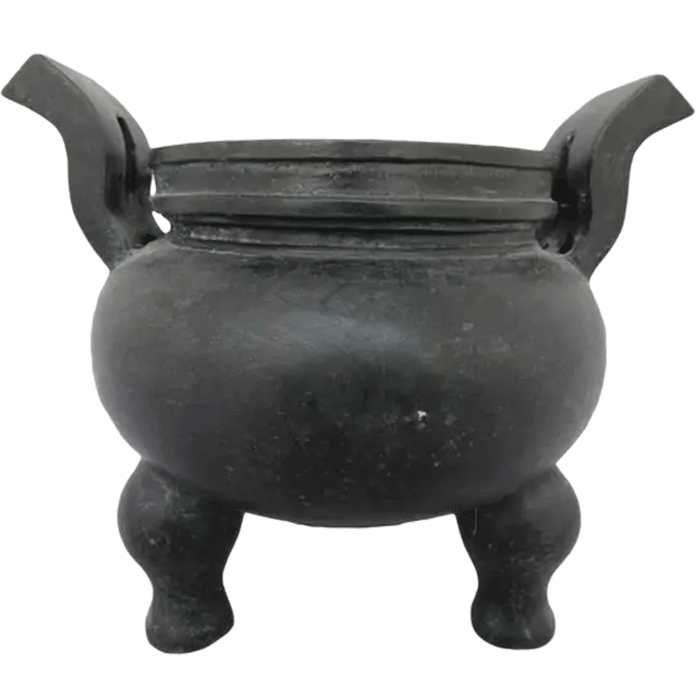
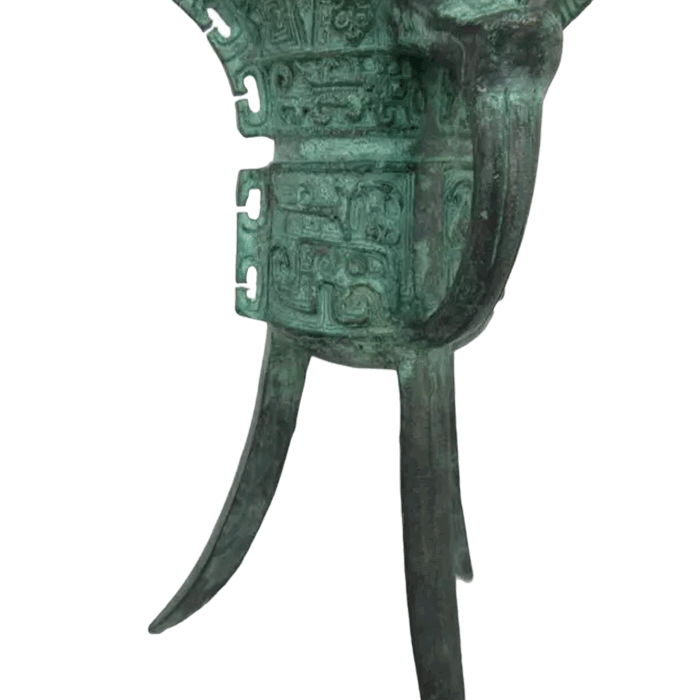
- Ding tripods are commonly associated with ritual food vessels, authority, and ceremonial status.
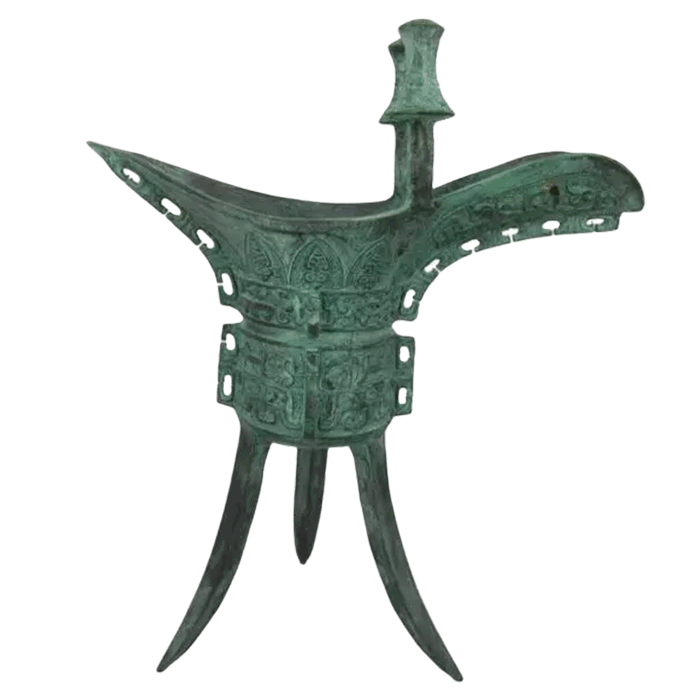
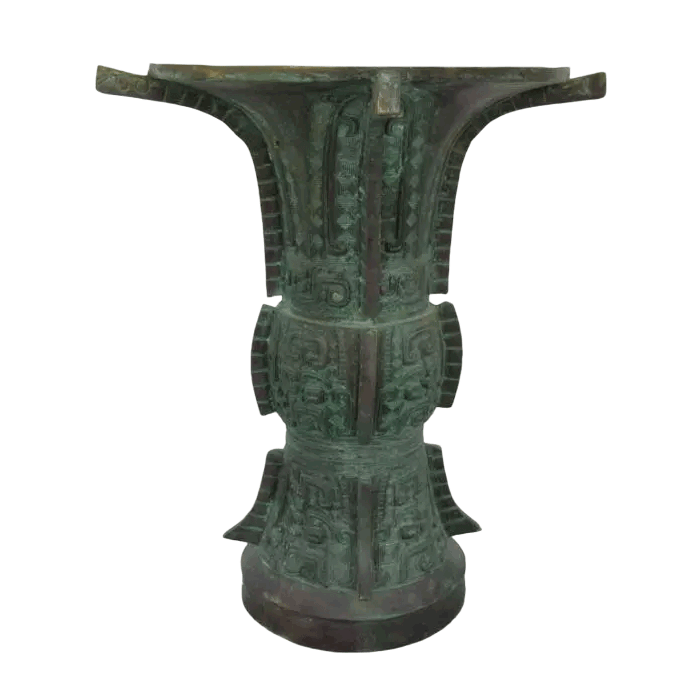
- Zun vessels often have expressive profiles and can feature animal-inspired forms or high-relief ornament.
- Hu vases usually emphasize a tall body, restrained symmetry, and handles or looped attachments.
- Bronze mirrors use the reverse side for decorative patterns, cosmological signs, animals, and inscriptions.
- Animal statues may communicate guardianship, vitality, rank, auspicious meaning, or a reference to historical bronzes.
- Buddhist figures are identified more through posture, hand gesture, facial expression, halos, robes, and devotional symbolism.
For a broader introduction to historical object categories, the resource on several bronze wares can help researchers become familiar with common forms before comparing decorative details.
Separate motif from function
Do not assume that a dragon, bird, tiger, or mask has one fixed meaning across all periods. A creature may be used as a handle, a lid finial, a surface pattern, a guardian figure, or the central body of the entire vessel. Its role changes the way it should be interpreted.
For example, an animal rendered as a sculptural vessel body is a major compositional feature. The same animal appearing as a small repeated border element serves a different decorative purpose. Functional components such as legs, handles, knobs, and spouts are especially useful because they reveal how symbolism and practical construction were combined.
Study the surface in layers
Traditional bronzes often use layered decoration. Look for a principal motif, secondary creatures, geometric ground patterns, borders, and raised relief. Dense surfaces can suggest an earlier ritual style, while open compositions, narrative scenes, or fluid line work may indicate a later design reference.
A practical observation sequence is:
- Identify the dominant silhouette from a distance.
- Examine the main motif at the center of each visible side.
- Check whether the background is plain, patterned, or deeply textured.
- Look at handles, feet, rims, and lids for supporting symbols.
- Review the patina separately from the modeled details.
Shang Dynasty References: Masks, Power, and Ritual Intensity
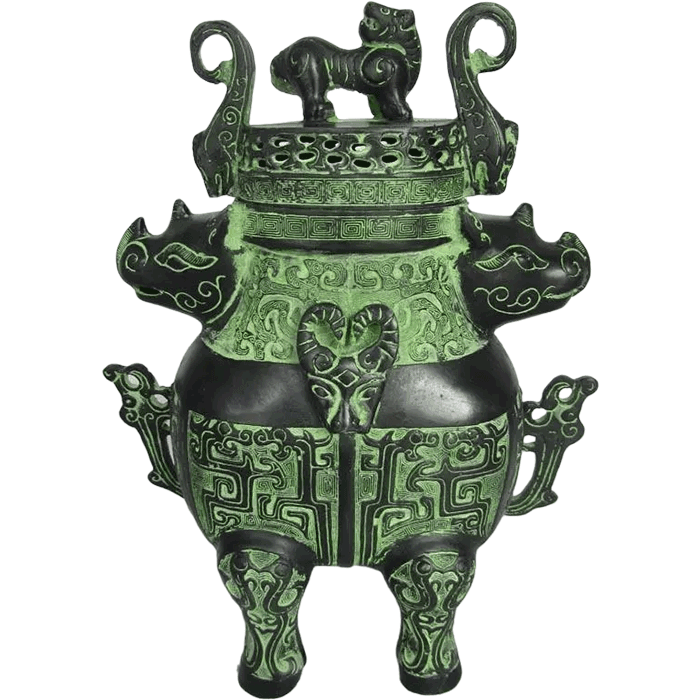
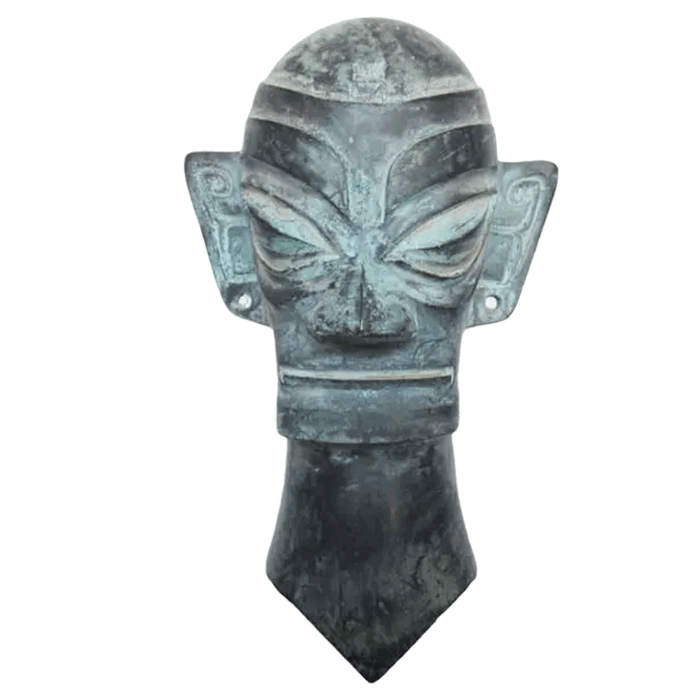
When a bronze work draws from Shang Dynasty visual language, the most recognizable feature is often the taotie-style mask. This frontal motif is typically organized around symmetrical eyes, brows, horns, fangs, and curved facial components. It can appear abstract at first glance, but its bilateral structure becomes clearer when viewed face-on.
Shang-inspired pieces commonly emphasize ritual gravity. The form may feel compact, heavy, and architectonic, with strong legs, thick rims, and carefully divided decorative panels. Rather than presenting a naturalistic animal, the surface often transforms animal features into a formal, almost geometric system.
Key signs to look for
- Prominent frontal mask imagery with large eyes.
- Dense relief decoration covering much of the vessel surface.
- Symmetrical organization around a central vertical axis.
- Animal-derived details integrated into handles, feet, or lid knobs.
- Strong, substantial forms that communicate ceremonial weight.
In modern decorative pieces, a Shang reference may be expressed through one key mask panel rather than full historical coverage. This is common when a designer wants the visual authority of ritual bronze but needs a cleaner contemporary silhouette. The important distinction is whether the mask is the main language of the object or simply one ornament among many.
The monumental tradition associated with the Houmuwu square cauldron is useful for studying the relationship between squared structure, ceremonial scale, and highly organized relief decoration.
Zhou Dynasty References: Order, Inscriptions, and Evolving Ornament
Zhou Dynasty bronze styles retained ritual vessel traditions while developing broader variation in proportion, inscription, and decorative arrangement. When comparing Zhou-inspired works with earlier Shang references, look for a stronger sense of ordered structure and, in many examples, greater attention to inscriptions and recognizable vessel identities.
Decorative motifs did not disappear, but they could become more controlled, elongated, or rhythmically arranged. Curving lines, bands, interlaced forms, and repeated relief patterns often contribute to an impression of visual order. The vessel itself may appear more refined in proportion, with the relationship between body, foot, neck, handles, and rim carefully balanced.
Symbols and details associated with Zhou-style interpretation
- Structured bands of ornament around the body or neck.
- More visible emphasis on inscriptions within the interior or on selected surfaces.
- Balanced proportions between decorative complexity and vessel form.
- Birds, dragons, and stylized animals arranged within an organized pattern system.
- Clear differentiation between primary panels, borders, and functional components.
For researchers, inscriptions should be treated carefully. Their presence can signal a historical reference to commemorative or ceremonial bronze traditions, but text alone does not prove a particular date or origin. In reproduction and custom work, inscriptions should be checked for character accuracy, intended message, placement, depth, and visual consistency with the overall design.
A reliable sourcing brief should specify whether an inscription is intended as a faithful visual reference, a modern commemorative message, or a decorative element. This distinction helps prevent mismatched styles, especially when an ancient vessel form is combined with contemporary branding or presentation text.
Spring and Autumn to Warring States: Movement, Creatures, and Openwork
Bronzes associated with the Spring and Autumn and Warring States periods are often recognized by increased visual movement. Earlier ritual symmetry remained important, but many works developed more energetic animal forms, flowing patterns, elaborate attachments, and complex surface relationships. The result can feel less static and more animated.
Dragons, birds, serpentine lines, and interlaced creatures may appear to move across the surface. Decorative systems can become more intricate, sometimes using openwork, inlay-inspired effects, or layered relief to create depth. Instead of a single frontal mask dominating the composition, the eye may travel across a network of active forms.
What makes this period visually distinctive
- More dynamic curves and intertwined creatures.
- Animals shown in profile, interaction, or repeated movement.
- Complex decorative layers that reward close viewing.
- Greater visual lightness in some designs through openwork elements.
- Stylized vitality rather than purely frontal, block-like symmetry.
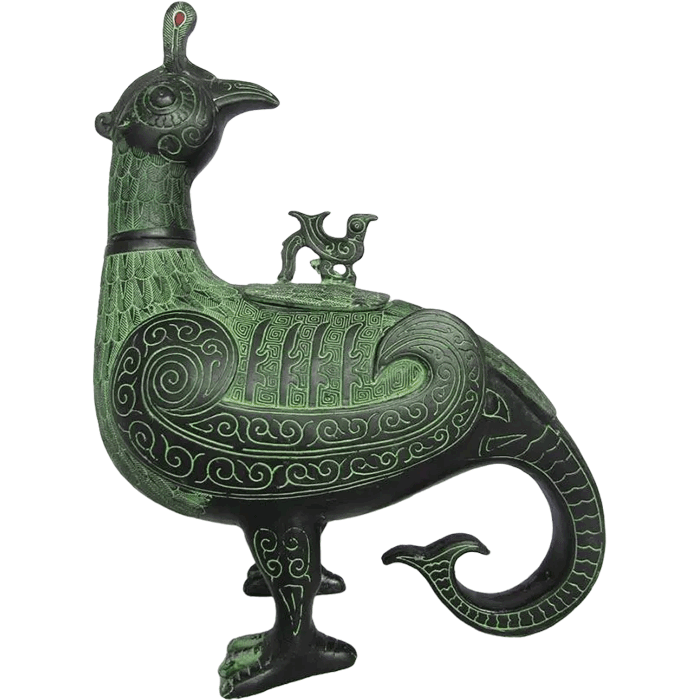
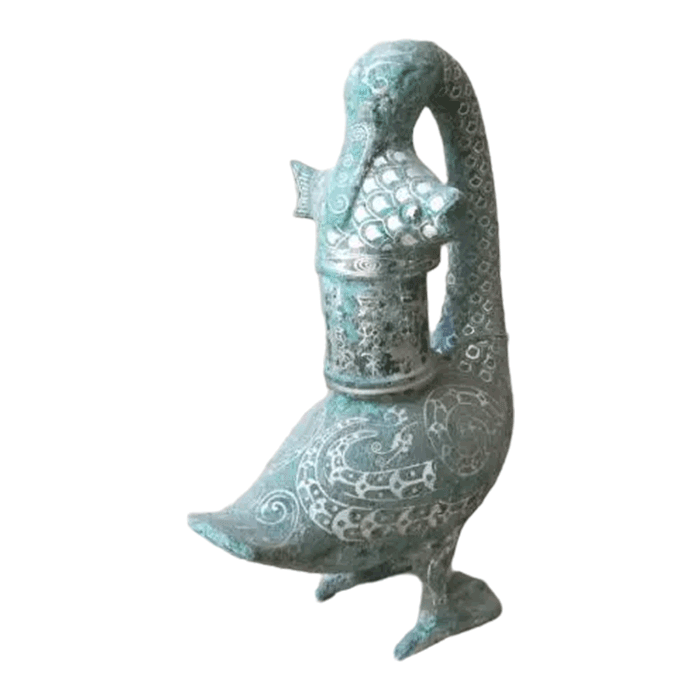
The Lotus Crane vessel offers a helpful point of reference for studying how sculptural animal and bird elements can transform the upper profile of a bronze object. It also demonstrates why silhouette is as important as surface pattern when interpreting historical influence.
When commissioning a decorative bronze inspired by this period, specify whether the priority is openwork complexity, animal movement, a particular vessel outline, or an inlaid visual effect. Combining every feature into one object can make the result visually crowded. A clear hierarchy of symbols generally produces a stronger finished design.
Han Dynasty References: Cosmology, Narrative, and Daily Life
Han Dynasty bronze imagery often broadens beyond earlier ritual symbolism into cosmology, immortality, architecture, processions, animals, and scenes connected with daily or ceremonial life. Forms may appear more expansive and expressive, and decorative programs can include imagery intended to communicate a larger worldview.
Bronze mirrors are especially useful for studying Han-period symbolism. Their decorated backs may include geometric arrangements, celestial ideas, inscriptions, mythical animals, and carefully organized radial patterns. In comparison with heavy ritual vessels, a mirror offers a flatter but highly informative symbolic field.
Common Han-style visual cues
- Cosmological patterns organized around central knobs or circular divisions.
- Mythical creatures, animals, and directional imagery.
- Narrative or scene-based decoration rather than only repeating masks.
- More naturalistic references in animal and human figures.
- Incense burners and sculptural forms that suggest mountains, clouds, or celestial landscapes.
Han-inspired animal sculpture may look more observant of anatomy than an earlier abstract animal motif, though it is still often stylized. A horse, bear, tiger, or bird may be modeled as a complete figure rather than reduced into a surface pattern. This difference is valuable when comparing a freestanding statue with a ritual vessel decorated by animal imagery.
Researchers comparing copper-based materials should also distinguish bronze from brass before making conclusions based on color alone. The article on bronze and brass differences provides useful material context for this comparison.
Tang and Later References: Naturalism, Spirituality, and Decorative Elegance
Tang-related bronze styles can be associated with fuller modeling, cosmopolitan visual influences, flowing robes, expressive animals, and more natural movement. Human and animal sculpture may have a greater sense of volume, with rounded forms and lively posture. This is particularly relevant for horse statues, guardian figures, and Buddhist imagery.
In Buddhist bronze sculpture, interpretation should start with iconographic structure: the figure’s seated or standing position, hand gesture, robe treatment, head ornament, halo, lotus base, and facial calm. Patina can support an antique presentation, but it should not replace accurate attention to these fundamental details.
Reading later-period decorative language
- Rounded, sculptural volume in human and animal forms.
- Flowing garments, balanced poses, and more natural body rhythm.
- Lotus motifs and devotional symbols in Buddhist works.
- Decorative refinement that may suit interiors as well as ceremonial display.
- Greater emphasis on the individual figure or scene than on all-over ritual pattern.
Later-inspired bronzes are often suitable for hospitality interiors, religious spaces, cultural projects, private collections, and landscape displays because the symbolism can be communicated through a recognizable subject: a horse in motion, a seated Buddha, a guardian animal, or an incense burner with a refined silhouette.
Use a Comparison Matrix Before Selecting a Style Direction
When comparing styles across periods, create a simple matrix instead of relying on general impressions. This method is useful for buyers sourcing replicas, decorative collections, museum-display pieces, or commissioned public art.
| Visual Question | What to Observe | Why It Matters |
|---|---|---|
| What is the core form? | Tripod, vase, mirror, incense burner, animal, human figure, or Buddhist statue | Form provides the first clue to historical and functional reference. |
| How is the surface organized? | Frontal mask, repeating band, openwork, narrative scene, or plain modeling | Surface structure helps separate ritual, dynamic, cosmological, and figurative styles. |
| What role do animals play? | Abstract motif, handle, foot, finial, full sculpture, or narrative participant | The role of the creature is often more informative than its species alone. |
| How is the object finished? | Polished bronze, dark brown patina, green patina, layered antique effect, or modern finish | Finish affects presentation but should support, not substitute for, accurate form. |
| Is text included? | Interior inscription, exterior text, seal mark, or no text | Text must be accurate and visually appropriate to the intended design direction. |
Translate Historical Symbols into a Custom Bronze Brief
For a custom project, historical research needs to become production-ready information. A useful brief includes reference images, dimensions, installation setting, desired alloy appearance, finish preference, inscription requirements, and packaging expectations. It should also identify which visual features are essential and which are optional.
Luoyang Yichuan Bronze Craft Co., Ltd. supports custom work from a single prototype, with custom sculpture MOQ starting from one piece. This is useful for researchers, designers, and institutions that need to evaluate a model or finish sample before discussing a larger installation or production run. Bulk order quantities can be negotiated according to sculpture size and design complexity.
The company uses premium Cu-Sn bronze alloy and the traditional lost-wax process, with hand chasing, polishing, and patina finishing available for antique or modern presentations. These production choices matter when a project requires deep relief, undercut details, animal forms, expressive robes, or a controlled antique surface.
For design teams preparing an original concept, the custom bronze project page can serve as a practical starting point for organizing a sculpture request.
Specify patina as a controlled design requirement
Patina should be described in clear visual terms. Instead of requesting an “old finish,” define the dominant color, darker recesses, highlight level, green or brown balance, and whether the surface should look uniform or naturally varied. Color reference images are helpful, but samples should be evaluated under lighting conditions similar to the final installation.
Consistent patina matching is especially important when a project includes multiple vessels, statues, or replacement pieces. Luoyang Yichuan Bronze Craft Co., Ltd. provides hand-applied patina options and after-sales guidance for patina touch-ups and restoration. Quality inspection is completed before every shipment, and casting defects are covered by free replacement.
Match the production process to the viewing distance
A small tabletop vessel, a museum-display reproduction, and a large outdoor animal sculpture are viewed differently. Fine inscription depth and facial details matter most at close range. Overall silhouette, strong proportions, and readable patina contrast become more important at longer distances.
With a 3,000-square-meter production area and more than 30 skilled craftsmen, including bronze-casting masters and finishing artisans, the company can support both detailed hand-finishing and larger production requirements. Its annual output exceeds 50,000 bronze art pieces, while ISO 9001 quality management certification and export quality inspection compliance provide additional assurance for international sourcing requirements.
A Final Method for Comparing Historical Bronze Styles
To interpret a bronze object by dynasty, avoid relying on a single symbol. Begin with the object type, then examine silhouette, surface organization, animal treatment, inscriptions, and finish. Shang references often emphasize ritual masks and density; Zhou works show ordered development in form and inscription; Spring and Autumn and Warring States styles bring movement and interlaced creatures; Han works expand toward cosmology and narrative; Tang and later references often favor fuller figures, spiritual iconography, and decorative elegance.
For buyers and researchers, the most effective comparison is not “Which dynasty does this resemble?” but “Which features create that resemblance?” This shift makes it easier to communicate with artists, curators, suppliers, and production teams. It also helps ensure that a custom bronze vessel, statue, mirror, incense burner, or Buddhist figure uses historical inspiration in a coherent and visually convincing way.