Bronze Jue: Why Do Rim Posts Appear? | Design Guide
Bronze Jue: Why Do Rim Posts Appear on This Ancient Wine Vessel?
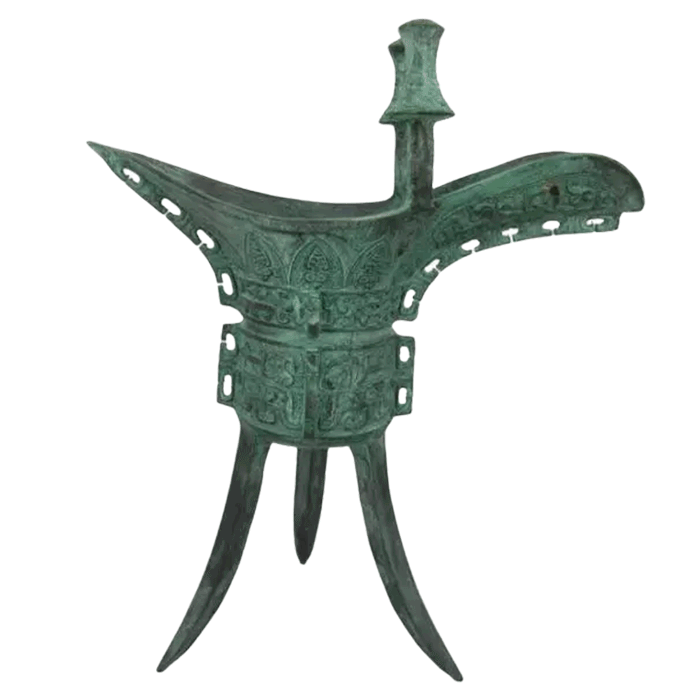
Among the many forms of ancient Chinese ritual bronzes, few are as visually distinctive as the tripod wine vessel with two small posts standing upright on its rim. This vessel is known as the Jue, and it remains one of the most frequently requested designs among heritage gift suppliers and museum-replica catalog writers. Yet one question comes up again and again during the research stage: why do these rim posts exist at all? Understanding their origin and function is essential before commissioning a faithful reproduction, since the posts are not decorative afterthoughts but a defining structural and cultural feature of the vessel.
This article examines the history, purpose, and design logic behind the rim posts on this ancient wine vessel, and offers practical guidance for buyers verifying design accuracy before placing custom orders.
What Is a Bronze Jue and Where Does It Come From?
The vessel belongs to the broader family of ancient Chinese wine vessels used during ritual ceremonies, ancestor worship, and formal banquets in the Shang and Zhou dynasties. It typically features three splayed legs, a deep rounded body, a long pouring spout on one side, a pointed tail on the opposite side, and — most notably — two vertical posts rising from the rim near the spout. Archaeological findings place its origins as early as the Erlitou culture period, making it one of the earliest bronze vessel forms produced in China, predating even more elaborate ding tripods and zun containers. For readers interested in the broader timeline of these developments, our overview of the evolution of bronze culture over 2000 years traces how vessel forms shifted across dynasties.
Because this vessel form is so old, surviving examples vary considerably in proportion, wall thickness, and decorative motifs, which is precisely why replica accuracy matters so much to catalog writers describing pieces to discerning collectors.
Why Do Rim Posts Appear on the Bronze Jue?
Several explanations have been proposed by scholars, and most reputable interpretations point to a combination of practical and ceremonial reasoning rather than a single purpose.
1. A Functional Handling Aid
One widely accepted theory suggests the posts served a practical role during use. When warming wine over a fire — a documented practice for ritual wine vessels of this era — the vessel would be lifted using a cloth or tool hooked around the posts, allowing the handler to avoid direct contact with the hot bronze body or the scalding liquid inside. The posts effectively functioned as heat-safe lifting points, a detail that becomes obvious once you consider that many surviving vessels show soot marks or fire damage near the base of the three legs.
2. A Filtering or Straining Function
Another theory holds that the posts helped hold a strainer cloth in place while pouring wine, preventing sediment or aromatic herbs steeped in the liquid from spilling into the drinking vessel. This would explain why the posts are positioned close to the spout rather than symmetrically around the rim.
3. A Ceremonial and Symbolic Marker
Beyond function, the posts likely carried ritual significance. Bronze vessels of this period were rarely designed for pure utility; their forms were deeply tied to status, lineage, and ceremonial protocol. The presence of posts may have distinguished vessels used specifically in ancestral offerings from ordinary drinking vessels, signaling the vessel's ritual status to participants in a ceremony.
Most bronze historians agree these explanations are not mutually exclusive — a design element in ancient ritual bronzes frequently served overlapping practical and symbolic purposes, a pattern also seen in other vessel types discussed in our article on some ancient Chinese bronze miscellaneous vessels.
Design Details Catalog Writers Should Verify Before Ordering Replicas
For suppliers sourcing museum-quality reproductions, the rim posts are one of several details that separate an accurate replica from a generic "ancient-style" vessel. Before finalizing a custom order, it is worth confirming the following specifications with the manufacturer.
Post Placement and Proportion
Authentic examples position the posts near the spout, not centered on the rim. Post height, thickness, and the distance between them vary by dynasty and regional style, so a replica intended to represent a specific historical period should match those proportions rather than using a generic template.
Leg Shape and Casting Method
The three legs should reflect the splayed, slightly outward-curving profile typical of early bronze wine vessels. Vessels produced using the traditional lost-wax casting method tend to capture finer surface texture and leg curvature than vessels made through simplified sand-casting, which matters significantly for catalog photography and collector scrutiny.
Surface Patina and Color Matching
Because many buyers are sourcing pieces intended to look authentically aged, consistent patina color matching across a production batch is critical. Uneven or overly uniform coloring is one of the fastest ways a reproduction reveals itself as inauthentic to an informed buyer. Ask suppliers directly how they control patina consistency across multiple units, especially for bulk orders destined for retail display.
Decorative Motifs
Taotie masks, thunder patterns, and geometric bands are common on the body of these vessels. Confirm whether the motifs are hand-chased after casting or molded directly, as hand-finishing generally produces sharper, more historically faithful detail.
How Luoyang Yichuan Bronze Craft Approaches Bronze Jue Reproduction
As a manufacturer based in Yichuan County, Luoyang — a region historically tied to China's bronze-casting heritage — our workshop produces ritual vessel replicas using premium bronze alloy (Cu-Sn) and the traditional lost-wax casting method. This approach allows for precise reproduction of fine details such as rim posts, leg curvature, and surface reliefs that are often lost in mass-produced alternatives.
Our production facility spans 3,000 square meters and employs more than 30 skilled craftsmen, including dedicated bronze-casting masters and finishing artisans who specialize in hand chasing, polishing, and patina application. Whether a project calls for antique-style aging or a cleaner modern presentation, finishing techniques can be adjusted to match catalog requirements. We support orders starting from a single custom prototype, which makes it practical for catalog writers and gift suppliers to request a sample piece for photography and quality verification before committing to a larger production run.
Every shipment undergoes quality inspection prior to dispatch, and casting defects are covered under our free replacement policy. Because ritual vessel replicas are often fragile and destined for international buyers, packaging is designed to meet export protection standards, reducing the risk of transit damage — a common concern raised by suppliers handling delicate bronze sculptures and vessels across long shipping routes.
Comparing Rim-Post Vessels to Other Ritual Bronze Forms
Catalog writers describing a full collection often need to explain how this vessel relates to other ritual bronzes. Unlike the three-legged ding used primarily for cooking and later as a symbol of political authority, or the zun and hu vessels used for storing wine and water, the vessel discussed here was specifically associated with drinking and pouring during ceremonial toasts. Readers building out product descriptions for a broader collection may also find our resource on introduction to several bronze wares useful for cross-referencing vessel functions and terminology.
It's also worth noting that not every three-legged bronze vessel with a spout includes rim posts — some related forms, such as the jiao, share a similar silhouette but omit this feature entirely, which is a common point of confusion in catalog descriptions and worth double-checking against reference photographs before publishing product listings.
Practical Recommendations for Sourcing Custom Replicas
- Request close-up photographs of the rim post area and leg joints from any supplier before committing to a full production run.
- Ask whether the piece is produced via lost-wax casting or a simplified casting method, since this affects surface detail sharpness.
- Clarify patina options — antique brown, black, or verdigris-style green finishes each require different aging techniques.
- Confirm MOQ flexibility if you need a single prototype for catalog photography before ordering in bulk.
- Verify export packaging standards, particularly for vessels with delicate rim posts that can be prone to damage during shipping.
For suppliers wanting to see how ritual vessel forms fit within a wider product range, our chinese bronze sculpture collection includes vessels, statues, and decorative bronze pieces produced under the same quality standards described above.
Final Thoughts for Catalog Writers and Gift Suppliers
The rim posts on this ancient wine vessel are far more than a stylistic flourish — they reflect a combination of practical handling needs and ceremonial significance rooted in Bronze Age ritual practice. For anyone verifying design accuracy before ordering replicas, understanding this detail helps ensure product descriptions are historically credible and that sourced pieces meet the expectations of collectors and cultural gift buyers alike.
Suppliers exploring custom options can review our customize a bronze sculpture process to discuss prototype development, finishing preferences, and production timelines suited to catalog and retail needs.