Bronze Jue: Shang Ritual Form & Use FAQs
Understanding the Ancient Chinese Bronze Jue: Shang Dynasty Ritual Form and Use FAQs
The jue (pronounced "jweh") represents one of the most distinctive and historically significant forms of ancient Chinese bronzeware, primarily associated with the Shang and early Western Zhou dynasties. These three-legged vessels served a crucial role in the elaborate ritual practices of the time, particularly in the ceremonial pouring and consumption of fermented beverages, often referred to as "wine." As objects imbued with profound cultural and religious meaning, the design and craftsmanship of the jue offer invaluable insights into the artistry, technology, and societal structures of early Chinese civilization. For B2B buyers and researchers seeking to understand or source authentic reproductions of these iconic artifacts, delving into their form, function, and historical context is essential. Luoyang Yichuan Bronze Craft Co., Ltd., with its ISO 9001 certification and expertise in traditional lost-wax casting, is dedicated to preserving this legacy through the creation of high-quality, export-compliant bronze art pieces.
The Historical Genesis and Cultural Significance of the Bronze Jue
The origins of the jue can be traced back to Neolithic pottery forms, evolving significantly with the advent of the Bronze Age in China. During the Shang Dynasty (c. 1600-1046 BCE), bronze casting reached an unprecedented level of sophistication, and the Bronze Jue emerged as a quintessential ritual vessel. Its prevalence in archaeological discoveries, particularly from royal tombs and sacrificial pits, underscores its central role in ancestral veneration and state ceremonies. These rituals were not merely symbolic; they were believed to connect the living with their ancestors and deities, ensuring the prosperity and stability of the kingdom. The presence of a jue in a burial context often signified the deceased's status and their continued importance in the afterlife.
What was the primary function of a jue in ancient China?
The primary function of the jue was as a vessel for heating and serving fermented grain beverages (often loosely translated as "wine") during ancestral worship ceremonies and other important rituals. Its design, particularly the long spout and pointed tail, facilitated the pouring of the liquid, while the three legs allowed it to be heated over a flame. The consumption of these beverages was a deeply sacred act, believed to induce altered states of consciousness, allowing communication with the spiritual realm. The elaborate decorative motifs frequently found on the surface of the jue, such as taotie (monster mask) designs, further emphasize its ritualistic importance and protective qualities.
Evolution of Design and Regional Variations
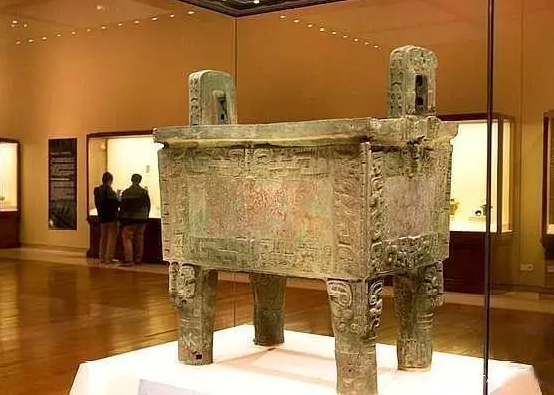
While the fundamental form of the jue remained consistent, its design underwent subtle evolutions throughout the Shang and early Western Zhou periods. Early examples tend to be simpler, with less elaborate ornamentation. As bronze technology advanced, so did the complexity of the jue's decoration, often featuring intricate leiwen (thunder patterns), zoomorphic figures, and even inscriptions (epigraphy) that recorded significant events or dedications. Regional variations also existed, reflecting the diverse artistic styles and preferences of different bronze-producing centers. Understanding these nuances is crucial for collectors, museums, and B2B clients who require historically accurate reproductions. Luoyang Yichuan Bronze Craft Co., Ltd. specializes in replicating these intricate details, ensuring that each custom bronze artwork reflects the precise historical period and stylistic characteristics. Our skilled craftsmen, including bronze-casting masters, are adept at capturing the subtle differences in form and decoration that distinguish various types of jue. For insights into the broader context of the evolution of bronze culture over 2000 years, our news section provides detailed historical perspectives.
The Distinctive Anatomy and Craftsmanship of the Bronze Jue
The unique silhouette of the jue is immediately recognizable, characterized by several key features that served both aesthetic and functional purposes. Each component was meticulously crafted using the sophisticated lost-wax method, a technique still employed by Luoyang Yichuan Bronze Craft Co., Ltd. today to achieve exceptional detail and precision.
What are the key components of a jue?
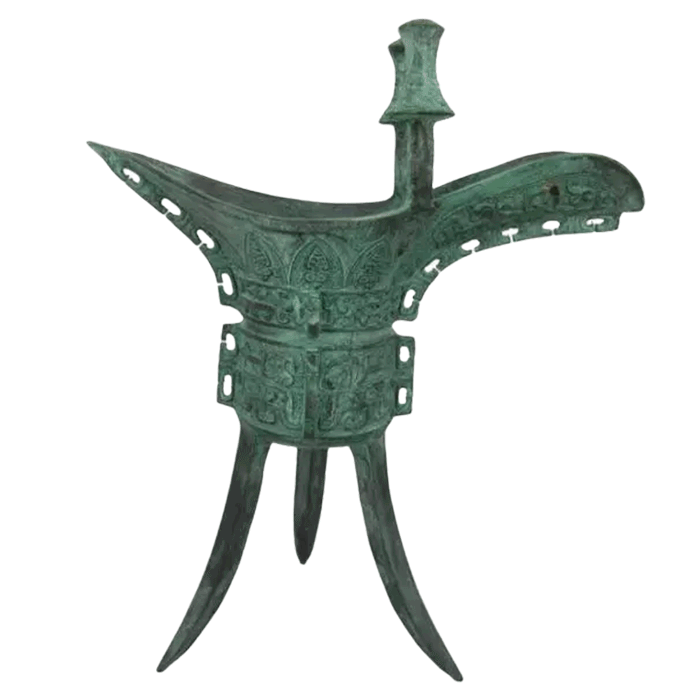
A typical Bronze Jue comprises several distinct elements:
- Spout (流, liu): A long, often trough-shaped spout extending from one side of the rim, designed for pouring liquids.
- Tail (尾, wei): A pointed, often flared tail opposite the spout, which helps balance the vessel and may have been used to grasp it.
- Columns (柱, zhu): Two mushroom-capped columns or posts rising vertically from the rim, typically positioned near the base of the spout. Their exact function is debated, but theories suggest they might have been used to secure a lid, hold a strainer, or simply as decorative elements.
- Handle (鋬, pan): A loop-shaped handle, often decorated with an animal head (like a bovine or ram), located on the side opposite the spout and tail, for gripping the hot vessel.
- Legs (足, zu): Three splayed, often knife-shaped or pointed legs (cone-shaped) that support the vessel and allow it to stand stably, often over a heat source.
The manufacturing process for such complex shapes required advanced metallurgical knowledge and skilled artistry. The premium bronze alloy (Cu-Sn) used by Luoyang Yichuan Bronze Craft Co., Ltd. ensures durability and a rich material quality, mirroring the ancient traditions. Our production area of 3,000 square meters, staffed by over 30 skilled craftsmen, allows for the precise execution of these intricate designs, from initial mold creation to the final finishing.
The Lost-Wax Casting Method for Bronze Jue Replicas
The traditional lost-wax casting method, or cire perdue, is paramount to creating high-fidelity replicas of ancient bronzeware like the jue. This multi-step process ensures that even the most intricate decorative motifs and delicate forms are accurately reproduced.
How is a modern jue replica made using lost-wax casting?
- Model Creation: A master model of the jue is sculpted, often in clay or wax, capturing every detail.
- Mold Making: A refractory mold is built around the wax model.
- Wax Melting: The wax is melted out, leaving a hollow cavity that is an exact negative of the jue.
- Bronze Pouring: Molten premium bronze alloy is poured into the cavity.
- Demolding: Once cooled, the mold is broken away, revealing the rough bronze casting.
- Finishing: This crucial stage involves extensive hand chasing to refine details, polishing to smooth surfaces, and the application of patinas to achieve antique or modern looks. Consistent patina color matching is a pain point Luoyang Yichuan Bronze Craft Co., Ltd. solves, ensuring a uniform aesthetic across bulk orders.
Every piece undergoes a rigorous quality inspection before shipment, and we offer free replacement for casting defects, underscoring our commitment to excellence. We also provide after-sales support for patina touch-ups and restoration guidance, demonstrating a comprehensive service approach for our B2B partners. Our capabilities extend to creating not just jue vessels but also a wide range of chinese bronze sculpture, including other ritual vessels and decorative items.
Ritual Context and Symbolic Interpretations of the Bronze Jue
Beyond its physical attributes, the jue held profound symbolic weight within the Shang and Zhou ritual system. Its use was inextricably linked to ancestor worship, state ceremonies, and the assertion of political legitimacy. The vessels were often part of larger sets of bronzeware, including ding (cauldrons), zun (wine containers), and gu (beakers), each playing a specific role in the ritual sequence.
What kind of rituals involved the jue?
The jue was primarily used in jiu (wine) rituals, which formed a cornerstone of Shang and Zhou religious and political life. These rituals often involved:
- Ancestral Offerings: Pouring wine as an offering to ancestors to seek their blessings or placate their spirits.
- Feasts and Banquets: Elite gatherings where the consumption of wine from jue vessels reinforced social hierarchy and celebrated important events.
- Divination: Wine rituals could precede or accompany divination practices, believed to facilitate communication with the spiritual world.
- Sacrificial Rites: As part of larger sacrifices involving food and other offerings.
The precise manner in which the Bronze Jue was held, filled, and emptied would have been governed by strict ritual protocols, emphasizing the solemnity and importance of the occasion. The intricate decorations on these vessels were not merely aesthetic; they were believed to enhance the potency of the ritual, connecting the human realm with cosmic forces.
The Jue as a Symbol of Status and Power
The ownership and display of bronze vessels, including the jue, were highly regulated and indicative of an individual's status and power within Shang and Zhou society. Only the elite – kings, nobles, and high-ranking officials – possessed the resources and authority to commission and utilize such expensive and labor-intensive artifacts. The sheer volume of bronze required, coupled with the sophisticated casting technology, made these objects symbols of immense wealth and political control. Archaeological findings consistently show that larger and more elaborately decorated jue vessels were associated with higher-status burials. For B2B clients seeking to curate collections that reflect historical authenticity and symbolic depth, understanding this context is paramount. Luoyang Yichuan Bronze Craft Co., Ltd. supports everything from a single custom prototype to bulk production runs, ensuring that bespoke requests for historically accurate pieces are met with unparalleled craftsmanship. Whether it is a bronze statue with different themes or a ritual vessel, our commitment to quality remains constant.
Sourcing Custom Bronze Jue Replicas for B2B Needs
For institutions, museums, galleries, and luxury retailers, sourcing historically accurate and high-quality bronze replicas presents unique challenges. Issues such as exact replication of antique bronzes, consistent patina color matching across multiple pieces, and export-compliant protective packaging for fragile sculptures are critical considerations. Luoyang Yichuan Bronze Craft Co., Ltd. directly addresses these pain points with its comprehensive service offerings.
Why choose Luoyang Yichuan Bronze Craft Co., Ltd. for custom jue replicas?
- Uncompromising Quality: Certified with ISO 9001, our products comply with export quality inspection standards for art crafts. We use premium bronze alloy (Cu-Sn) and the traditional lost-wax method, ensuring exceptional fidelity to historical designs and structural integrity.
- Customization Expertise: We offer custom bronze artworks, including the jue, with a minimum order quantity (MOQ) from 1 piece for custom sculptures. This flexibility allows clients to commission unique prototypes or small batches before committing to larger orders. Our ability to create customize a bronze sculpture from sculpmart.com ensures that specific historical details or artistic interpretations can be precisely realized.
- Capacity for Scale: With an annual output of over 50,000 bronze art pieces and a production area of 3,000 square meters, we support everything from a single custom prototype to large bulk production runs, meeting diverse B2B demands efficiently.
- Skilled Artisanship: Our team of over 30 skilled craftsmen, including bronze-casting masters and finishing artisans, possesses the expertise required for hand chasing, polishing, and patina finishing in both antique and modern looks, ensuring consistent quality and aesthetic appeal.
- Reliable Logistics & After-Sales: We conduct quality inspection before every shipment and provide export-compliant protective packaging designed specifically for fragile sculptures. In the rare event of casting defects, we offer free replacement. Furthermore, our after-sales support extends to guidance for patina touch-ups and restoration, ensuring the longevity and value of your investment.
The Bronze Jue stands as a powerful testament to the artistic, technological, and spiritual achievements of ancient Chinese civilization. Its distinctive form and ritualistic function offer a window into the complex societal structures and belief systems of the Shang and early Western Zhou dynasties. For B2B clients and researchers, understanding the intricate history and craftsmanship behind these vessels is essential for appreciating their enduring value. Luoyang Yichuan Bronze Craft Co., Ltd. is committed to bringing this history to life through expertly crafted, high-quality bronze reproductions. By combining traditional casting methods with modern quality assurance, we provide reliable solutions for sourcing historically accurate and aesthetically compelling bronze art pieces, ensuring that the legacy of the jue continues to inspire and educate.