Bronze Jue Identification by Spout, Legs and Posts
A Bronze Jue is identified by its pointed spout, three legs, and paired posts
For buyers, collection managers, decorators, and exhibition planners, correctly recognizing traditional Chinese vessel forms is essential when reviewing product catalogs or selecting antique-style furnishings. A Bronze Jue is one of the most recognizable early wine-vessel forms, yet it can still be confused with related ritual vessels when photographs are incomplete or descriptions use broad terms such as “tripod cup” or “bronze wine vessel.”
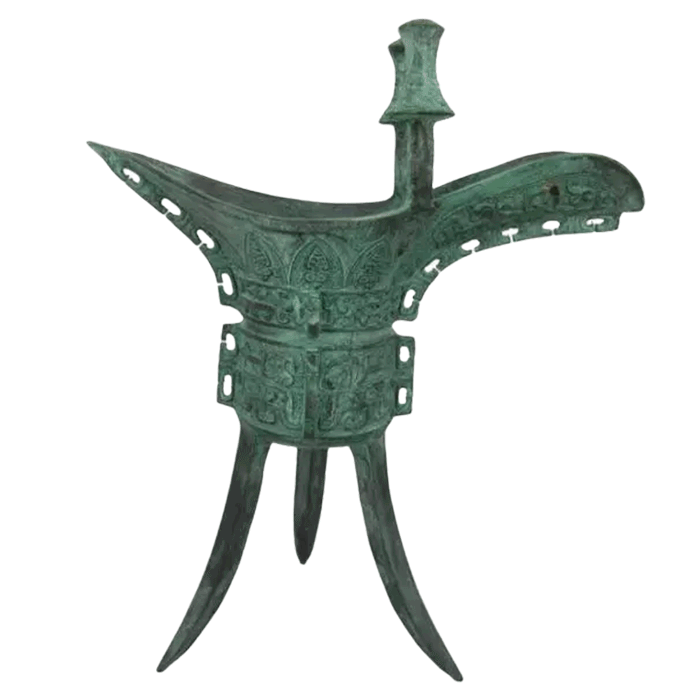
The fastest way to identify this form is to examine three structural details together: a long forward pouring spout, three narrow supporting legs, and two upright posts positioned near the rim. When these elements appear in the same vessel, they create a distinctive silhouette that differs clearly from a ding, jia, zun, hu, or later decorative cup.
Understanding these details helps professional buyers compare supplier listings more accurately, prepare clearer exhibition labels, and specify the correct form when ordering custom metalwork. It also supports more informed selection when creating themed interiors, museum-style displays, hospitality decor, or cultural gift collections.
The three defining features of a jue vessel
A jue is normally recognized through its profile rather than through surface decoration alone. Patina, motifs, inscriptions, and handles may vary between designs, but the functional outline remains the key identifying feature. Buyers should review the vessel from the side and above, because each angle reveals a different part of its structure.
The forward pouring spout
The most immediately visible feature is the extended pouring spout. It projects from one side of the vessel body and normally rises or curves slightly upward toward the tip. This narrow extension gives the form its elegant, bird-like profile and distinguishes it from many round-mouthed vessels.
In catalog photographs, the spout may be partially hidden if the vessel is turned away from the camera. For that reason, a single front image is not always enough for identification. Requesting side, top, and three-quarter views can help a buyer verify whether an apparent cup is actually a ritual pouring vessel.
The spout is usually opposite a rear handle. Together, these two elements establish a practical visual balance: one side is designed for pouring, while the other provides a point for holding or stabilizing the vessel. Although decorative reinterpretations may simplify the handle or alter proportions, the spout should remain a dominant identifying characteristic.
The three slender legs
The second feature is the tripod base. A jue normally stands on three legs rather than on a circular foot ring, flat pedestal, or four-legged base. These legs often extend directly from the underside of the body and give the vessel a raised position above the table surface.
In many traditional-inspired designs, the legs are long and narrow, creating a light and elevated appearance. Their shape may be round, tapered, faceted, or styled with subtle animal-inspired details. Regardless of decorative treatment, the three-point support is central to recognizing the form.
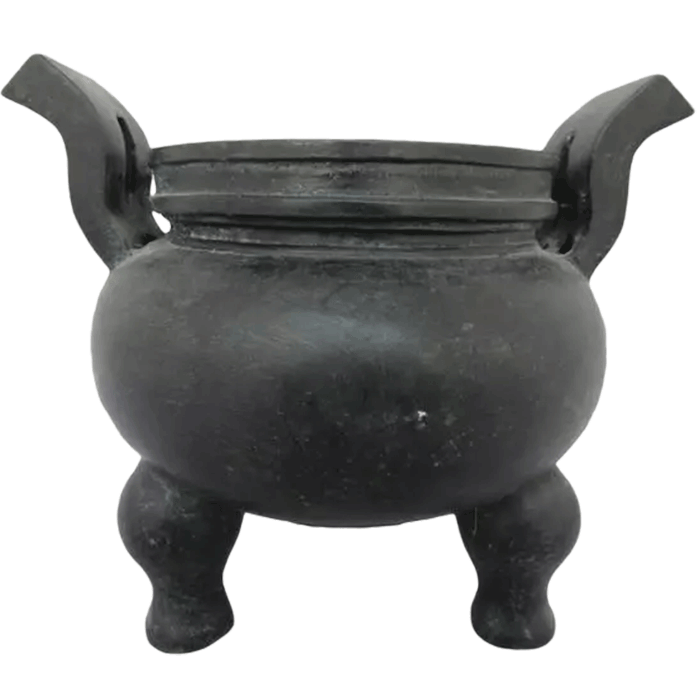
When checking an item description, do not assume that every three-legged bronze vessel is a jue. A ding can also have three legs, but a ding generally has a wider open bowl and lacks the long pointed spout and paired rim posts. Identifying the combination of features is more reliable than relying on legs alone.
The paired posts near the rim
The third defining detail is a pair of upright posts, often called finials or caps, positioned near the upper edge of the vessel. They usually rise from the rim area on the side opposite or adjacent to the spout, depending on the design and viewing angle. These posts are often topped with rounded, mushroom-like, conical, or decorative caps.
For product identification, the posts are especially useful because they are uncommon on ordinary cups and many other vessel categories. Their exact historical purpose has been discussed in different ways, but for a buyer comparing forms, their visual value is clear: two vertical posts above the rim are a strong indicator of a jue-type vessel.
A complete form therefore has a clear visual formula: pointed spout, rear handle, elevated bowl, three legs, and two posts. If a product image shows only one or two of these traits, it may be necessary to obtain additional photographs or dimensional drawings before assigning the vessel category.
How to inspect a Bronze Jue in a catalog or exhibition listing
Catalog descriptions may use translated names, generic classifications, or broad references to ancient Chinese bronzes. A structured review process reduces the risk of ordering or labeling the wrong vessel form. The following sequence is useful for procurement teams, galleries, retailers, and cultural institutions.
- Check the rim profile. Look for an open cup-like body with a pronounced pouring end rather than a fully symmetrical circular mouth.
- Locate the spout. Confirm that the projection is designed as a narrow pouring channel, not simply an ornamental edge or sculptural extension.
- Count the legs. Verify a three-legged configuration and assess whether the legs appear to support the body independently.
- Look above the rim. Identify two separate upright posts with visible caps or finials.
- Review the opposite side. Find the handle, which commonly sits behind the body and balances the spout.
- Compare dimensions. A vessel with a very broad basin, low foot, or enclosed cover may belong to a different category.
It is also useful to distinguish between a historical reproduction, an antique-style decorative vessel, and a contemporary artwork inspired by ancient forms. These products may share the same recognizable outline while differing in scale, finish, wall thickness, ornament, and intended use. A clear purchase specification should therefore name both the vessel type and the desired design treatment.
For broader context on early ritual containers and related categories, buyers can review this guide to ancient Chinese bronze wine vessel forms. Comparing several vessel types side by side makes the unique silhouette easier to remember.
Distinguishing the jue from similar Chinese bronze vessels
Traditional Chinese bronze ware includes many forms that share tripod legs, handles, decorative motifs, or ritual associations. Accurate classification requires attention to construction rather than color alone. Dark brown, black, green, or mottled patinas can occur across different vessel types and should not be treated as the primary identification method.
| Vessel type | Typical identifying features | Key difference from a jue |
|---|---|---|
| Jue | Pointed spout, three legs, two upright posts, rear handle | The complete combination of spout, posts, and tripod structure is distinctive. |
| Jia | Tripod body with two handles and upright posts | Usually lacks the long pointed pouring spout and has a more symmetrical upper form. |
| Ding | Round or rectangular bowl, legs, often two side handles | Designed as a cauldron-like vessel rather than a narrow-spouted pouring cup. |
| Zun | Tall or broad wine vessel with varied profiles | Usually does not have the defining tripod, spout, and paired-post arrangement. |
| Hu | Vase-like body, narrower neck, often symmetrical shape | More vertical and enclosed in profile, without the characteristic pouring end. |
A jia is particularly important to compare because it may also have three legs and upright posts. However, the jia is generally more symmetrical at the top and often incorporates handles on both sides. The extended spout remains the quickest way to separate the two forms in a product image.
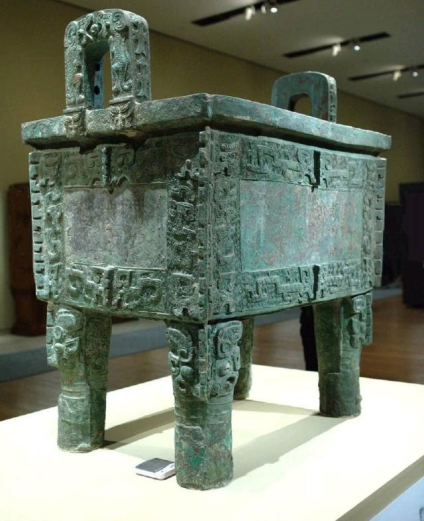
A ding is also frequently included in antique-inspired decor assortments. It is typically more robust and cauldron-like, with a broad bowl intended to stand firmly on legs. Buyers sourcing ceremonial or cultural display pieces can explore the visual characteristics of a houmuwu square cauldron to understand how ding proportions differ from a slender pouring vessel.
When an assortment includes several historical styles, suppliers should provide individual names, dimensions, material information, finishes, and clear multi-angle images. This practice helps retailers avoid using a generic term such as “bronze tripod” for several visually and functionally different forms.
Surface details that support identification
Structural features should come first, but surface details can provide additional context. Traditional-inspired pieces may use geometric bands, taotie-style masks, raised borders, animal motifs, or patterned handles. These decorative elements can enrich the vessel’s historical appearance, although they do not by themselves determine the form.
For example, a vessel may have an antique green patina and mask decoration but still be a ding, zun, or incense burner rather than a jue. Conversely, a simplified modern version with a smooth surface and dark polished finish can still be recognized through its spout, legs, handle, and posts.
Patina selection matters for display coordination. Antique brown, dark bronze, green-toned, and mixed aged finishes can complement traditional interiors, heritage-style retail displays, and cultural exhibitions. A more uniform modern patina may better suit contemporary hotel lobbies, offices, or residential projects. For projects focused on coordinating finishes across multiple items, suppliers should confirm the expected color range and hand-finishing approach before production.
Understanding the base metal is equally useful. Bronze is distinct from brass in alloy composition and visual character, and the choice can influence color, weight, casting behavior, and finishing options. Buyers comparing materials may consult this explanation of bronze and brass before preparing a specification.
Specify the correct form for custom production
When ordering a custom vessel, the product brief should describe more than “an ancient Chinese wine cup.” That wording can lead to different interpretations. A more precise brief identifies the intended silhouette, dimensions, decorative references, surface finish, display environment, and packaging requirements.
For a custom jue-style project, buyers can include the following information in an inquiry:
- Overall height, width, depth, and target weight range where relevant
- Spout length and angle relative to the main body
- Leg style, including tapered, plain, patterned, or animal-inspired details
- Post height, cap shape, and placement around the rim
- Handle design and whether it should include relief decoration
- Requested patina, such as antique brown, aged green, dark bronze, or a modern finish
- Reference photographs, drawings, or museum-inspired design direction
- Intended use, including display, interior decor, cultural retail, or exhibition presentation
Luoyang Yichuan Bronze Craft Co., Ltd. produces bronze vessels and custom bronze artworks using premium Cu-Sn bronze alloy and the traditional lost-wax casting method. Hand chasing, polishing, and patina finishing can be arranged according to the requested design direction. The company supports custom sculpture and artwork orders from one piece, while bulk-order arrangements can be discussed according to size and design complexity.
For buyers who need a bespoke model, the option to customize a bronze sculpture can also support projects that combine vessel forms with sculptural bases, decorative stands, or themed display concepts. Clear references are particularly important when the goal is to replicate specific proportions or coordinate patina across a group of pieces.
Quality considerations for buyers and curators
A well-made decorative or collectible vessel should be assessed not only for recognizable form but also for casting clarity, balanced proportions, stable support, and finish consistency. On a tripod vessel, the legs should create stable contact points so the piece sits securely. The spout, posts, and handle should appear integrated with the body rather than visually disconnected.
For antique-style works, fine finishing is especially important around the rim, spout edges, post caps, relief patterns, and transitions between the body and legs. These areas can reveal whether the final surface has received careful hand chasing and polishing after casting.
Luoyang Yichuan Bronze Craft Co., Ltd. operates under an ISO 9001 quality management system and performs quality inspection before shipment. Its bronze artworks are produced for export requirements, with protective packaging arranged for fragile sculptures and vessels. The company also provides replacement support for casting defects and after-sales guidance for patina touch-ups and restoration.
Whether used in a catalog, a cultural display, or an antique-style interior collection, a Bronze Jue is easiest to recognize when its defining structure is considered as a whole. The long spout identifies its pouring direction, the three legs establish its elevated tripod profile, and the paired posts complete the unmistakable upper silhouette. By checking these features before purchase or labeling, buyers can distinguish this classic vessel form from other Chinese bronze wares with greater confidence.