Bronze Jue: Dating Clues and Their Limits for Buyers
A Bronze Jue Carries Dating Clues in Its Form, But Style Alone Cannot Confirm Its Age
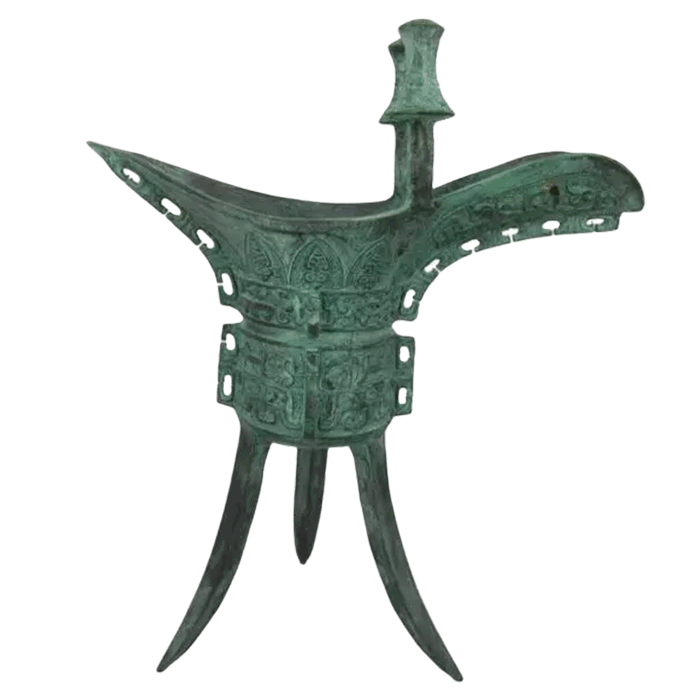
For collectors and procurement teams evaluating ancient Chinese bronze wine vessels, few pieces raise as many questions as the tripod cup known as the jue. Its tapering legs, spouted rim, and post-like projections are instantly recognizable, yet identifying the exact period of manufacture is rarely straightforward. Buyers who rely only on shape and surface decoration to date a vessel often overlook the broader evidence that separates a confident attribution from a guess. This article walks through the visual clues typically used to date this vessel type, explains where those clues fall short, and outlines what B2B buyers should request before treating a stylistic estimate as fact.
What a Bronze Jue Is and Why Dating It Matters
The jue is a three-legged bronze cup traditionally used for warming and pouring ritual wine during the Shang and early Western Zhou periods. Its form evolved over several centuries, and each phase left recognizable traits in leg shape, wall thickness, and ornamentation. For museums, private collectors, and reproduction buyers alike, dating matters because it affects valuation, display context, and the accuracy of any replica commissioned for exhibition or gifting purposes. A piece marketed as "Shang dynasty style" versus "Zhou dynasty style" is not a cosmetic distinction — it changes the entire narrative attached to the object.
Readers who want a broader timeline of how bronze forms changed across dynasties may find our overview on the evolution of bronze culture over 2000 years useful background before diving into vessel-specific dating.
Stylistic Dating Clues Used to Assess a Bronze Jue
Leg Shape and Proportions
Early examples tend to have thin, blade-like legs set at a wide angle, while later versions show thicker, more upright legs. This progression is one of the more reliable stylistic markers, though it is a general trend rather than a fixed rule, since regional workshops sometimes retained older leg forms alongside newer decorative motifs.
Surface Decoration and Motif Density
Taotie masks, thread-relief lines, and background spirals are common decorative layers. Denser, more crowded ornamentation is often associated with later Shang production, while sparser or absent decoration is linked to earlier phases. Comparing motif style against documented excavation finds remains one of the more dependable dating references.
Casting Technique and Wall Thickness
Piece-mold casting left seam lines and thickness variations that shifted as bronze-casting technology matured. Uneven wall thickness, visible casting flaws, or a lack of fine surface finishing can indicate an earlier or more experimental production stage, though these traits can also result from deliberate stylistic choices in later reproductions.
Inscription Presence
Inscribed clan or dedication marks became more common in the later Shang and Western Zhou periods. A short, simple inscription versus a long ceremonial text can help narrow a date range, but inscriptions must be evaluated for consistency with the casting method — a mismatch between inscription style and vessel form is itself a warning sign.
Why Stylistic Dating Alone Has Limits
Style-based dating is a useful starting point, but it is not proof of age or authenticity on its own. Several factors limit how far these visual clues can be trusted:
- Regional variation: Workshops outside the central Shang heartland sometimes mixed older and newer stylistic elements, making a single vessel look "older" or "newer" than its actual production date.
- Deliberate archaism: Later periods, including the Song and Qing dynasties, produced bronzes intentionally styled after Shang and Zhou originals for ritual or decorative purposes, complicating attribution based on form alone.
- Modern reproduction skill: Skilled lost-wax casting today can replicate leg proportions, motif density, and even artificial surface aging, meaning style alone cannot distinguish a well-made reproduction from an excavated original.
- Restoration and composite repairs: A vessel may combine an authentic body with replaced legs or a re-patinated surface, producing a stylistic profile that does not correspond to any single historical phase.
This is why serious buyers pair stylistic review with material analysis, provenance documentation, and — where available — archaeological context. Readers researching related vessel types and how their forms changed over time may also want to review our notes on introduction to several bronze wares and the discussion of dynastic transitions in the characteristics of the bronze wares of the Spring and Autumn and Warring States.
Provenance and Authentication: What Buyers Should Ask For
Before treating a dating estimate as settled, buyers evaluating an antique or antique-style vessel should request:
- Excavation or collection history documentation, if the piece is claimed to be ancient.
- Alloy composition testing (copper-tin ratio analysis), since alloy proportions shifted across periods and workshops.
- Patina analysis to confirm whether surface coloration formed naturally over centuries or was applied through accelerated chemical treatment.
- Independent expert review separate from the seller, particularly for high-value acquisitions.
For buyers who are commissioning a museum-quality reproduction rather than acquiring an antique, these same questions shift focus: instead of proving age, the priority becomes verifying casting accuracy, alloy quality, and finishing consistency against a reference piece.
Sourcing a Reproduction or Custom Bronze Jue with Confidence
Luoyang Yichuan Bronze Craft Co., Ltd. works with collectors, galleries, and B2B buyers who need an accurate reproduction rather than an unverifiable antique claim. Our workshop in Yichuan County, Luoyang, Henan Province, operates a 3,000-square-meter production facility staffed by more than 30 skilled craftsmen, including bronze-casting masters and finishing artisans who specialize in traditional lost-wax casting and hand chasing.
Because sourcing a historically accurate replica carries its own risks — inconsistent patina color, imprecise proportions, or damage during shipping — we address these directly:
- ISO 9001-certified quality management ensures every casting run follows a documented process, with products meeting export quality inspection standards for art crafts.
- MOQ from a single piece allows collectors or small galleries to commission one accurate custom vessel without committing to bulk minimums, while our annual output of over 50,000 bronze art pieces supports larger institutional orders as well.
- Pre-shipment quality inspection and free replacement for casting defects reduce the risk of receiving a piece with structural or surface flaws.
- Export-compliant protective packaging is built specifically for fragile cast bronze forms, including the delicate tripod legs and spouted rim of this vessel type.
Buyers researching related vessel categories, such as ding tripods and zun vases, can browse our range of chinese bronze handicrafts or explore options for a fully customize a bronze sculpture project tailored to a specific dynasty style or decorative motif.
Matching Reproduction Requests to Documented Dating Phases
When a client requests a piece styled after a specific period — early Shang, late Shang, or Western Zhou — our craftsmen reference documented leg proportions, motif layouts, and inscription conventions appropriate to that phase rather than blending features indiscriminately. This distinction matters for galleries and collectors who intend to display the reproduction alongside period-accurate context, since a mismatched stylistic profile undermines the educational or decorative purpose of the piece.
We also provide after-sales support for patina touch-ups and restoration guidance, which is particularly relevant for buyers who commission a vessel meant to age gracefully in a display environment over years of handling.
Final Considerations for Evaluation-Stage Buyers
Dating clues drawn from leg shape, decoration density, casting technique, and inscription style provide a reasonable starting framework, but none of them substitute for material testing, provenance research, or independent expert verification when the claim is that a piece is genuinely ancient. For buyers seeking a documented, quality-controlled reproduction instead, the priority shifts to workshop credentials, casting accuracy, and after-sales accountability.
Those wanting to understand how vessel forms and decorative conventions shifted across specific dynasties may also find value in our related articles on ancient Chinese bronze wine vessel traditions and some ancient Chinese bronze miscellaneous vessels, both of which provide useful comparative context when evaluating a vessel's stylistic period.
Whether the goal is acquiring an antique with verified provenance or commissioning an accurate reproduction for display, treating stylistic dating as one input among several — not a final verdict — protects both the buyer's investment and the integrity of the collection it joins.