Bronze Goose-fish Lamp Decor: An Ancient Smoke-Control System
How Ingenious Bronze Goose-fish Lamp Decor Controlled Smoke in Ancient China
The intersection of art and engineering often produces objects of breathtaking beauty and remarkable utility. Few artifacts exemplify this synthesis better than the ancient Chinese goose-fish lamp. More than just a source of light, this masterpiece of Han Dynasty metalwork was a sophisticated air purification system, a testament to the advanced understanding of physics and fluid dynamics possessed by artisans over two thousand years ago. For collectors, museum curators, and retailers of fine historical reproductions, understanding the functional genius behind this iconic piece is key to appreciating its enduring value. This article explores the elegant mechanics of how this ancient lamp scrubbed smoke from the air, a feature that makes modern, high-fidelity reproductions a compelling story for any collection.
The design, which masterfully channels soot-filled smoke through a water-filled chamber, represents a pinnacle of early environmental engineering. It solved a pervasive problem of indoor life in a way that was both scientifically sound and artistically sublime. As we delve into its history and mechanics, we uncover not only a clever invention but also a piece of cultural heritage that continues to inspire artisans and engineers today. For businesses sourcing unique bronze decorations, the goose-fish lamp offers a narrative of innovation that resonates powerfully with discerning clients.
The Historical Context: Illumination Challenges in the Han Dynasty
To fully appreciate the innovation of the goose-fish lamp, one must first understand the environment in which it was created. During the Han Dynasty (206 BCE – 220 CE), a period of significant economic prosperity and cultural advancement, the homes of the elite were becoming increasingly complex and ornate. Palaces and the manors of nobility were filled with fine silks, intricate lacquerware, and painted murals. Yet, the methods of illumination available posed a constant threat to these luxurious interiors and the health of their inhabitants.
The primary fuels for lamps were animal fats, such as lard or tallow, and various vegetable oils. While effective for producing light, these substances burned inefficiently, releasing a thick, greasy smoke laden with soot. In poorly ventilated rooms, this smoke would quickly accumulate, staining walls and fabrics, tarnishing valuable objects, and creating an unhealthy, acrid atmosphere. The particulate matter would irritate the eyes and lungs, posing a significant indoor air quality problem long before the concept was formally understood.
This challenge was not merely one of comfort but also of status. A grand, well-lit hall was a sign of wealth, but a hall filled with smoke was anything but refined. The imperial court and aristocratic households required a lighting solution that was both brilliant and clean. This practical need drove the innovation that led to the creation of what is perhaps the world's first smokeless lamp. The artisans of the time were tasked with a difficult problem: how to capture the byproducts of combustion at the source, before they could pollute the indoor environment. Their solution was not a crude filter but an elegant, integrated system disguised as a beautiful work of art.
Unveiling the Design: The Anatomy of a Smoke-Controlling Lamp
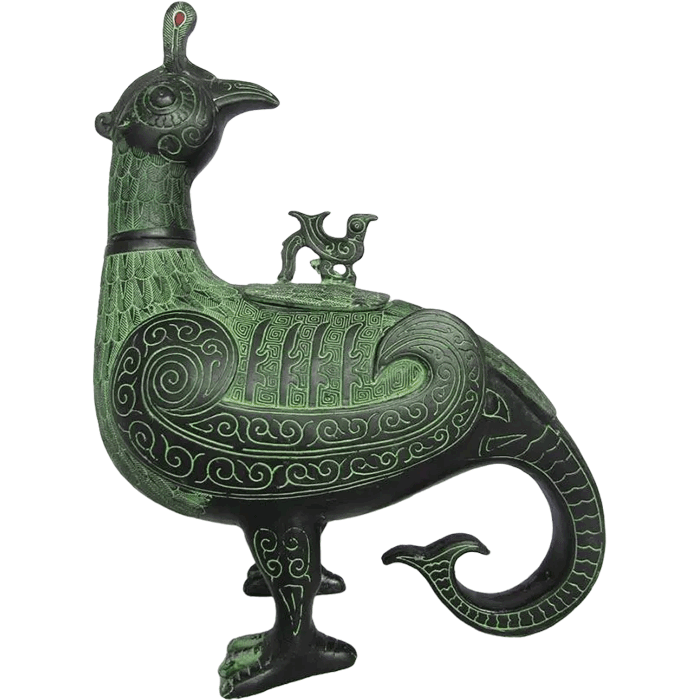
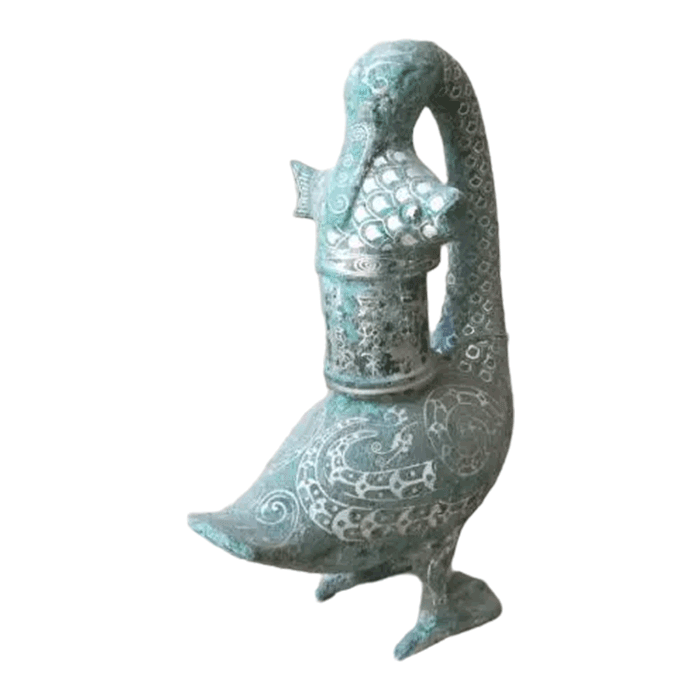
At first glance, the lamp appears to be a purely decorative sculpture: a graceful goose, often with its head turned back, holding a fish in its beak. The genius, however, lies in its hollow, multi-part construction, a feat made possible by the sophisticated lost-wax casting process. Luoyang Yichuan Bronze Craft Co., Ltd. continues this tradition, employing the very same traditional lost-wax method to create intricate, hollow forms that honor the ingenuity of the original creators. This time-honored technique is essential for achieving the complex internal architecture required for the lamp's function.
The lamp can be deconstructed into several key functional components:
The Oil Reservoir and Wick
The "fish" held in the goose's beak is not merely ornamental. It serves as the primary oil reservoir. A wick would be placed in the fish's mouth, drawing up the fuel to be burned. The fish itself was often designed to be rotatable or detachable, allowing for easy refilling and maintenance.
The Adjustable Hood
Positioned above the flame was a semi-circular, often sliding or rotating panel. This component acted as a lampshade, allowing the user to control the direction and intensity of the light. More importantly, it served as the intake for the smoke-capturing system, funneling the rising smoke and soot directly into the goose's head.
The Internal Flue System
This is the core of the lamp's innovative design. The smoke, captured by the hood, does not simply dissipate. Instead, it is channeled into an opening that leads through the goose's gracefully curved neck. The neck functions as a flue or chimney pipe, directing the hot, soot-filled gas away from the immediate environment and down towards the body of the goose.
The Water-Filled Body
The hollow body of the goose was designed to be filled with a certain amount of clean water before the lamp was lit. As the hot smoke traveled down the neck and into the main chamber, it was forced to pass over and through this water. The water acted as a natural filter, trapping the particulate matter. The soot would either dissolve into the water or become suspended, effectively scrubbing it from the air. The relatively "clean" exhaust gas would then exit, leaving the harmful pollutants behind in the water. After use, the water, now blackened with soot, could be easily poured out and replaced, making the system reusable and easy to maintain.
The Science Behind the Art: How Water Trapped the Soot
The effectiveness of the goose-fish lamp's smoke-control mechanism relies on simple yet elegant scientific principles. The Han Dynasty craftsmen may not have had the language of modern physics to describe it, but they had a profound empirical understanding of how to manipulate heat, air, and water to achieve their desired outcome. The process involved several phenomena working in concert.
First, as the hot smoke and soot particles traveled down the goose's neck and entered the main body, they came into contact with the large, cool surface of the water. This temperature difference caused some of the vapor in the smoke to condense. Soot particles, acting as condensation nuclei, would become heavier and fall into the water.
Second, the principle of adhesion came into play. Water molecules are polar and have a natural attraction to many types of particles. As the soot-laden smoke bubbled across the water's surface, the particulates would adhere to the water and be trapped. This is a rudimentary form of a wet scrubber, a technology still used in modern industrial applications to remove pollutants from exhaust fumes.
Finally, gravity played its part. Any larger, heavier particles of soot that were not immediately dissolved or captured through adhesion would lose their kinetic energy in the larger chamber of the goose's body, falling out of the air stream and settling into the water below. The result was a remarkably efficient system for improving indoor air quality, all contained within an object of exceptional beauty. This fusion of utility and artistry is a hallmark of the finest chinese bronze sculpture from this period.

Sourcing High-Fidelity Reproductions for Modern Collections
For businesses looking to source historical replicas, the Bronze Goose-fish Lamp Decor presents a unique opportunity. It is not just a product but a story of ancient innovation. However, creating a faithful reproduction requires a deep understanding of the original's form, function, and artistic spirit. Sourcing from a manufacturer with proven expertise is paramount.
Authenticity begins with the manufacturing process. The complex, hollow passages of the lamp can only be accurately replicated using the lost-wax casting technique. A supplier must demonstrate mastery of this method to ensure the final product is not merely a solid, decorative object but a true representation of the original's engineering. At Luoyang Yichuan Bronze Craft Co., Ltd., our team of over 30 skilled craftsmen, including bronze-casting masters and finishing artisans, specializes in this precise method, ensuring every curve and internal channel is rendered with historical accuracy.
Another critical factor is the finish. The patina of an ancient bronze is a key part of its aesthetic appeal. Achieving a consistent and convincing antique finish is a common sourcing pain point for buyers. Our artisans are adept at hand-chasing, polishing, and applying complex patinas to match specific historical periods or custom design requirements. Furthermore, as an ISO 9001 certified company, we adhere to strict quality management systems, with a thorough quality inspection before every shipment to guarantee consistency and excellence. We solve the challenge of sourcing by offering everything from a single custom prototype to large-scale production runs, with a flexible MOQ starting from just one piece for custom designs.
Beyond Function: Symbolism and Artistic Merit
While its smoke-capturing function is a marvel of engineering, the lamp's artistic and symbolic value is equally profound. In Chinese culture, both the goose and the fish are auspicious symbols. The goose is often associated with loyalty, marital fidelity, and communication, as wild geese were believed to carry messages. The fish (鱼, yú) is a homophone for the word for abundance or surplus (余, yú), making it a powerful symbol of wealth and prosperity.
The combination of the two in a single object creates a rich tapestry of meaning, suggesting a harmonious and prosperous household. These lamps were not mass-produced; they were luxury items commissioned by and for the highest echelons of Han society. The most famous example was excavated in 1968 from the tomb of Dou Wan, wife of the Han prince Liu Sheng, solidifying its status as an object of imperial quality. Owning such a lamp was a clear display of wealth, sophistication, and a desire for a clean, modern living environment. This rich cultural backdrop adds immense value to reproductions, transforming them from mere decorative items into conversation pieces steeped in history. For those looking to create a specific piece, it's possible to customize a bronze sculpture from sculpmart.com to meet precise historical or aesthetic specifications.
In conclusion, the ancient Chinese goose-fish lamp is a masterclass in design, seamlessly blending artistic elegance with scientific principles. Its ability to provide clean, smoke-free light made it an invaluable innovation for its time. Today, the story of this ingenious device continues to captivate, making high-quality reproductions a valuable addition to any collection of fine art or historical decor. Partnering with a manufacturer that respects this legacy and possesses the technical skill to replicate it faithfully is the key to bringing this piece of history to a modern audience.