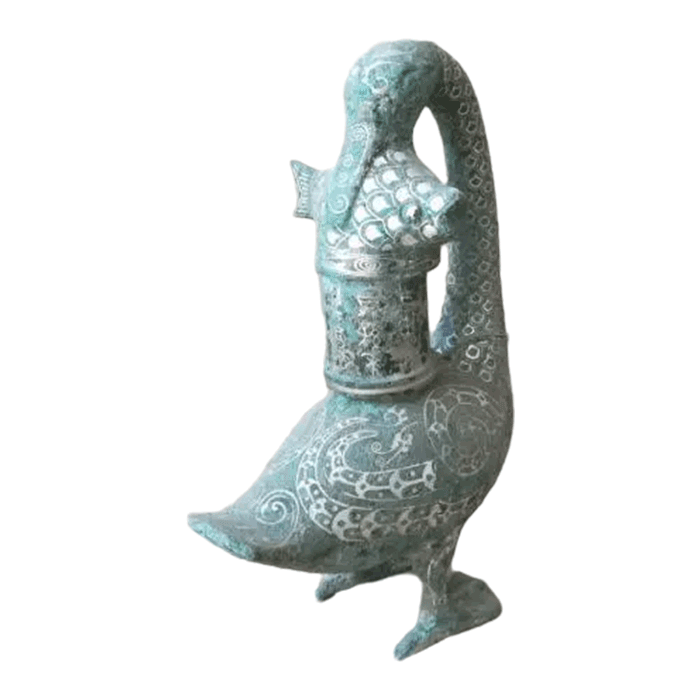
Bronze Goose-fish Lamp Decor: An Ancient Design Marvel
How Does the Ingenious Bronze Goose-fish Lamp Decor Function?
Among the vast treasures of Chinese antiquity, few objects so perfectly capture the union of artistic beauty and scientific ingenuity as the goose-fish lamp of the Han Dynasty (206 BCE – 220 CE). More than just a source of light, this remarkable artifact is a testament to the sophisticated craftsmanship and environmental awareness of ancient artisans. For museum curators, decor importers, and connoisseurs of cultural art, understanding its intricate mechanics reveals a story of innovation that continues to inspire. This article delves into the functional design, the clever physics of its smoke-abatement system, and the rich symbolism embedded within its form.
At Luoyang Yichuan Bronze Craft Co., Ltd., we are situated in the heart of a region with a 3,000-year legacy of bronze casting. This heritage informs our meticulous approach to recreating historical masterpieces. By exploring the original function of artifacts like the goose-fish lamp, we can better appreciate and replicate the genius of their creators, ensuring that their legacy of art and innovation endures for a new generation of admirers and collectors.
The Anatomy of an Ancient Innovation: Deconstructing the Lamp's Design
To understand how this ancient lamp works, we must first examine its constituent parts. The goose-fish lamp is typically cast in several pieces that fit together seamlessly, a hallmark of advanced bronze-working techniques. The design is both aesthetically pleasing and eminently practical, with each component playing a crucial role in its overall function.
The primary components include:
- The Goose Body: The main structure of the lamp is a gracefully rendered wild goose, often depicted turning its head as if in motion. This hollow body serves as the lamp's foundation and, most importantly, its water reservoir and filtration chamber. The realism in the depiction, from the texture of the feathers to the curve of the neck, showcases the high level of artistic skill prevalent during the Han Dynasty.
- The Fish: Clutched in the goose's beak is a fish, which often appears to be writhing. While it adds a dynamic, narrative element to the sculpture, the fish is a solid, decorative component that contributes to the lamp's balance and symbolic meaning.
- The Lamp Plate: This is the functional heart of the lamp. It is a shallow, circular dish where fuel—most likely animal fat or oil—and a wick were placed to be ignited. On many original examples, this plate is designed to rotate, allowing the user to easily access it for refueling or cleaning without moving the entire heavy lamp.
- The Lampshade: A pair of curved, sliding bronze panels form the shade. These are ingeniously designed to pivot around the lamp plate. This feature allowed users to control both the direction and the intensity of the light, shielding their eyes from the direct flame and focusing the illumination where it was needed. This adjustable design was a significant advancement in ancient lighting technology.
The entire assembly was cast using a premium bronze alloy, primarily a mixture of copper and tin (Cu-Sn). The creation process would have involved the sophisticated lost-wax method, a technique that allows for intricate details and hollow forms. This is the same traditional method our master craftsmen employ today to ensure that every replica captures the essence and structural integrity of the original. Understanding this complex anatomy is the first step in appreciating the lamp's primary innovation: its ability to provide clean, smoke-free light.

A Masterclass in Environmental Engineering: The Smoke Abatement System
The true genius of the goose-fish lamp lies in its self-contained, passive smoke-filtering system. In an era when interior spaces were lit by open flames that produced copious amounts of soot and smoke, this lamp was a revolutionary solution to indoor air pollution. Its design preempted modern environmental engineering principles by over two millennia. The process is a simple yet brilliant application of physics.
Here is how the smoke abatement system works:
- Combustion and Capture: When the lamp is lit, the burning fuel on the lamp plate produces light, heat, and smoke. The smoke, laden with soot particles, naturally rises.
- Directional Funneling: The adjustable lampshade not only directs light but also acts as a hood, capturing the rising smoke and preventing it from dissipating into the room.
- Conduction through the Neck: The smoke is channeled from the shade into an opening that leads directly into the goose's long, hollow neck. The elegant curve of the neck is not just for show; it is the conduit that guides the toxic fumes away from the immediate environment.
- Filtration in the Body: The hollow body of the goose is designed to be filled with a small amount of water. As the hot smoke travels down the neck and enters the main chamber, it comes into contact with the surface of this water.
- Dissolving the Soot: The soot particles, the primary pollutant in the smoke, are trapped by the water and dissolve into it. Over time, the water would become blackened with accumulated soot, but the air exiting the lamp would be significantly cleaner. The water could be easily changed by disassembling the lamp.
This mechanism transformed the experience of indoor lighting. It protected the health of the inhabitants, prevented soot from blackening walls and ceilings, and created a more pleasant living environment. For modern businesses sourcing unique decor, this story of ancient innovation adds immense value, transforming a beautiful object into a conversation piece about history, science, and design. This clever, functional aspect is a key reason why the goose-fish lamp is celebrated as a pinnacle of chinese bronze sculpture.
Symbolism and Cultural Significance in Han Dynasty Art
Beyond its functional brilliance, the goose-fish lamp is rich with cultural symbolism that would have been immediately recognizable to its original owners. The choice of a goose and a fish was not arbitrary; each creature carried deep meaning in Han Dynasty cosmology and folklore.
The Goose (雁, yàn): Wild geese were highly regarded in ancient China. As migratory birds, they were symbols of seasonality, rhythm, and reliability. They were also famous for flying in a V-formation and were thus seen as emblems of order, community, and marital fidelity, as they were believed to mate for life. In a more practical sense, geese were known as messengers. The story of Su Wu, a Han dynasty diplomat who supposedly sent a message tied to a goose's leg, cemented their association with communication and the delivery of good news. In the context of a lamp, the goose can be interpreted as a bearer of light and clarity—a messenger bringing illumination out of darkness.
The Fish (鱼, yú): The fish is one of the most auspicious symbols in Chinese culture, primarily due to a linguistic pun. The word for fish, yú, is a homophone for the word for surplus or abundance (余, yú). Therefore, a fish has always represented wealth, prosperity, and good fortune. The visual motif of the goose capturing the fish can be interpreted as "obtaining abundance" or "securing prosperity," a powerful wish for any noble household. The dynamic struggle between the two creatures adds a sense of life and energy to the piece, a characteristic feature of Han-era art that moved away from the more rigid, ritualistic forms of earlier dynasties.
Together, the goose and fish create a powerful narrative of achieving prosperity through order and reliability. This combination of practical function and layered symbolism makes the goose-fish lamp a holistic work of art, reflecting the sophisticated worldview of its time. For those studying the evolution of bronze culture over 2000 years, this piece is a key example of how art objects served both utilitarian and ideological purposes.

The Art of Replication: Recreating a Masterpiece with Modern Precision
Creating a faithful reproduction of a historical artifact like the goose-fish lamp requires more than just technical skill; it demands a deep understanding of the original's materials, methods, and artistic intent. At Luoyang Yichuan Bronze Craft Co., Ltd., our process is rooted in the same traditions that produced the original masterpieces, augmented by modern quality control standards.
Our ISO 9001 certified facility follows a meticulous process to bring these ancient designs to life:
- Scholarly Research and Prototyping: Every project begins with extensive research. We study historical records, archaeological findings, and high-resolution images of original artifacts. Our artisans then create a precise clay or wax model, ensuring every curve, feather, and scale is accurately represented. This foundational step is critical for achieving historical fidelity, a non-negotiable requirement for our museum and collector clients.
- Traditional Lost-Wax Casting: We exclusively use the traditional lost-wax method, a technique that has remained largely unchanged for millennia. A wax model is coated in a ceramic slurry to create a mold. The mold is fired, melting the wax out (hence "lost wax") and leaving a hardened, hollow shell. Molten bronze is then poured into this shell. Once cooled, the ceramic mold is carefully broken away to reveal the raw bronze casting. This method is ideal for creating the complex, hollow forms required for the lamp's smoke-filtering body.
- Meticulous Hand-Finishing: The raw casting is only the beginning. Our team of over 30 skilled craftsmen, including master chasers and finishing artisans, then begins the painstaking work of hand-finishing. This includes chasing (using specialized tools to sharpen details), welding and joining separately cast parts, and polishing the surface to the desired texture.
- Expert Patination: The final step is applying the patina, the surface coloration that gives bronze its characteristic antique appearance. This is a controlled chemical process that requires immense skill and experience. We specialize in achieving consistent color matching across large orders, solving a common pain point for importers who require uniformity in their product lines. Whether a client desires a classic verdigris green or a more modern polished bronze look, our artisans can deliver with precision.
This blend of ancient techniques and rigorous quality management allows us to customize a bronze sculpture from sculpmart.com to meet the exacting standards of any project, from a single prototype to a bulk production run of thousands of pieces.
Sourcing High-Quality Bronze Reproductions for Your Collection or Project
For businesses seeking to source high-quality reproductions of the Bronze Goose-fish Lamp Decor or other historical artifacts, partnering with a knowledgeable and capable manufacturer is paramount. Luoyang Yichuan Bronze Craft Co., Ltd. is positioned as a premier supplier for B2B clients, including museums, galleries, interior design firms, and specialty decor importers.
We understand the specific challenges of sourcing fine art crafts internationally. Our commitment to quality is backed by our ISO 9001 certification and compliance with all export quality inspection standards. We address key client pain points head-on by guaranteeing exact replication of historical designs, providing consistent patina finishing, and utilizing export-compliant protective packaging to ensure even the most fragile sculptures arrive safely.
With an annual output of over 50,000 pieces and a flexible MOQ starting from a single unit for custom works, we have the capacity to support projects of any scale. Every piece undergoes a rigorous quality inspection before shipment, and we stand behind our craftsmanship with a free replacement policy for any casting defects and provide after-sales support for restoration guidance. By choosing us as your production partner, you gain access to a 3,000-year-old tradition of bronze artistry, channeled through a modern, reliable, and professional manufacturing framework. We are dedicated to keeping the magnificent art of Chinese bronze alive for the global market.