Bronze Goose-fish Lamp Decor: An Ancient Airflow Design
Trace the Ingenious Airflow Design of the Bronze Goose-fish Lamp Decor
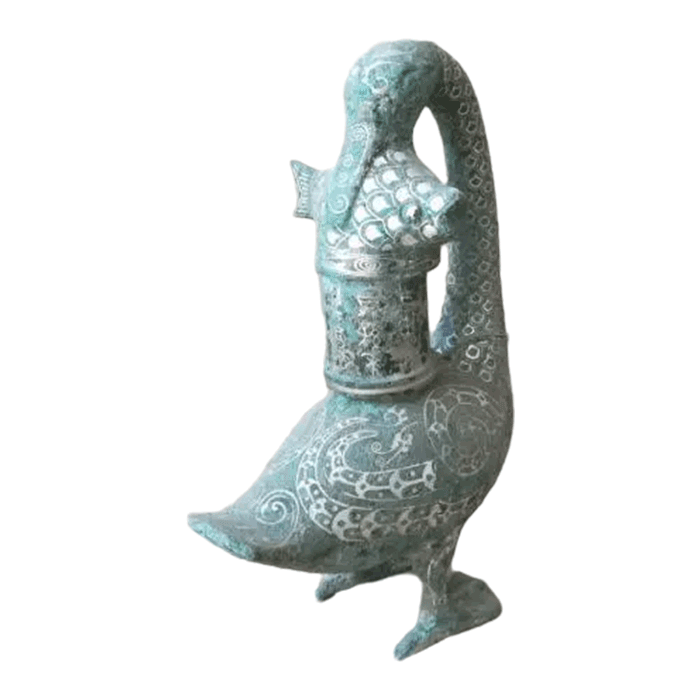
The Bronze Goose-fish Lamp, an archeological treasure from the Western Han Dynasty (206 BCE – 9 CE), represents a pinnacle of ancient Chinese artistry and engineering. More than just an object of illumination, this remarkable artifact is a sophisticated, self-contained air purification system. For product developers, museum curators, and wholesale buyers of historical replicas, understanding the intricate mechanics of this lamp is crucial. It not only reveals the depth of ancient ingenuity but also sets the standard for what constitutes a truly faithful and high-quality reproduction. This article provides a detailed analysis of the lamp's components and traces the precise path of airflow that allowed it to burn cleanly, a feature that was centuries ahead of its time.
Evaluating the accuracy of a replica goes beyond surface aesthetics. It requires an appreciation for the functional design that made the original so revolutionary. In sourcing such intricate pieces, partnering with a manufacturer who understands this complexity is paramount. At Luoyang Yichuan Bronze Craft Co., Ltd., we combine ancient techniques with modern quality control to produce artifacts that honor their historical counterparts in both form and function.
The Historical and Cultural Significance of the Goose-fish Lamp
To fully appreciate the lamp's design, one must understand the context of its creation. During the Han Dynasty, interior spaces were typically lit by open-flame oil lamps fueled by animal fats or vegetable oils. While effective for providing light, this method came with a significant drawback: thick, acrid smoke and soot. This pollution would blacken walls, stain fabrics, and create an unhealthy indoor environment, particularly in the enclosed, often opulent chambers of the aristocracy.
The invention of the Goose-fish Lamp was a direct and brilliant response to this problem. Unearthed from ancient tombs, these lamps were clearly luxury items, reserved for the elite who could afford such advanced craftsmanship. Their existence demonstrates a sophisticated understanding of fluid dynamics and thermodynamics. The design ingeniously traps harmful soot particles before they can escape into the room, making it one of the world's earliest known examples of environmentally conscious technology. The lamp is a testament to how the evolution of bronze culture over 2000 years was not just about ritual vessels but also about practical, life-improving innovations.
The lamp's aesthetic is equally significant. The elegant form of a goose catching a fish is not merely decorative; it's a dynamic and naturalistic composition that was popular in Han art. This fusion of utility and beauty makes the Goose-fish Lamp an iconic piece, representing a period of immense cultural and technological advancement. For this reason, replicas must capture not only its clever function but also its graceful artistic spirit.
Deconstructing the Lamp's Anatomy: An Interlocking System
The genius of the Goose-fish Lamp lies in its modular construction. The original artifacts were designed to be easily disassembled for cleaning and refilling. A faithful reproduction must honor this multi-part structure, as the precise fit of each component is essential for the airflow system to function correctly. This level of precision requires advanced casting and finishing capabilities.
Our mastery of the traditional lost-wax casting method, a technique passed down through generations and perfected by our team of over 30 skilled artisans, allows us to recreate these complex, interlocking structures with historical fidelity. The lamp can be broken down into four primary, functional sections:
1. The Lamp Pan and Sliding Shade
The source of light is a simple, circular pan where the wick and oil are placed. This pan is often attached to a movable plate. The most ingenious feature here is the pair of arched, sliding panels that form the lampshade. These panels can be rotated around the light source. This simple mechanism allowed the user to control both the direction and the intensity of the light, effectively creating an ancient spotlight or dimmer. The panels also serve the critical function of containing the initial cloud of smoke and directing it upwards into the filtration system.
2. The Goose's Head and Neck
The head and long, curving neck of the goose are completely hollow. This section fits snugly over the lamp pan, acting as the primary flue or chimney. When the lamp is lit, the hot smoke naturally rises from the pan and is funneled directly into the opening in the goose's head. The elegant S-curve of the neck is not just for aesthetic grace; it is the conduit that transfers the polluted air from the light source to the filtration chamber within the goose's body.
3. The Goose's Body: The Filtration Chamber
The hollow body of the goose is the heart of the lamp's environmental technology. This section is designed to be filled with a small amount of water, transforming it into a highly effective scrubbing filter. The smoke, having traveled down the neck, is expelled into this chamber. As the hot, soot-filled gas comes into contact with the cool surface of the water, two things happen. First, the smoke cools rapidly, causing the heavy carbon particulates (soot) to lose their buoyancy. Second, the particles fall and are trapped in the water, which readily absorbs them. The result is that the soot is captured within the lamp's body instead of being released into the room.
4. The Fish and Base Structure
The fish, held firmly in the goose's beak, and the goose's webbed feet form a stable and decorative base. While the fish is primarily an artistic element that completes the narrative of the sculpture, the entire base assembly provides the structural integrity needed to support the upper components. In some variations of the lamp, the fish itself is also a part of the interlocking mechanism, ensuring a tight seal for the entire assembly.
Tracing the Path of Smoke and Air: Step-by-Step Analysis
To fully grasp the lamp's functionality, it is helpful to trace the journey of a single particle of soot from combustion to capture. This process illustrates a remarkable understanding of natural physics applied to solve a common household problem.
- Combustion and Updraft: A wick, submerged in oil within the lamp pan, is lit. The flame consumes the fuel, producing light, heat, and smoke laden with soot. The heat from the flame creates a natural updraft, causing the hot smoke to rise.
- Containment and Funneling: The rotatable lampshades contain this initial plume of smoke, preventing it from immediately dispersing. The structure of the shade and the overlying goose head funnels the rising smoke into the opening of the goose's beak and neck.
- Travel Through the Flue: The smoke is drawn down the long, hollow channel of the goose's neck. This enclosed path ensures that none of the polluted air escapes prematurely. The journey through this long tube may also contribute to some initial cooling.
- Introduction to the Filtration Chamber: The smoke exits the neck and enters the larger, hollow cavity of the goose's body. This chamber, partially filled with water, presents a large, cool surface area.
- Soot Deposition and Filtration: As the hot smoke hits the water, the rapid temperature change causes the solid soot particles to precipitate out of the gaseous mixture. They fall into the water and are trapped, effectively scrubbing the air. Over time, the water becomes dark and saturated with carbon.
- Release of Cleaned Air: The now-filtered air, having deposited its pollutants, is free to circulate out of the chamber, possibly through a small, discreet opening or simply by displacing air back up the neck once the pressure equalizes. The result is a significantly cleaner and healthier indoor atmosphere.
This entire process, contained within a beautiful bronze sculpture, is a marvel of multifunctional design. It demonstrates a level of scientific application that challenges common perceptions of ancient technology, rivaling the ingenuity seen in other famous artifacts like the Changxin Palace Lantern and Bronze Galloping Horse.
Replicating an Ancient Marvel: Challenges in Crafting a Bronze Goose-fish Lamp Decor
For B2B clients sourcing historical reproductions, the quality of a Bronze Goose-fish Lamp Decor is defined by its fidelity to the original's complex engineering. Simply mimicking the external shape is insufficient. A high-quality replica must address several key manufacturing challenges.
The first challenge is achieving the correct internal hollow structures. The channels within the goose's neck must be smooth and unobstructed to ensure proper airflow. The body cavity must be spacious enough to hold water and effectively trap soot. This requires precise core work during the lost-wax casting process—a core competency of our facility in Luoyang.
The second challenge is the perfect assembly of its detachable parts. The head must fit securely onto the body, and the lamp pan must align with the opening of the flue. There can be no gaps where smoke might escape. As an ISO 9001 certified manufacturer, we implement rigorous quality inspections before every shipment. For a piece like the Goose-fish lamp, this includes ensuring the hollow channels are clear and the components align perfectly, guaranteeing both aesthetic integrity and functional potential.
Finally, achieving an authentic patina is critical. The finish should evoke the age and artistry of the Han Dynasty. We offer a range of hand-applied patina finishes, from traditional antique greens and browns to more modern looks, allowing clients to specify the exact aesthetic for their market. We solve common sourcing pain points by offering consistent patina color matching across large orders and developing export-compliant protective packaging to ensure these intricate sculptures arrive safely.
Whether you require a single, museum-quality prototype for evaluation or a bulk production run for a catalog, our flexible manufacturing process can meet your needs. With a Minimum Order Quantity (MOQ) starting from just one piece for custom projects, you can customize a bronze sculpture from sculpmart.com to your exact specifications, confident in the knowledge that it is backed by a commitment to historical accuracy and superior craftsmanship.
In conclusion, the Bronze Goose-fish Lamp Decor is far more than a decorative item. It is a sophisticated piece of ancient technology. Its smoke-filtering system showcases a deep, practical understanding of physics that is seamlessly integrated into a work of high art. For businesses looking to source replicas of this iconic artifact, partnering with a manufacturer that respects and can replicate this intricate functionality is the key to acquiring a product of true value and historical integrity.