Ancient Chinese Ritual Wine Vessel Jue: Shang Zhou Clues
An Ancient Chinese Ritual Wine Vessel Jue Can Reveal Shang and Zhou Clues
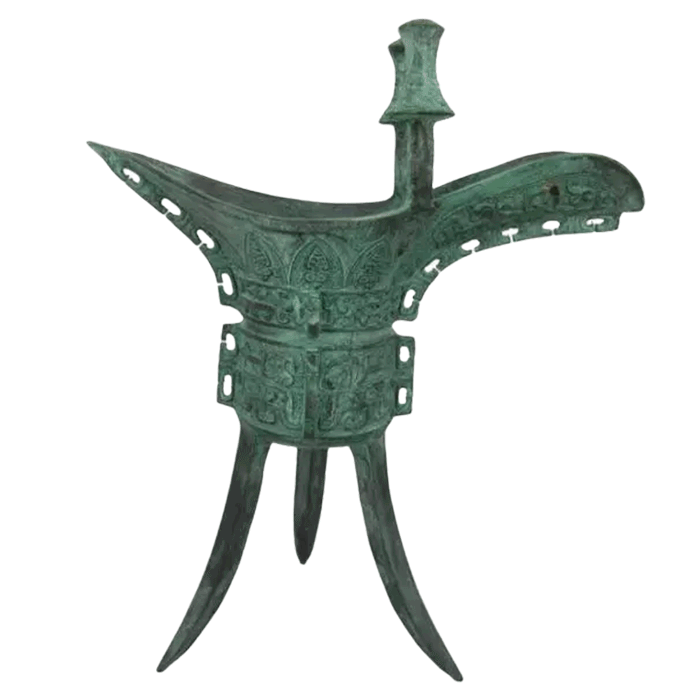
The jue is one of the most recognizable forms in the study of early Chinese ritual bronzes. Its distinctive silhouette—an open cup, a long pouring spout, a rear tail-like projection, three slender legs, and often two capped posts near the rim—makes it immediately useful for identifying the visual language of the Shang and early Zhou periods. Yet its apparent simplicity can be misleading. Small decisions in profile, ornament, casting structure, and surface color may indicate different historical inspirations, workshop traditions, or reproduction priorities.
For collectors, museum teams, architects, hospitality designers, and buyers developing period-inspired bronze collections, a jue should be assessed as more than a decorative cup. It is a reference point for understanding early ritual culture, bronze technology, and formal balance. Studying its details can help buyers compare objects intelligently, prepare accurate reproduction briefs, and select complementary vessel types such as ding, zun, and hu.
Why the Jue Matters in Early Ritual Bronze Studies
A jue is generally understood as a ritual wine vessel associated especially with the Bronze Age cultures of ancient China. The vessel was designed with a practical pouring feature, but its ceremonial significance was expressed through its material, form, ornament, and participation in a larger ritual set. In historical displays and reproduction projects, the jue is often paired with food vessels, warming vessels, storage vessels, musical instruments, and weapons to create a more complete period atmosphere.
Its tripod construction is central to its identity. Three legs elevate the cup above a surface and give the vessel a purposeful, architectural stance. The legs can appear straight, tapered, curved, or integrated with animal-inspired forms. Their proportions strongly influence whether a reproduction feels light and early in character or heavier and more monumental.
The forward spout is another essential visual clue. On some examples, it is long and sharply projected; on others, the transition from cup to spout is more gradual. The rear tail balances the outline and creates a directional composition that is unlike later, more symmetrical vessel types. When evaluating a jue-inspired artwork, the relationship between spout, tail, body, and legs should be considered as a unified profile rather than as separate decorative parts.
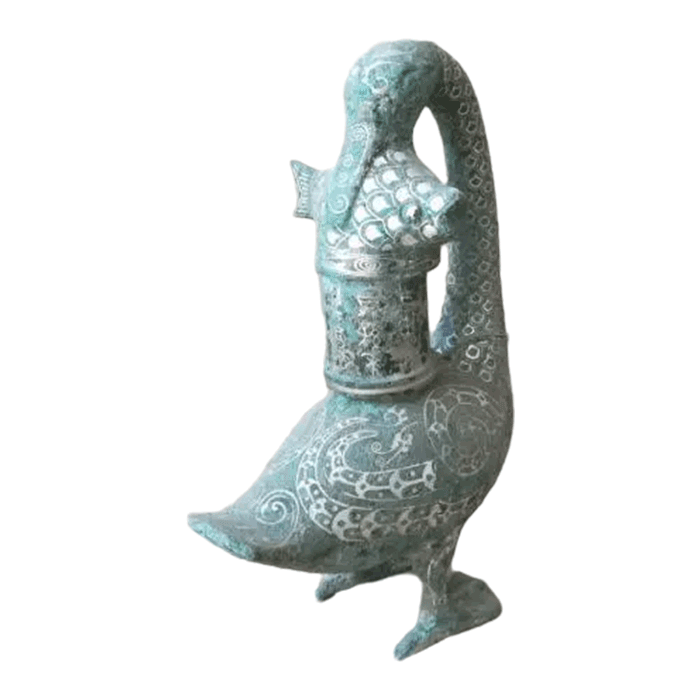
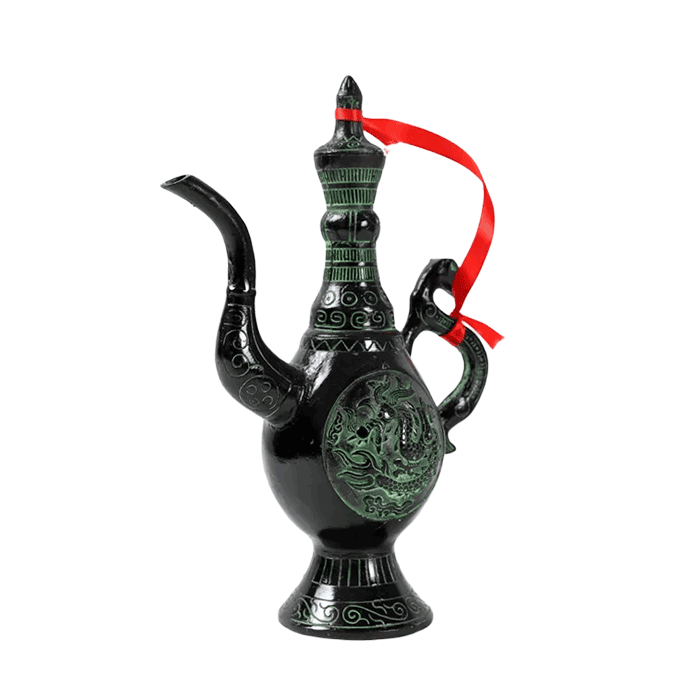
For a broader context on the role of wine-related ritual forms, buyers may consult this overview of an ancient Chinese bronze wine vessel. Comparing several vessel categories helps clarify why the jue should not be selected only for its unusual outline, but also for its relationship to ritual use and early bronze design.
Shang-Style Clues to Examine in a Jue Form
Shang-inspired jue designs are often valued for their strong silhouette, compact visual tension, and powerful ornament. Although no single feature can date an object on its own, a combination of form and decoration can guide a historically informed comparison. Buyers commissioning reproductions should identify which visual features are essential to the intended Shang reference before approving a model.
Strong, purposeful proportions
Many Shang-style interpretations emphasize a relatively compact body set high on three legs. The cup may appear narrow and deep, with a pronounced spout and tail. The result is an object that looks functional but also ceremonially controlled. A reproduction that makes the body too wide, the legs too thick, or the spout too short may lose this early bronze character even if it retains the basic outline.
Leg placement matters. The three supports should create a stable visual rhythm without making the vessel feel squat. In a hand-finished bronze, subtle differences in leg angle can affect the overall balance. This is why a dimensional drawing, reference photographs, or a 3D model is useful during the custom-development stage.
Taotie-inspired mask decoration
Shang bronzes are widely associated with bold animal-mask motifs often described as taotie. On a jue, these motifs may be arranged around the body in bands, panels, or symmetrical compositions. Raised lines, recessed grounds, and spiral elements create contrast that becomes more visible under side lighting.
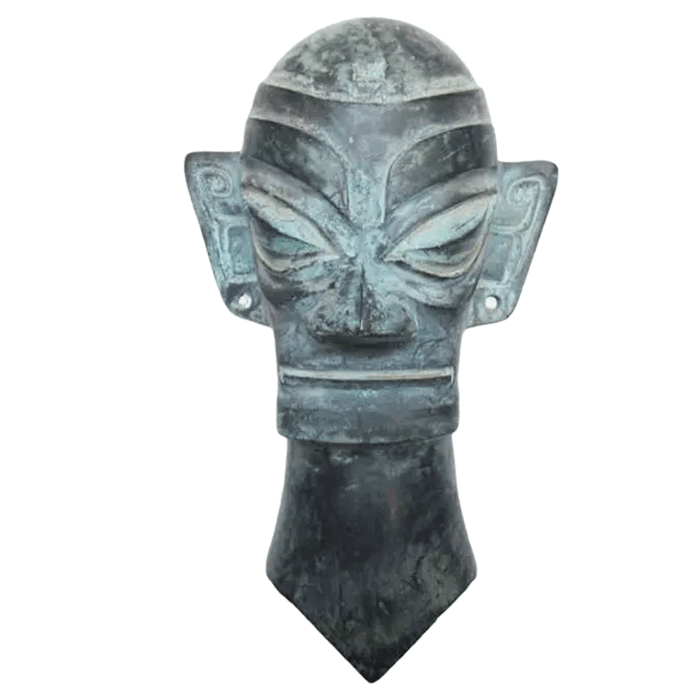
The key issue is not simply adding a mask motif to the surface. The design should follow the vessel’s curvature and preserve the balance between decorated and undecorated areas. Overly dense ornament can obscure the elegant shape of the cup, while shallow or poorly defined relief may not read clearly after patina finishing. For research into broader early bronze imagery, the discussion of Sanxingdui bronze wares offers another perspective on the range of ancient Chinese bronze expression.
Capped posts and rim details
The two posts near the rim are among the most recognizable features of many jue forms. Their exact historical use has been debated, but their visual importance is clear. They may be plain, topped with rounded caps, or shaped with more elaborate terminals. In reproduction work, the height, spacing, and cap design of these posts should match the selected reference style.
Posts that are too tall can make the vessel look exaggerated. Posts that are too low can weaken the silhouette. Likewise, a rim that is too thin may appear fragile, while an overly thick rim can make a refined vessel feel heavy. These are small details, but they affect how convincingly a piece reflects an early bronze vocabulary.
Zhou-Period Shifts in Form and Decorative Language
As bronze traditions developed into the Zhou period, vessel forms and decorative approaches changed in ways that can be useful for comparative research. Early Zhou work may retain much of the strength and ritual gravity associated with Shang precedents, while later Zhou designs can show shifts toward different patterns, more ordered layouts, and evolving proportions. A jue-inspired reproduction should therefore be described as Shang-style, early Zhou-style, or broadly archaic only after its intended visual direction is defined.
More structured decorative organization
One practical comparison point is the organization of ornament. Shang-style decoration can appear forceful and densely integrated with the vessel’s structure. Zhou-inspired decoration may show more clearly separated zones, repeating bands, or an increased sense of order. This does not mean that every Zhou vessel is less complex; rather, the relationship between pattern and form can be approached differently.
Buyers should review whether the selected pattern wraps naturally around the body and whether it remains legible from several viewing angles. A vessel intended for a hotel lobby, cultural center, gallery display, or private study may be viewed from above as well as from the side. Relief depth and pattern placement should account for real installation conditions.
Changing profiles and visual weight
Some Zhou-related interpretations may present a more controlled or regular profile, with adjustments to the body, rim, legs, and appendages. A historical reproduction does not need to imitate corrosion or damage to communicate age. Instead, the form itself should carry the period reference. Correct proportions, carefully modeled transitions, and disciplined ornament are more valuable than artificial distressing.
For a wider comparison of changing styles, this resource on bronze ware characteristics can help readers see how later decorative preferences developed beyond the earlier Shang and Zhou visual framework.
How to Compare a Jue Reference Before Ordering a Reproduction
Period-appropriate sourcing starts with a clear reference package. A single front-view image rarely provides enough information for a reliable custom bronze project. Buyers should identify the exact features that need to be preserved and separate those from features that may be adjusted for size, display environment, budget, or fabrication requirements.
- Overall dimensions: Confirm height, cup width, spout length, tail length, and the footprint created by the three legs.
- Reference period: State whether the object should lean toward Shang, early Zhou, later archaic, or a blended museum-inspired style.
- Ornament placement: Mark mask motifs, geometric bands, inscriptions, animal heads, or other relief details on the relevant surfaces.
- Surface appearance: Specify whether the desired finish is dark brown, warm bronze, green antique patina, blackened bronze, or a more contemporary polished appearance.
- Display conditions: Explain whether the piece will be installed indoors, in a protected exterior location, in a showcase, or as part of a larger cultural display.
- Quantity requirements: Identify whether the project needs one prototype, a limited collection, or a repeatable bulk production run.
Where an original antique is the reference, buyers should distinguish between historical design features and age-related surface conditions. Ancient objects may have uneven corrosion, buried mineral deposits, repairs, or missing sections. A new cast bronze can reproduce the intended form and selected patina character without presenting modern fabrication as an original archaeological object.
Luoyang Yichuan Bronze Craft Co., Ltd. supports custom bronze artworks from a single prototype through negotiable bulk quantities based on design complexity and size. With a production area of 3,000 square meters and more than 30 skilled craftsmen, the company can work from drawings, photographs, dimensions, and design references for bronze vessels and related art pieces. Buyers seeking a project workflow can review how to customize a bronze sculpture for reference preparation and customization options.
Lost-Wax Casting and Patina Considerations for Ritual Vessels
Historical form is only one part of a successful bronze reproduction. Casting quality and finishing determine whether the profile, relief, and surface remain convincing at close range. Premium Cu-Sn bronze alloy and traditional lost-wax casting are well suited to vessels with complex contours, raised decorative bands, small posts, narrow spouts, and detailed animal-mask relief.
In the lost-wax process, the model is developed before the mold and casting stages. This enables fine surface details to be planned early rather than added as an afterthought. Following casting, hand chasing can refine selected edges and motifs, while polishing controls the level of reflectivity. Patina finishing then gives the piece its visual direction.
An antique-style finish may use layered brown, black, green, or mixed tonal effects to suggest depth and age. A modern finish may retain warmer bronze tones and clearer highlights. Neither option is automatically more appropriate. The correct choice depends on whether the project requires a museum-inspired display object, a contemporary interior accent, a cultural landscape feature, or a coordinated group of ritual vessel reproductions.
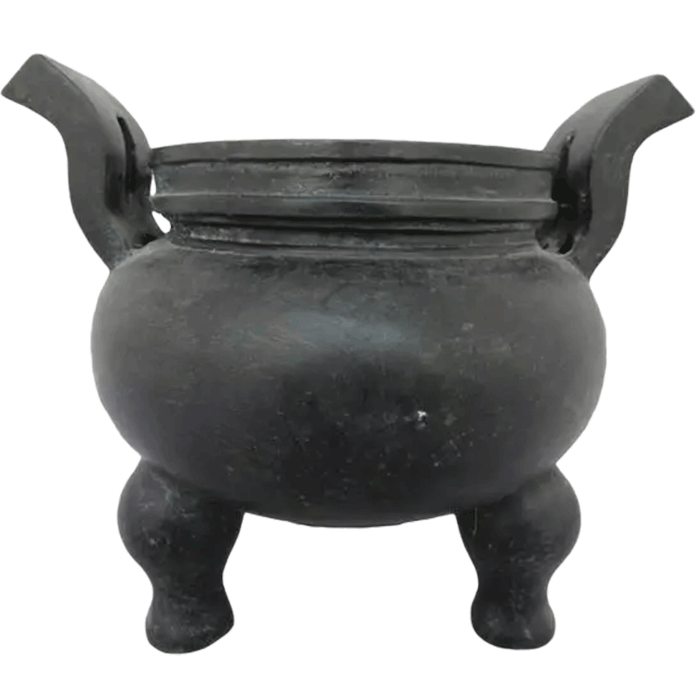
Patina matching is particularly important when multiple pieces must be displayed together. A jue placed beside a ding, zun, mirror, or incense burner should have compatible color temperature and surface texture. Because hand-applied patina can respond differently to relief depth and bronze surface conditions, approval samples or detailed finish references are helpful for projects that require visual consistency.
Building a Coherent Shang and Zhou-Inspired Bronze Display
A jue often has the strongest impact when it is presented as part of a considered group rather than as an isolated object. For example, a small tabletop display may combine a jue-inspired wine vessel with a bronze mirror and incense burner. A larger cultural or commercial installation may use several vessel types at varied heights, supported by explanatory signage, stone bases, wood cabinets, or controlled lighting.
Scale should be planned carefully. A historically proportioned vessel can be reproduced at a larger decorative size, but enlargement must preserve the relationship between its legs, body, posts, and spout. If only the cup is enlarged, the vessel may lose its recognizable balance. If ornament is enlarged without refinement, the relief can become coarse. Skilled modeling and finishing are needed to keep the design coherent.
For collections that also include figures or animals, buyers can explore related Chinese bronze sculpture categories. Combining vessels with human or animal bronzes can support a broader cultural design concept, provided each item has a clearly defined stylistic role.
Before shipment, quality inspection should confirm the casting surface, structural stability, decorative completeness, finish consistency, and protective packaging requirements. Luoyang Yichuan Bronze Craft Co., Ltd. performs quality inspection before every shipment and provides free replacement for casting defects. The company also offers after-sales support for patina touch-ups and restoration guidance, which can be relevant for long-term displays and carefully maintained collections.
Using Historical Clues Without Losing Design Practicality
The most successful jue projects balance historical research with practical design decisions. A buyer may want close adherence to a museum reference, a simplified form for contemporary interiors, or a scaled interpretation for a public cultural venue. Each direction is valid when it is clearly described from the beginning.
Start by selecting the era and visual priorities. Then confirm the silhouette, legs, posts, decorative zones, surface finish, dimensions, and installation requirements. A detailed brief reduces uncertainty during modeling, casting, hand finishing, and final inspection. It also helps ensure that a Shang-inspired object does not accidentally receive later decorative features, or that a Zhou-inspired reproduction does not lose the disciplined proportions that define its reference.
By reading the clues in shape, ornament, structure, and patina, buyers can use the jue as a practical guide to early Chinese bronze culture. It remains a powerful reference for historical comparison and an adaptable starting point for carefully made bronze vessel reproductions.