Ancient Chinese Ritual Wine Vessel Jue Repair Guide
Ancient Chinese Ritual Wine Vessel Jue: Avoid Mistaking Repairs for Age
For collectors, retailers, museum buyers, and sourcing teams, a jue deserves more than a quick visual inspection. Its compact size, distinctive tripod form, and complex surface texture can make it especially difficult to evaluate from photographs or a short sample review. A dark seam may look like an old repair but may actually be a casting line. A patch may suggest long-term use, yet it can also result from recent workshop restoration. Conversely, a carefully finished modern reproduction may be mistaken for an untouched antique if the review focuses only on color and general appearance.
The key is to separate three different questions: what the object was designed to look like, how it was made, and whether it has been altered after casting. This approach is useful whether a buyer is reviewing an antique listing, selecting decorative reproductions for a retail collection, or commissioning a historically inspired vessel for a hospitality, cultural, or interior project.
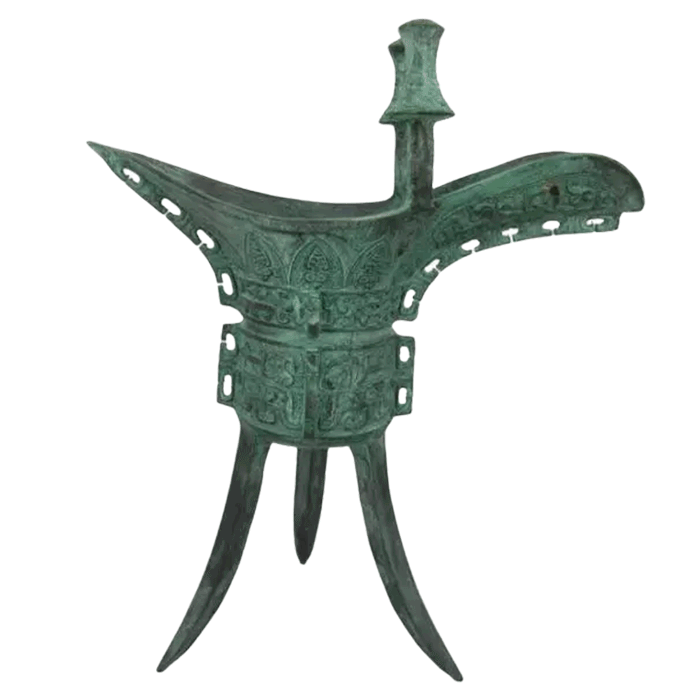
A jue is traditionally recognized by its three legs, a pouring spout, a rear handle, and two upright posts near the rim. The form is associated with early Chinese ritual bronze culture and is often interpreted as a wine-heating or wine-serving vessel. However, identifying the vessel type is only the first step. A correct silhouette does not establish age, originality, or repair history.
Why Repair History Matters When Reviewing a Jue
Repairs can influence value, structural reliability, display suitability, and sourcing decisions. In an antique context, a documented historic repair may be part of the object’s condition record. It should still be disclosed clearly, because repaired areas can have different strength, color stability, and future conservation needs than the original metal. In a decorative-reproduction context, visible repair-like details may be intentional surface styling, but buyers should know whether those details are decorative or structural.
Confusion often occurs because bronze naturally develops irregular color, mineral deposits, scratches, abrasions, and oxidation over time. These features can visually overlap with the signs of repair. A darkened area around a leg joint, for example, may be old corrosion, a casting transition, a later metal addition, or artificial aging. One visual clue alone is rarely enough to reach a reliable conclusion.
For purchasing teams, the practical goal is not to make an unsupported authenticity declaration from one image. The goal is to ask informed questions, compare observations across the vessel, and request appropriate condition documentation. A transparent review process helps prevent an old-looking finish from being treated as proof of age or a normal production feature from being misidentified as damage.
Buyers who are studying broader vessel categories can also review this overview of ancient Chinese bronze wine vessel forms. Comparing different vessel profiles helps reviewers understand why the geometry of a jue’s legs, spout, body, and handle should be assessed as a connected structure rather than as isolated decorative parts.
Common Features That Can Be Mistaken for Repairs
A careful inspection begins with understanding the features that may resemble later intervention. Not every seam, tonal change, or textured area indicates that a vessel has been repaired. The following points are useful for first-stage visual screening.
Casting seams and mold-related lines
Traditional bronze production can leave evidence of the mold system and finishing process. Depending on the manufacturing method, a line may remain where mold sections met, or a chased area may show where a maker refined the casting after it cooled. Such lines often follow a logical route related to the vessel’s form: around a body section, near a handle attachment, or along a location where the mold could reasonably have separated.
A repair seam, by contrast, may appear less consistent with the object’s original construction. It can stop abruptly, cut across decorative motifs, surround a localized crack, or show a different metal texture at its edges. Still, these are observations rather than final proof. Surface corrosion and previous cleaning can obscure the original relationship between a seam and the surrounding bronze.
Patina variation around legs and handles
Color variation is common on bronze, especially near recesses, joints, and areas that collect moisture or handling residue. A darker band around a leg or handle may therefore be natural surface development. It can also be associated with a repair, especially when the color differs sharply from adjacent areas or follows a narrow added-metal boundary.
Reviewers should look for continuity. Does the patina transition gradually across the surface, or does it stop at a distinct line? Does the area have the same texture as nearby bronze? Is the finish similarly worn on raised edges? If the vessel is offered as an antique, close photographs under neutral light can be more useful than heavily edited listing images, because strong contrast and warm lighting may exaggerate color differences.
Decorative texture versus added patches
Early-style bronze surfaces can include masks, bands, geometric motifs, and deliberately textured backgrounds. These details should not be confused with patches. A genuine-looking patch usually has a boundary that appears independent of the vessel’s intended ornament. It may cover part of a motif, interrupt a smooth panel, or create an area with unusual thickness or uneven contour.
At the same time, a patch-like region may be a foundry correction made during original production, a later repair, or a deliberately designed feature on a modern reproduction. When the production history is unknown, it is better to describe the observation precisely than to assign a date without supporting evidence. For example, “localized metal area with an irregular perimeter” is more responsible than immediately calling it an ancient repair.
Tool marks and finishing marks
Chasing, filing, polishing, and patina preparation can leave small marks around edges, spouts, handles, and decorative relief. On a handcrafted reproduction, these marks may be part of the finishing process rather than evidence of damage. On an older object, they may reflect original finishing, historic handling, conservation, or later surface alteration.
The most useful question is whether the marks match the surrounding workmanship. Uniform finishing across an entire vessel may indicate a coordinated modern process. Highly localized marks around a crack, hole, or seam can deserve closer attention. Neither pattern alone is conclusive, but each can guide the next inspection step.
A Practical Inspection Sequence for Antique-Style Jue Pieces
A repeatable process reduces the risk of relying on a single dramatic feature. The inspection can be applied to physical samples, dealer photographs, product listings, and prototype approvals. It is also helpful when comparing several decorative pieces intended for the same collection.
- Review the overall silhouette. Check whether the body, legs, spout, posts, and handle appear balanced. A distorted leg angle, an unusually thick join, or a spout that sits unevenly may point to damage, alteration, or an inconsistent reproduction process.
- Inspect structural junctions. Examine where the three legs meet the body, where the handle connects, and where the spout transitions into the vessel wall. These areas experience stress and are common locations for both original construction features and later repairs.
- Follow all visible lines. Trace seams, cracks, and changes in color from end to end. A line that follows the vessel’s construction may be a casting feature. A line that circles a damaged zone or crosses ornamental details may require further review.
- Compare surface texture. Look at the suspected area beside an undisturbed-looking area. Differences in granularity, polishing, pitting, or edge sharpness can reveal whether surfaces were treated differently.
- Check interior and exterior views. Where available, interior images are valuable. A repair visible outside may have an interior reinforcement, color change, or metal addition. Conversely, an exterior line without an interior counterpart may be a superficial surface feature.
- Request dimensions and weight. These details do not authenticate an object by themselves, but they support comparison between samples and can reveal whether a vessel has unusually heavy added areas or unexpectedly thin sections.
- Record observations before conclusions. Use clear notes and photographs. Separate what is visible from what is inferred, especially when reviewing remote listings.
| Observed Feature | Possible Explanation | Useful Follow-Up |
|---|---|---|
| Dark linear mark | Patina change, casting line, crack, or repair seam | Request close-up images in neutral light and inspect continuity |
| Raised irregular area | Decorative relief, casting correction, added patch, or corrosion | Compare texture, motif alignment, and interior view |
| Different color around a leg | Natural oxidation, cleaning history, patina work, or repair | Check whether color changes follow a joint or damaged zone |
| Uneven spout or handle angle | Original design variation, casting distortion, impact damage, or restoration | Compare symmetry and request multiple-angle photographs |
When an object is represented as an archaeological antique or a valuable historic work, inspection by an appropriately qualified independent specialist may be necessary. Visual review is a useful screening tool, but it cannot replace professional examination, provenance research, or technical testing when those services are required for a high-value acquisition.
How to Distinguish Decorative Reproductions from Antique Claims
Retailers and project buyers often need antique-inspired pieces without the uncertainty associated with sourcing original antiquities. In that setting, transparency is more valuable than simulated rarity. Product descriptions should identify a piece as a reproduction, replica, interpretation, or custom-made bronze vessel when that is what it is. A decorative finish may reference an aged bronze appearance, but it should not be presented as evidence of historical origin.
For custom projects, buyers can specify the intended visual direction: restrained dark brown, green-toned patina, antique-style surface variation, or a cleaner modern bronze finish. The finish sample should be reviewed alongside the intended display environment, because lighting, nearby materials, and handling expectations affect how the surface will appear after installation.
Luoyang Yichuan Bronze Craft Co., Ltd. produces bronze vessels and custom bronze artworks using premium Cu-Sn bronze alloy and traditional lost-wax casting. Hand chasing, polishing, and patina finishing are available for antique or modern visual requirements. This makes it possible to discuss intentional casting character and finish appearance during the production stage, rather than asking buyers to interpret decorative aging as unknown repair history.
For broader examples of traditional-inspired metalwork, explore Chinese bronze sculpture collections. Buyers seeking coordinated interior display options can also consider bronze home decor alongside vessel-based focal pieces.
Questions Sourcing Teams Should Ask Before Ordering
Whether the requirement is one presentation sample or a larger decorative program, a structured inquiry helps align expectations. A sourcing team should provide reference images, target dimensions, preferred finish direction, installation setting, and any packaging requirements. If the buyer wants a close visual interpretation of an existing jue, images should show front, rear, sides, top, interior, base, handle junctions, leg junctions, and all notable markings.
- Is the requested vessel an original antique, a decorative reproduction, or a custom interpretation?
- Which visual features are essential: silhouette, taotie-style ornament, rim posts, handle profile, or patina color?
- Should surface variation look restrained and uniform, or intentionally aged and more irregular?
- Will the piece be used for display only, retail presentation, or an interior design installation?
- Are there fragile projections, such as rim posts or a narrow spout, that require export-compliant protective packaging?
- What approval materials are needed before production, such as drawings, reference photographs, or a prototype?
The company supports orders from a single custom prototype to bulk production runs, with custom sculpture MOQ starting from one piece and bulk quantities negotiated according to size and design complexity. Its Yichuan County, Luoyang production facility covers 3,000 square meters and includes more than 30 skilled craftsmen, including bronze-casting masters and finishing artisans. Each shipment receives quality inspection, and free replacement is available for casting defects. After-sales support also includes patina touch-up and restoration guidance.
For a project requiring a custom vessel or an antique-inspired display work, buyers may customize a bronze sculpture with reference-based requirements. Clear communication about intended age appearance, finish boundaries, and acceptable handmade variation is the best way to avoid confusion later.
Make Condition Language Clear and Evidence-Based
The most reliable way to avoid mistaking repairs for age is to use precise language. Rather than describing a jue as “ancient-looking” or “fully original” based on appearance alone, identify what can actually be observed: a visible seam near the handle, irregular patina at one leg, a possible patch beneath a decorative band, or a polished area around the spout.
For antique listings, condition reports should distinguish known repairs, suspected repairs, cleaning, patina changes, and areas that could not be examined. For decorative reproductions, descriptions should distinguish structural construction from surface styling. This protects buyers, supports responsible sourcing, and helps retailers communicate accurately with their own customers.
A jue carries visual associations with ritual culture, bronze craftsmanship, and historic collecting. Those associations are strongest when the piece is evaluated honestly. Careful observation, good documentation, and transparent production information allow buyers to appreciate the form without confusing repair traces, handcrafted finishing, and genuine age.