Ancient Chinese Bianzhong: Shape and Suspension Guide
Ancient Chinese Bianzhong Bells Can Be Identified by Shape and Suspension Details
For collectors, replica researchers, museum display planners, and cultural buyers, identifying an Ancient Chinese Bianzhong begins with more than recognizing a bronze bell. Bianzhong are organized bell instruments, and each bell was designed to occupy a particular visual and acoustic position within a suspended set. Their body profile, mouth shape, top fitting, hanging angle, and relationship to a frame can provide useful evidence when evaluating a reference image, an antique-style reproduction, or a proposed custom display.
A single bronze bell may resemble other early Chinese percussion objects at first glance. However, an object should not be classified as a bianzhong only because it has a decorative surface, a green patina, or a historical appearance. Careful identification requires an examination of structural features. In particular, buyers should study whether the bell was intended to hang, how it was attached to a rack, whether its mouth is circular or elongated, and whether its shape supports the characteristic two-tone striking arrangement associated with many historical chime bells.
This guide focuses on visual identification rather than musical performance testing. It is intended to help buyers form clearer requirements before requesting a bronze reproduction, commissioning a display installation, or comparing reference materials from collections and publications.
Start with the Overall Bell Body Shape
The most useful first step is to look at the bell from the front, side, and bottom. A bianzhong bell often has a vertically elongated body rather than the evenly rounded profile commonly associated with a modern handbell. The upper section is narrower, the body broadens through the middle, and the mouth is usually wider than the neck. The exact proportions vary by period, bell size, and decorative tradition, but the silhouette commonly appears deliberate and architectural rather than simply bowl-shaped.
The mouth opening is especially important. Many historical Chinese chime bells have an elongated, oval, or almond-like mouth profile instead of a perfect circle. This profile is not merely decorative. It relates to the bell’s structural behavior when struck at different points. When examining a photograph, look for the lower rim from a slightly angled viewpoint. A circular-looking opening may indicate a different type of bell, although perspective can make an elongated mouth appear round in a frontal image.
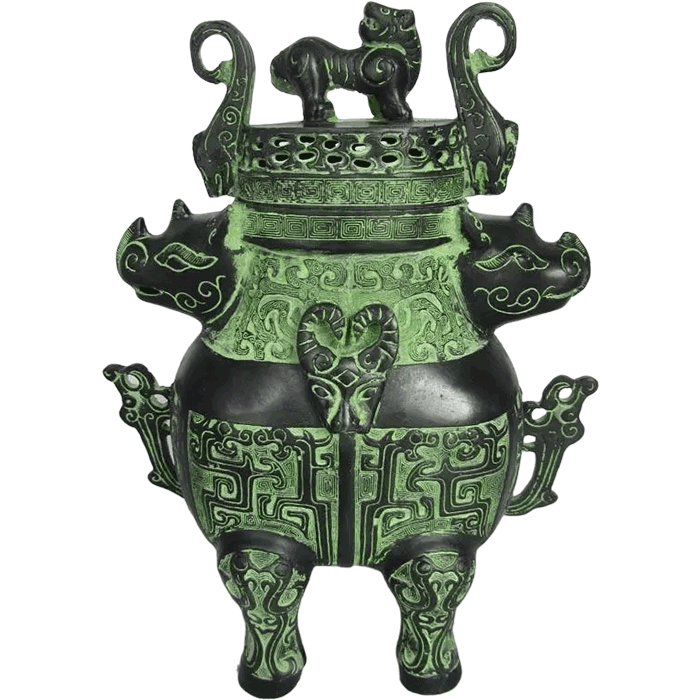
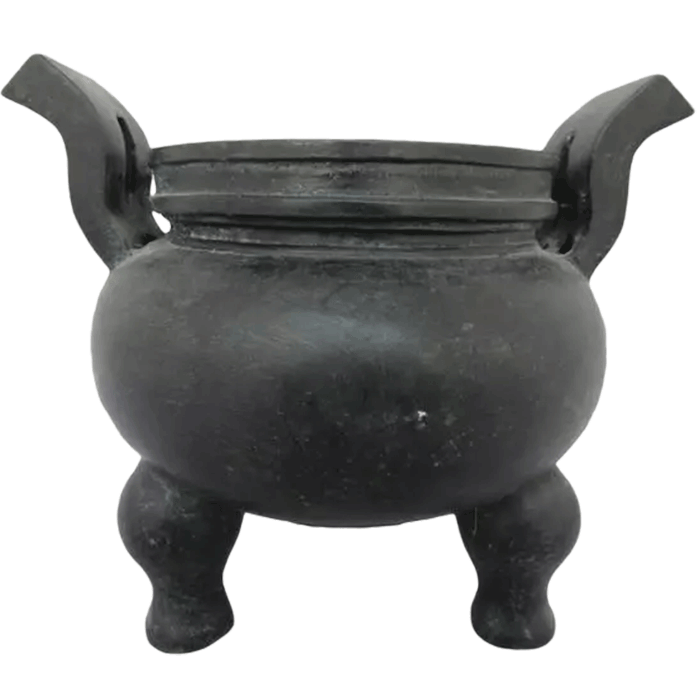
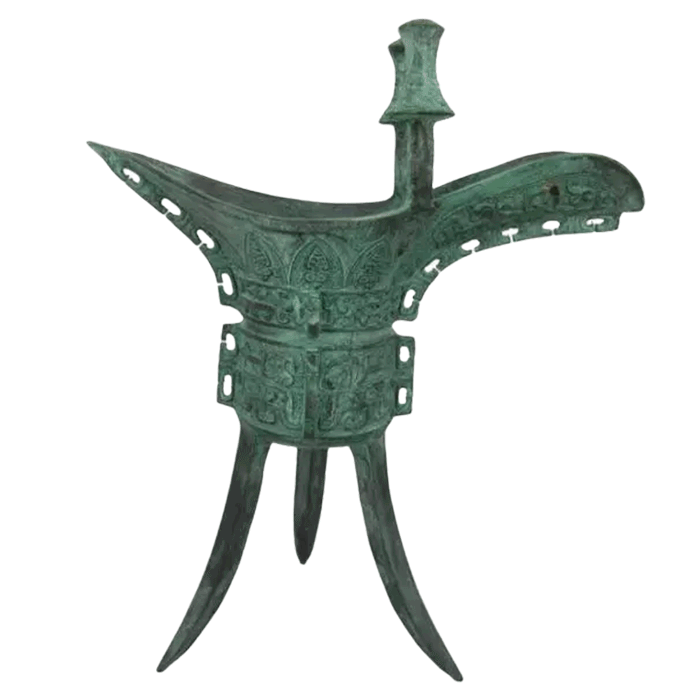
Researchers should also distinguish between a bell body and a vessel-shaped object. Bronze ritual vessels, such as ding, zun, and hu forms, may have feet, lids, handles, or broad openings that can create visual confusion in incomplete photographs. A bell should show a clear sound-producing body with an identifiable striking area and a suspension-related upper structure. A vessel, by contrast, is normally designed to stand upright or contain an object.
Look for a Lenticular or Oval Cross-Section
In many chime bell designs, the body cross-section is better described as lenticular, compressed oval, or leaf-like rather than round. The front and back surfaces can appear broader, while the side dimension is relatively narrower. This gives the bell a recognizable flattened volume when viewed from above or below.
The distinction matters because the cross-section can help explain why some bells are associated with two distinct strike zones. Historical examples are frequently discussed in relation to tones produced by striking different areas of the bell. For object identification, the practical point is simpler: a body that visibly has differentiated front, side, and mouth geometry deserves closer consideration as a chime-bell form.
- Front view: Check for a tall, balanced body with a flared lower section.
- Side view: Look for a compressed depth rather than a fully circular bowl form.
- Bottom view: Examine whether the mouth appears oval, elongated, or pointed at two opposing ends.
- Top view: Identify whether the suspension fitting is centered, angled, looped, or formed as a projecting shank.
Surface decoration should be considered after structural shape. Raised bosses, geometric bands, animal-mask motifs, and patterned borders can be valuable stylistic evidence, but decoration may be copied across many categories of bronze crafts. The underlying body profile and suspension design are generally more reliable starting points.
Examine the Mouth, Rim, and Strike Areas
The mouth and lower rim help separate a chime bell from a general decorative bell. In reference images, the rim may be partly hidden by a display rack or shadow, so it is useful to request multiple views when possible. A direct bottom image, a side image, and a scale reference can substantially improve early-stage identification.
Many bianzhong bells have a mouth that is not uniformly round. Its rim can show two broader sides and two narrower ends, producing an elongated perimeter. The body may also carry visible zones where a beater would contact the surface. These zones are not always obvious on aged surfaces, replicas with dark patina, or photographs with strong reflections, but they can often be inferred from the layout of raised ornament.
Do not assume that every visible mark is a strike point. Corrosion, casting seams, handling wear, restoration work, and patina variation may create irregular areas on bronze. Identification should rely on the complete relationship between shape, fitting, rim, and intended display orientation rather than one isolated visual feature.
| Feature to Inspect | What It May Suggest | Questions for Evaluation |
|---|---|---|
| Mouth profile | An elongated or oval mouth can support chime-bell identification. | Is the opening truly oval, or is perspective distorting the image? |
| Body depth | A flattened or lenticular volume differs from a round bell body. | Does the side view show a compressed profile? |
| Rim condition | The rim may show manufacturing, age, or use-related evidence. | Are irregularities part of the casting, later damage, or an intentional finish? |
| Decorative zones | Pattern arrangement may indicate front, side, and striking orientation. | Do the decorative bands align consistently with the hanging position? |
| Scale within a set | Different sizes can indicate a ranked bell arrangement. | Is the object shown alone, or with bells of graduated dimensions? |
Collectors evaluating replicas should request agreed reference dimensions. Height alone is not enough. The width at the mouth, front-to-side depth, rim thickness, top fitting dimensions, and expected hanging angle should be listed separately. A visually convincing bell can still look incorrect in a display if the mouth width or upper suspension portion is out of proportion.
For broader historical context on bell sets and related archaeological subjects, the resource on zenghouyi chime bell and qinshihuang mausoleum bronze chariots and horses can help buyers compare their reference materials with well-known bronze culture themes.
Use Suspension Type to Identify Ancient Chinese Bianzhong
Suspension is one of the strongest visual clues because a chime bell was designed to be mounted within a larger arrangement. The upper fitting is not a minor detail. It affects the bell’s orientation, its distance from neighboring bells, the direction of the mouth, and the visual rhythm of the entire rack.
One common arrangement uses a projecting shank or stem at the top of the bell. This fitting is often described as a yong, and bells of this structural type may be called yongzhong. The shank can extend upward or at an angle, allowing the bell to be mounted on a frame. In photographs, this feature may resemble a handle, but it should be evaluated as a functional suspension component rather than a carrying handle.
Another type uses a loop-like or knob-like top attachment, commonly described in relation to a niu. Such bells may be suspended from a cord, hook, or frame element. The loop can be damaged, restored, or simplified in modern reproductions, so buyers should verify whether the fitting is integral to the casting, separately attached, or purely decorative.
Why the Hanging Angle Matters
A bianzhong was not necessarily displayed in the same upright orientation as a table bell or a freestanding ritual vessel. The top fitting may position the bell at a particular angle. This can be especially visible when the bell is shown as part of a rack: the mouth may face downward or outward, while the body is aligned for access by a striker.
A hanging angle should be judged together with the bell’s body shape. If a reproduction uses an accurate bell body but attaches it with a generic straight loop, it may lose the intended historical character. Conversely, an elaborate rack cannot correct a bell that has the wrong top fitting or an unsuitable center of balance.
- Identify whether the object has a shank, loop, knob, hole, or another top attachment.
- Check whether the fitting is centered or offset from the bell body.
- Observe the likely direction of the mouth when hung.
- Determine whether the fitting can support a rack-mounted arrangement.
- Compare the suspension method with other bells in the same reference set.
Some early Chinese bells were intended to be placed or struck in orientations different from suspended chime bells. Therefore, an upward-facing mouth, a lack of a clear hanging fitting, or a base designed for standing may point toward another bell category. This is why suspension evidence should not be overlooked when cataloging a bronze object from a single image.
Differentiate Chime Bells from Similar Bronze Objects
Correct identification requires comparison. Several types of bronze objects can be mistaken for one another when only a partial view is available. A buyer should avoid making a final classification based only on terms used in an auction caption, online listing, or decorative product description.
A decorative hanging bell may have a round body, a simple loop, and a clapper inside. This differs from the typical external striking method associated with historical chime bells. A ritual vessel may have a broad opening and ornamental handles but will generally lack the hanging geometry and strike-oriented body structure of a bell. A freestanding percussion object may have a different mouth orientation and should not automatically be grouped with rack-mounted instruments.
Similarly, not every group of bells is a bianzhong. The word refers to an organized arrangement of bells rather than simply a bronze bell in isolation. A single bell can be discussed as part of such a system when its shape and mounting evidence support that interpretation, but a complete set normally requires graduated sizes, ordered placement, and a rack or other coherent display structure.
When reviewing period references, buyers can also compare bell forms with other categories of ritual bronze. The article on introduction to several bronze wares provides useful terminology for distinguishing musical objects from vessels and related bronze forms.
Assess Condition, Patina, and Replica Evidence Carefully
Patina can add visual depth to a bell, but it should not be treated as proof of age or authenticity. Bronze surfaces can develop natural changes over time, while reproduction pieces can receive controlled patina finishing to achieve antique or modern visual effects. For a display commission, the relevant question is often whether the finish matches the approved reference and remains consistent across all bells, fittings, and rack components.
Collectors and cultural buyers should separate three issues: historical classification, physical condition, and reproduction requirements. A bell can be accurately shaped but newly cast. An antique-style finish can be visually appropriate for a museum-inspired interior while remaining clearly identified as a reproduction. Conversely, a heavily aged-looking surface does not resolve uncertainty about the form or suspension type.
For custom projects, a good reference package should include high-resolution photographs, measured drawings where available, desired bell quantity, rack dimensions, target finish, installation location, and expected viewing distance. These details allow a manufacturer to assess whether the project is a single interpretive display bell, a partial group, or a complete staged bell arrangement.
Luoyang Yichuan Bronze Craft Co., Ltd. produces custom bronze artworks using premium Cu-Sn bronze alloy and the traditional lost-wax casting method. With hand chasing, polishing, and patina finishing available, the company can support projects ranging from a single custom prototype to negotiated bulk production runs. Buyers seeking a historically informed display can use customize a bronze sculpture resources to prepare a clear commissioning brief.
For projects that combine bells with figures, architectural elements, or educational exhibition components, related chinese bronze sculpture references may also help define a consistent bronze finish and visual language across the installation.
Prepare a Clear Identification Checklist Before Commissioning
Before acquiring or commissioning an Ancient Chinese Bianzhong-inspired display piece, organize the evidence in a practical checklist. This reduces avoidable revisions and helps ensure that the final object reflects the intended historical form rather than a generic decorative bell.
- Object category: Is the reference a single bell, a partial bell group, or a full chime-bell arrangement?
- Body shape: Does the bell have an elongated profile and a compressed oval cross-section?
- Mouth form: Is the rim circular, oval, almond-like, or otherwise clearly shaped?
- Suspension fitting: Does it use a projecting shank, a loop, a knob, or another mounting detail?
- Hanging orientation: What angle should the bell take when displayed on a rack?
- Surface design: Which decorative bands, raised elements, inscriptions, or texture details must be retained?
- Patina direction: Is the desired finish dark brown, warm bronze, green-toned, antiqued, or modern polished bronze?
- Display requirements: Will the object hang indoors, form part of an exhibition, or be installed in a protected outdoor setting?
- Packaging needs: Does the project require export-compliant protective packaging for fragile cast components?
For large or delicate bell arrangements, the rack should be planned at the same time as the bells. The weight distribution, hanging points, spacing, installation sequence, and protective packaging requirements should be reviewed before production. A bell set can contain many separate cast pieces, and consistent measurements are essential for a balanced final presentation.
Luoyang Yichuan Bronze Craft Co., Ltd. operates under an ISO 9001 quality management system and performs quality inspection before shipment. The company also provides free replacement for casting defects and after-sales support for patina touch-ups and restoration guidance. These production controls are relevant when a cultural display requires consistent finish matching across multiple bronze elements.
Make Identification Decisions from Structure, Not Decoration Alone
The most reliable way to identify a historical Chinese chime bell is to begin with its physical logic. Study the profile, mouth, cross-section, upper fitting, and intended hanging position before focusing on color or ornament. Shape reveals how the bell was formed; suspension reveals how it was meant to function within an organized display or musical arrangement.
For early-stage research, a careful visual assessment can help distinguish a plausible bianzhong reference from a generic bronze bell, a ritual vessel, or another percussion form. For custom reproduction work, the same assessment gives designers, researchers, and bronze craftsmen a clearer basis for discussing proportions, rack mounting, decorative details, and patina expectations.
By documenting both the body shape and the suspension method, buyers can move from a broad historical impression toward a more precise project specification. That clarity is valuable whether the final goal is a single study replica, a collector-focused display, an educational exhibit, or a larger custom bronze installation.