A Guide to the Ancient Chinese Ritual Wine Vessel Jue
The Jue: A Guide to the Ancient Chinese Ritual Wine Vessel Jue
Among the vast and impressive array of Chinese bronzes, few objects are as iconic or as evocative of the ancient world as the Jue vessel. With its distinctive tripod legs, elegant spout, and enigmatic posts, the Jue is a quintessential symbol of the Shang (c. 1600–1046 BCE) and Zhou (c. 1046–256 BCE) dynasties. More than just a container, it was a vital instrument in the elaborate rituals that connected the living with their ancestors and the spirit world. For students, collectors, and procurers of historical art, understanding the Jue is the first step toward appreciating the profound technological and cultural achievements of China's Bronze Age. This guide addresses the most frequently asked questions about this remarkable artifact, exploring its function, evolution, and the intricate craftsmanship behind its creation.
What is a Jue Vessel and What Was Its Primary Function?
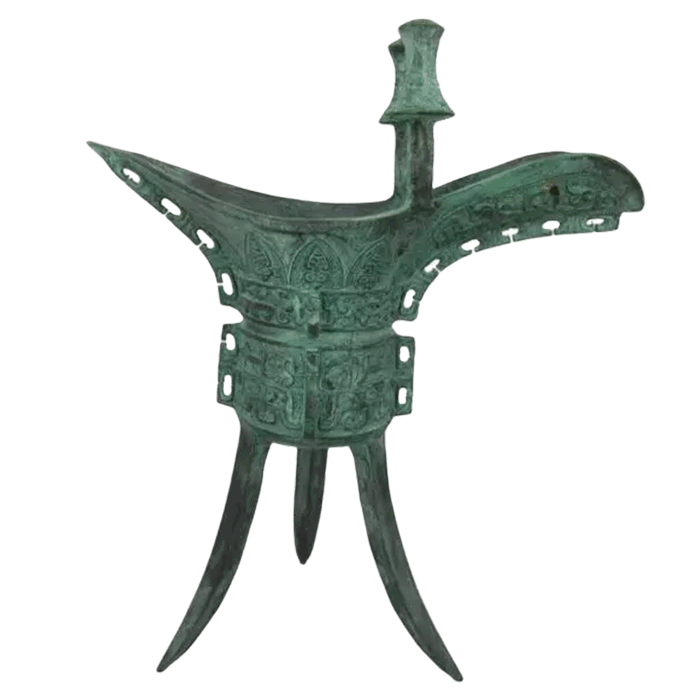
A Jue is a specific type of tripod vessel used for serving and warming wine, typically made from cast bronze. Its unique form is instantly recognizable and was meticulously designed for its ritual purpose. The key anatomical features of a Jue include:
- Three Legs (Zú): The vessel stands on three splayed, blade-like or conical legs. This tripod design provided excellent stability, a crucial feature when placed on uneven earthen floors in ancient temples or over a heat source.
- A Spout (Liú): A long, trough-like spout was used for pouring liquid offerings, or libations, during ceremonies. Its shape allowed for a controlled, graceful stream of wine.
- A Flared Tail (Wěi): Opposite the spout is a pointed or flared tail, which served as a counterbalance to the long spout, making the vessel easier to handle.
- A Handle (Pàn): A loop-shaped handle is typically located on the side, often decorated with an animal head, allowing the vessel to be lifted safely when hot.
- Two Posts (Zhù): Perhaps the most mysterious feature, two posts, often capped with whorl or mushroom-like tops, rise from the rim. Their exact function is debated among scholars. Theories suggest they were used to help lift the vessel with tongs, to hold strainers or herbs, or perhaps for hanging the Jue. Some also speculate they had a symbolic or ritualistic purpose related to drinking etiquette.
The primary function of the Jue was for warming and pouring millet wine in solemn ancestral worship ceremonies. These rituals were the cornerstone of Shang and Zhou dynasty state religion. The ruling elite believed that the spirits of their ancestors held power over the mortal world, influencing harvests, military campaigns, and personal fortunes. By making offerings of food and wine in elaborate bronze vessels like the Jue, they sought to appease and nourish these spirits, ensuring their favor and maintaining cosmic harmony. The act of pouring the warmed wine as a libation was a sacred gesture of communication between the earthly and spiritual realms.
The Evolution of the Jue Through the Shang and Zhou Dynasties
The Jue was not a static design; it evolved significantly over more than a thousand years, reflecting changes in technology, aesthetics, and ritual practices. Its stylistic journey provides a clear timeline of the development of Chinese bronze art.
Early Shang Period (Erlitou and Erligang Phases)
The earliest known bronze Jue vessels date back to the Erlitou culture (c. 1900–1500 BCE), a precursor to the Shang dynasty. These early examples are characterized by their thin walls, delicate construction, and relatively simple decoration, often consisting of thin raised lines or bands of abstract patterns. The overall form is often flatter and wider, with less pronounced spouts and tails. The craftsmanship, while impressive for its time, was still developing, and the focus was primarily on the vessel's fundamental function.
Late Shang Period (Anyang Phase)
This period represents the apex of Chinese bronze casting. Jue vessels from the Late Shang dynasty became heavier, more robust, and far more ornate. The walls are thicker, the legs are more substantial, and the overall profile is more dramatic and powerful. This era saw the full development of the iconic taotie (zoomorphic mask) motif, which often formed the main decorative band around the vessel's body. The surface of the Jue would be covered in intricate background patterns like the leiwen (thunder pattern). The craftsmanship reached a level of extraordinary precision and artistic expression, turning these ritual tools into magnificent works of art that projected the power and wealth of the Shang elite.
Western Zhou Dynasty
After the Zhou conquered the Shang, they inherited and continued many Shang ritual traditions and vessel forms, including the Jue. However, Western Zhou Jue vessels began to exhibit stylistic changes. While the overall form remained, the dramatic, almost ferocious energy of Shang decoration was gradually replaced by a more restrained and orderly aesthetic. Bird motifs, particularly long-tailed phoenixes, became more popular. Most significantly, this period saw the rise of long bronze inscriptions (jīnwén). These cast-in texts documented important events, royal decrees, land grants, and military honors, transforming the vessels from purely ritual objects into invaluable historical documents. You can learn more about the characteristics of the bronze wares of the Spring and Autumn and Warring States periods that followed.
Eastern Zhou Dynasty and Decline
By the Eastern Zhou period, which includes the Spring and Autumn and Warring States periods, the ritual system underwent significant changes. The Jue's central role in ceremonies diminished, and it was gradually superseded by other vessel types. While still produced, they became far less common in tomb assemblages. The focus of bronze production shifted towards other forms like the ding (cauldron), hu (vase), and musical instruments like bells. The decline of the Jue marks a major transition in ancient Chinese ritual and social structure.
Decoding the Symbolism: What Do the Decorations on a Jue Mean?
The surfaces of Shang and Zhou bronzes are rarely plain. They are covered in a complex vocabulary of motifs that were deeply meaningful to their creators, though their exact interpretations are still a subject of scholarly research. The most prominent decorations found on a Jue include:
- The Taotie Mask: This is the most dominant and mysterious motif in Shang art. The taotie is a symmetrical, zoomorphic mask characterized by large, staring eyes, and often featuring horns, fangs, and a split body that extends to either side. It has no lower jaw. Its identity is unknown; it may represent a mythical beast, a fearsome guardian spirit, a totemic ancestor, or a warning against gluttony. Whatever its precise meaning, its powerful presence was clearly intended to inspire awe and reverence during rituals.
- The Leiwen (Thunder Pattern): This pattern, composed of fine, squared spirals, often serves as an intricate background filler for the main motifs. It is believed to represent clouds and thunder, elements associated with rain and, by extension, agricultural abundance. Its presence reinforced the vessel's role in rituals aimed at securing nature's blessings.
- Kui Dragons and Birds: Other common motifs include the kui, a type of one-legged dragon shown in profile, and various birds, which may represent phoenixes or other mythical fowl. These creatures were potent symbols of power and acted as intermediaries between the human and spirit worlds.
The Art of Creation: How Were Ancient Jue Vessels Made?
The creation of a bronze Jue was a complex and labor-intensive process that showcased the advanced metallurgical skills of ancient Chinese artisans. The primary technique used was the piece-mold casting method, a sophisticated variant of which is the lost-wax method, which allowed for incredible detail and precision.
This traditional lost-wax method, a testament to the evolution of bronze culture over 2000 years, is the same process employed today by the master artisans at Luoyang Yichuan Bronze Craft Co., Ltd. Our facility, staffed by over 30 skilled craftsmen, continues this ancient tradition to produce historically faithful bronze reproductions. The process involves several key stages:
- Model and Mold Making: First, a precise model of the Jue is made from a material like clay. A negative impression of this model is then taken using clay, which is fired to create a durable outer mold, often made in several pieces.
- Creating the Cavity: A wax layer is applied to the inside of the outer mold, with its thickness determining the thickness of the final bronze vessel. The intricate decorations are carved directly into this wax layer.
- The Core: A clay core is then placed inside the wax-lined mold, creating a void between the core and the outer mold. Bronze pins or chaplets are used to hold the core in place.
- Casting: The entire assembly is heated, causing the wax to melt and run out through channels (the "lost wax"). Molten bronze, a premium alloy of copper and tin, is then poured into the cavity left by the wax.
- Finishing: Once the bronze has cooled and solidified, the outer mold and inner core are broken away. The vessel is then meticulously hand-finished through processes like chasing (sharpening details), grinding, and polishing to remove imperfections and reveal the intricate designs.
This commitment to historical techniques, governed by our ISO 9001 certified quality management system, ensures that every piece we create is not just a product, but a faithful continuation of an ancient artistic legacy.
Sourcing and Collecting Jue Replicas Today
For businesses, museums, educational institutions, or private collectors looking to acquire a replica of an ancient Chinese ritual wine vessel Jue, understanding the markers of quality is essential. A superior reproduction goes beyond simple resemblance; it captures the spirit and technical fidelity of the original artifact.
Key considerations include material authenticity, sharpness of detail, and the quality of the patina. An authentic replica should be cast from a true bronze alloy, not brass or other substitutes. The decorative elements, whether a complex taotie mask or a delicate leiwen pattern, should be crisp and well-defined. One of the most significant challenges in sourcing high-quality reproductions is ensuring consistency, particularly in patina color matching across multiple pieces and achieving exact replication of museum-grade artifacts. These are common pain points that can compromise the integrity of a collection or project.
At Luoyang Yichuan Bronze Craft Co., Ltd., we specialize in solving these exact issues. Our expertise in the lost-wax method and hand-finishing techniques allows us to control the final look with precision, ensuring that every piece meets stringent export quality inspection standards. We offer the flexibility to support projects of any scale, from a single prototype with a minimum order quantity (MOQ) of just one piece to large production runs. Whether you wish to procure a replica of a known historical Jue or customize a bronze sculpture from sculpmart.com based on historical motifs, our team provides a seamless and reliable sourcing solution, complete with protective, export-compliant packaging for safe global shipping.